 News Desk
On a crisp May morning, Megha Vemuri, a 22-year-old Indian-American senior at the Massachusetts Institute of Technology, stepped onto the stage at the OneMIT Commencement Ceremony, her graduation robe adorned with a red keffiyeh, a scarf symbolizing Palestinian solidarity. As the elected president of the Class of 2025, she was expected to deliver a speech celebrating academic triumphs and future aspirations. Instead, she chose to confront a moral crisis, condemning MIT’s research ties with the Israeli military and the devastation of Gaza’s academic infrastructure. “Right now, while we prepare to graduate and move forward with our lives, there are no universities left in Gaza,” she told a crowd of graduates, families, and faculty. “We are watching Israel try to wipe Palestine off the face of the earth, and it is a shame that MIT is a part of it.”
Vemuri’s words, delivered with unflinching clarity, sparked cheers from some and unease from others. They also cost her the chance to walk across the stage at MIT’s undergraduate ceremony the following day. Barred from the event and banned from campus until it concluded, she was informed by Chancellor Melissa Nobles that her speech violated MIT’s rules by “misleading Commencement organizers” and staging a protest. Vemuri, undeterred, called the decision an “overreach” and stood by her message, telling CNN, “I see no need to walk across the stage of an institution that is complicit in this genocide.”
Born and raised in Alpharetta, Georgia, to parents who immigrated from India, Vemuri embodies the drive and ambition often associated with the Indian-American diaspora. A double major in computation and cognition and linguistics, she graduated from Alpharetta High School in 2021 and brought her intellectual curiosity to MIT, where she led the Written Revolution, a student initiative advocating for global justice, and interned at the University of Cape Town’s Neuroscience Institute. Her Indian heritage, rooted in a culture of resilience and community, shaped her commitment to speak out, even at personal cost. “My parents taught me to stand for what’s right, no matter how hard it is,” she said in a recent interview. “That’s what drove me to use this moment.”
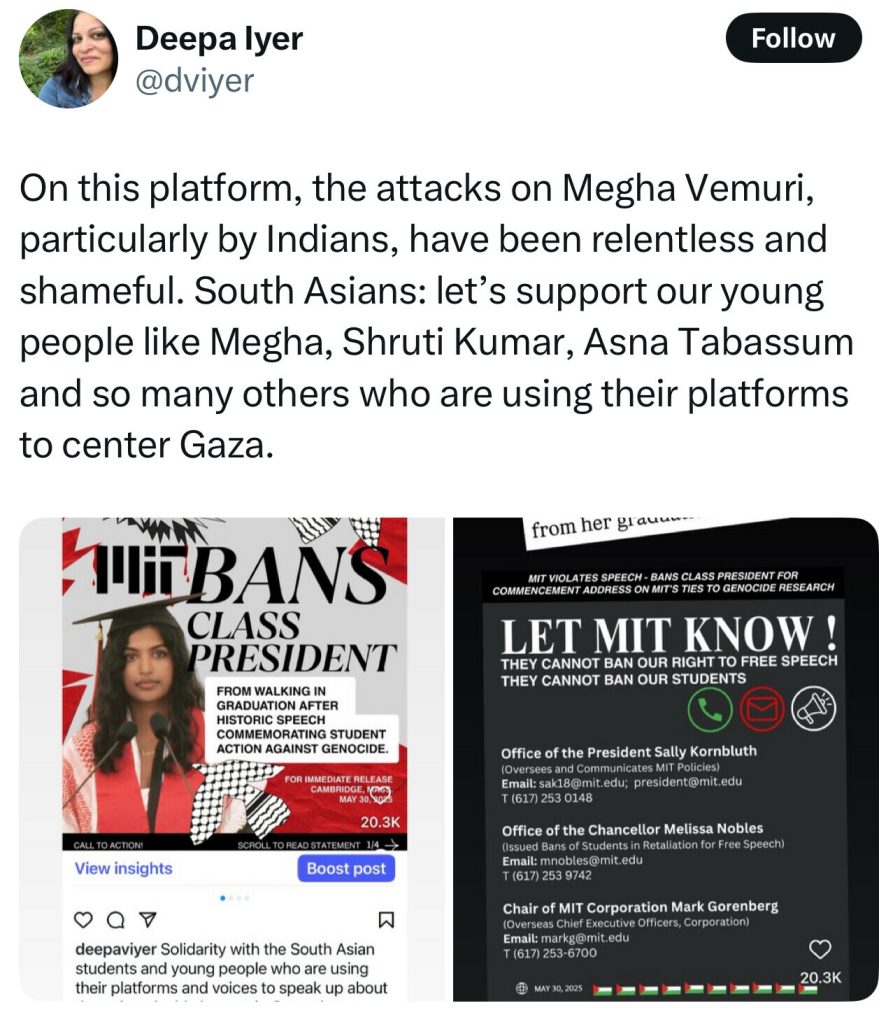
Vemuri is not alone in her courage. Across U.S. campuses, other Indian-American students have risked their academic standing to protest Israel’s war on Gaza, which has claimed over 53,000 lives since October 2023. At the University of Southern California, Asna Tabassum, a biomedical engineering major from Chino Hills, California, was selected as the 2024 valedictorian but barred from delivering her commencement address due to her vocal support for Palestinian rights. Tabassum, whose parents hail from South India, faced intense backlash for her activism, yet she remained steadfast, stating, “Silence in the face of injustice is not an option.”
At Harvard, Shruti Kumar, a senior from Connecticut with roots in Uttar Pradesh, made headlines when she interrupted the university’s commencement to protest the suspension of 13 pro-Palestinian students. “This is about civil rights and upholding democratic principles,” Kumar said, her voice steady despite jeers from the crowd. Her parents, immigrants who instilled a deep sense of social responsibility, watched with pride as she challenged Harvard’s crackdown on dissent.
These young women, all first-generation Indian-Americans, share more than their heritage. They carry the weight of a diaspora often celebrated for academic excellence but increasingly visible in the fight for global justice. Their actions reflect a growing trend among South Asian students in the U.S., who are using their platforms to address issues like war, occupation, and institutional complicity. “We’re not just here to get degrees and stay quiet,” said Kumar, who plans to pursue a career in public policy. “Our education comes with a responsibility to speak for those who can’t.”
Vemuri’s speech, which went viral after being shared by the Palestinian Youth Movement, was a call to action. She praised MIT’s undergraduate body and Graduate Student Union for voting overwhelmingly last spring to sever ties with the Israeli military, despite facing “threats, intimidation, and suppression” from university officials. “You showed the world that MIT wants a free Palestine,” she said, her voice rising over applause. She invoked the MIT tradition of turning the class ring, featuring the mascot Tim the Beaver, outward to face the world—a symbol of graduates’ responsibility to confront global challenges. “We carry the stamp of the MIT name, the same name that is directly complicit in the ongoing genocide of the Palestinian people,” she declared.
The backlash was swift. Vemuri faced vicious online trolling, with some Indian critics accusing her of “selective activism” for not addressing issues like violence in Pahalgam, a town in Jammu and Kashmir. Hardline religious extremists from India hurled personal insults, targeting her accent and career prospects. Yet supporters rallied around her, with one X user writing, “Megha Vemuri is a hero! A brave girl being ridiculed by her own, but she’s the only sane one.” Another urged the South Asian community to uplift students like Vemuri, Tabassum, and Kumar, who “center Gaza” despite immense pressure.
The crackdown on Vemuri reflects a broader clampdown on pro-Palestinian voices across U.S. campuses. At New York University, student Logan Rozos had his diploma withheld after condemning Gaza’s “atrocities” in an unsanctioned speech. Columbia suspended over 65 students for a library protest, and Harvard faced scrutiny after the U.S. Department of Homeland Security threatened to revoke its international student program over DEI initiatives and campus activism.
For Vemuri, Tabassum, and Kumar, the personal cost of speaking out is steep but necessary. “My grandparents came from India with nothing but hope for a better life,” Tabassum said. “They taught me that freedom isn’t free—it demands courage.” As these students navigate a polarized world, their Indian roots anchor their resolve, blending a legacy of resilience with a commitment to justice. Vemuri, now an MIT alumna, plans to continue her advocacy, undaunted by the controversy. “This isn’t about one speech,” she said. “It’s about a world where no one’s education, or life, is erased.”
Their voices, rising above the noise, remind us that dissent is not just a right—it’s a legacy. For these Indian-American women, it’s a legacy they’re writing, one bold word at a time.