
 News Desk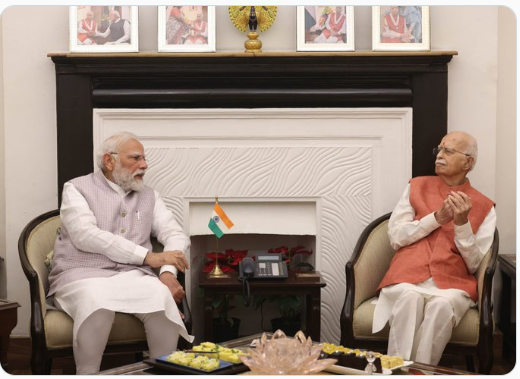
NEW DELHI — At 98, Lal Krishna Advani sat upright in his chair, his eyes tracking Prime Minister Narendra Modi’s movements with unwavering focus. When PM. Modi reached for his feet in a traditional gesture of respect on Tuesday, Mr. Advani’s hand shot out—not in feeble acceptance, but to clasp the Prime Minister’s arm, his lips moving in what witnesses described as clear, coherent blessing.
The birthday visit, captured in photographs that ricocheted across Indian social media, has reignited a persistent, if delicate, conversation in political circles here: Why do so many of Asia’s elder statesmen appear to defy the cognitive decline that afflicts so many elsewhere?
It is a question draped in anecdote, not data. Yet the images of Mr. Advani—who helped forge modern India’s Hindu nationalist movement and, a leader whom critics hold responsible for the demolition of the Babri mosque, remains, by all accounts from those close to him, mentally acute—join a gallery of ageing Asian leaders whose continued sharpness has long fascinated observers. Mahathir Mohamad governed Malaysia until age 94. Lee Kuan Yew continued to counsel Singaporean leaders into his 90s. Thailand’s Bhumibol Adulyadej offered constitutional commentary well into his ninth decade. Maumoon Abdul Gayoom of the Maldives remains active in his 80s.
The pattern, if it exists, may be less mysterious than it appears. These are men who were never permitted the luxury of disengagement—never fully “retired” in the Western sense. The brain, like any muscle, withers without use, and politics in this part of the world offers no reprieve: daily crises, complex social negotiations, the constant exercise of memory and manoeuvre. It is a relentless regimen, and perhaps one that keeps the mind sharp.
Mr. Advani’s aides say he reads three newspapers each morning, follows parliamentary debate on television, and recently corrected a visiting biographer on the date of a 1970s by-election. During Tuesday’s 20-minute meeting, they said, he asked about specific infrastructure projects and recalled PM. Modi’s 2014 campaign promise to clean the Ganges River.
The Prime Minister’s office offered a terse statement: “Advaniji’s blessings are a source of inspiration.” But the body language in the official photographs told a more detailed story—PM. Modi leaning in to listen, not to shout; the two men sharing a laugh that required timing and comprehension.
Still, experts warn against romanticising a political dynasty into a biological fortress. Dementia and cognitive impairment are rising elsewhere as populations age, and many families of former leaders keep diagnoses private, hidden behind gates and careful press releases. The apparent pattern, they argue, may be one of survivorship bias: only those who remain sharp stay visible.
What is undeniable is the symbolism. In a region obsessed with revering its elders, Mr. Advani’s clarity is political capital. For PM. Modi, photographed at the feet of his mentor, it is a living link to the movement’s founding narrative. For the public, it is reassurance that some constants—memory, wisdom, the ability to bless a younger leader with coherent counsel—remain intact.
Mr. Advani’s birthday passed without a public speech. He did not need one. The photograph, widely shared, made its own argument: here was a mind, at 98, still very much at work.
Whether that constitutes proof of anything beyond one man’s resilience, however, is a question best left to science—not politics.


