News Desk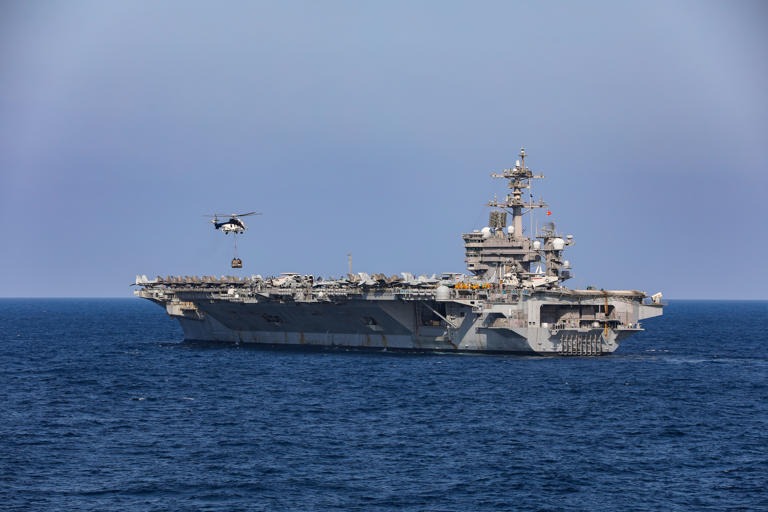
WASHINGTON — As American warships pound Houthi positions in Yemen and fend off missile and drone attacks in the Red Sea, China is closely observing, seeking lessons for a potential invasion of Taiwan, military experts say. The intensifying U.S. naval campaign, ordered by President Donald J. Trump, reveals both the strengths and vulnerabilities of American sea power — insights Beijing is eager to exploit as it eyes the self-ruled island it claims as its own.
Since March 15, the U.S. Navy has deployed two aircraft carrier strike groups, led by the USS Harry S. Truman and USS Carl Vinson, to conduct airstrikes against the Iran-backed Houthis in western Yemen. The Pentagon has bolstered its Middle East presence, redirecting a carrier group from the Pacific to counter Houthi attacks on U.S. warships and commercial vessels. These operations, experts warn, offer China a real-time case study in modern naval warfare, particularly in countering asymmetric threats like those Taiwan might deploy.
“China is watching how the U.S. handles a range of threats, from ballistic missiles to drones, many of which mirror capabilities the People’s Liberation Army would use,” said Alex Luck, an Australia-based naval analyst. “The Houthi campaign shows how cheaper, innovative tactics can challenge even the most advanced navies.”
The Houthis’ use of drones, shore-based precision weapons, and coordinated missile strikes has exposed potential weaknesses in traditional naval assets like aircraft carriers, which are central to U.S. power projection. Phil Yu, a senior researcher at the Atlantic Council, noted that Taiwan, at Washington’s urging, has prioritized similar asymmetric defenses — including mobile missile systems designed to target China’s vast naval fleet, the world’s largest by ship count.
“Beijing will study how Taiwan could adopt Houthi-like tactics to blunt Chinese maritime dominance,” Mr. Yu said. “The PLA Navy must prepare to counter these systems while refining its own asymmetric strategies.”
China’s military ambitions extend far beyond Taiwan. The Pentagon’s latest report on Chinese military power highlights Beijing’s push to expand its global reach, with overseas bases in Djibouti and Cambodia and plans for further outposts. These facilities could sustain long-range operations, much like the U.S. Navy’s global network of bases supports its Middle East campaign. “The PLA is learning the value of overseas access to project power far from home,” said Daniel Byman, director of the Warfare, Irregular Threats, and Terrorism Program at the Center for Strategic and International Studies.
The U.S. operation in Yemen has also raised concerns about resource strain. The Navy has expended 770 weapons, from missiles to bombs, in self-defense and strikes since late 2023, depleting stockpiles and highlighting the challenge of sustaining high-intensity campaigns. “A navy needs to optimize its munitions use and lean on cost-effective tools,” said Shawn Creamer, a senior researcher at the Atlantic Council. “Asymmetric foes like the Houthis demand joint operations, including land forces, to decisively defeat.”
For China, the U.S. campaign underscores the complexities of confronting a determined, less-equipped adversary — a scenario Beijing could face in Taiwan, where the island’s rugged terrain and missile defenses pose significant obstacles. Taiwan’s military, though smaller than China’s, has invested heavily in survivable weapons systems under the Taiwan Relations Act, which mandates U.S. support for the island’s defense.
Beijing’s silence on the Yemen conflict speaks volumes. The Chinese Defense Ministry did not respond to requests for comment, but its strategic calculus is clear: every U.S. strike, every defensive maneuver, is a data point in China’s preparations for a potential cross-strait conflict. As Mr. Byman put it, “The Houthis show that degrading an adversary’s will and infrastructure requires sustained effort and exquisite intelligence — lessons China is undoubtedly absorbing.”
The U.S. Navy’s operations may deter aggression in the Middle East, but they also risk emboldening China’s long-term ambitions. With Taiwan’s fate hanging in the balance, Beijing’s scrutiny of American missteps and successes could shape the Indo-Pacific’s future.