 News Desk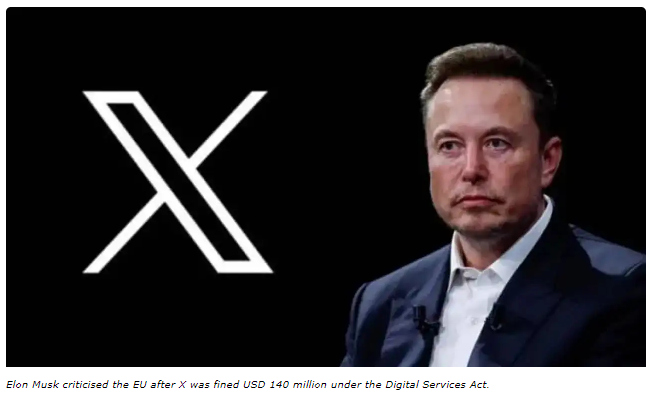
When Elon Musk declared that the European Union “should be abolished” after regulators fined his platform X $140 million, he revealed more than just disdain for bureaucracy. He exposed a worldview in which democratic institutions are expendable, and corporate sovereignty reigns supreme. Musk’s rhetoric is not merely bluster—it is symptomatic of a deeper problem: the unchecked power of billionaires who operate platforms that shape public discourse yet remain unaccountable to the very citizens they claim to serve.
For millions of users, the promise of a blue checkmark on X was sold as a badge of authenticity. People paid real money for it, only to find themselves suspended or blocked without explanation. No reason is given, no appeal process offered, and no refund issued. The transaction is one-sided: Musk’s company takes the money, delivers a symbol of legitimacy, and then strips it away at will.
We have, in fact, a case in hand—the @e_truthmv account—where this exact scenario played out. The user purchased verification, only to be abruptly silenced without justification. No transparency, no accountability, and no recourse. It is emblematic of a broader pattern: Musk’s platform monetizes trust, then arbitrarily withdraws it, leaving users powerless.
This is not transparency. It is a virtual corporate dictatorship, where rules are opaque, accountability is absent, and communication channels are deliberately closed. Users are left shouting into the void, while Musk himself insists that his platform is a bastion of free speech.
And yet, we have seen what Musk’s version of “free speech” looks like in practice. Episodes such as the grotesque “burning babies” saga illustrate the hollowness of his rhetoric. Free speech, in Musk’s hands, becomes a shield for sensationalism and exploitation, not a principle of democratic discourse.
Musk often frames himself as a champion of openness, but his governance of X tells another story. Decisions are made behind closed doors, policies shift without warning, and enforcement is arbitrary. The irony is stark: a man who rails against government regulation for being heavy-handed presides over a platform where the rules are unknowable and the punishments unexplained.
Does being the richest man in the world grant Musk the authority to dismantle unions, challenge sovereign states, and silence users who question him? Wealth amplifies his voice, but it does not legitimize his calls to abolish institutions designed to protect citizens. Sovereignty belongs to electorates, not to billionaires.
Musk’s influence is undeniable. His companies build rockets, cars, and satellites; his words move markets and sway public opinion. But influence without accountability is dangerous. When a single individual can dictate the terms of global conversation, democracy itself is at risk.
The EU fine was not an act of tyranny—it was an attempt to enforce transparency and protect citizens from deception. Musk’s response, to call for the abolition of the EU, is not the rhetoric of a visionary. It is the tantrum of a mogul unwilling to be reined in.
Elon Musk’s digital empire thrives on the illusion of freedom while practicing the mechanics of control. The blue check debacle is not a minor grievance—it is emblematic of a system where users are exploited, silenced, and ignored. If democracy is to survive in the digital age, Musk must be reigned—not celebrated.