News Desk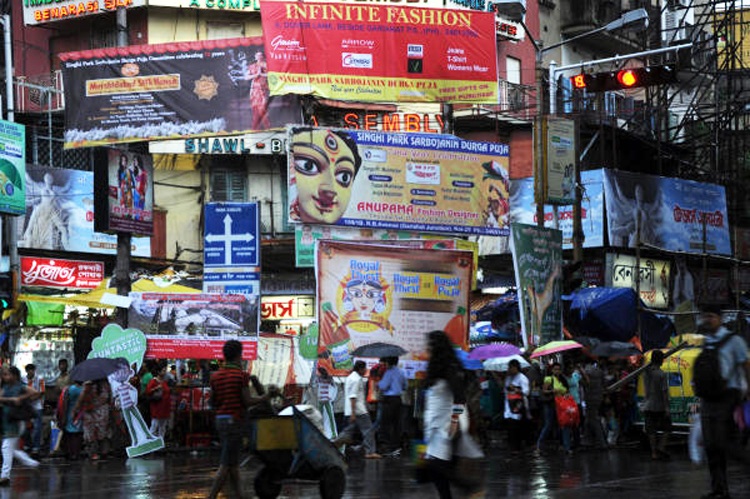
This article is part 3 of our series on the evolution of Indian design, exploring how creativity and tradition shape the country’s everyday objects and global influence.
MUMBAI, India — On a bustling corner in Dadar, a hand-painted sign for “Bhimseni Surma” gleams in red and gold, its kohl-darkened eye staring out since 1947. Down the street, a rickshaw’s rear flaunts a Bollywood poster, all swirling fonts and starstruck faces.
This is India’s graphic design in motion—raw, vivid, everywhere. It’s not just art; it’s a language, born from bazaars and billboards, now shaping brands that resonate from Kerala to Kansas.
In a country of 1.4 billion, where chaos meets creativity, graphic design isn’t a luxury—it’s a lifeline, and India’s mastery of it is rewriting the rules.
The story starts small. In the 1950s, as India shook off colonial shackles, businesses needed voices. Enter the street artists—painters with brushes and buckets, turning shopfronts into canvases.
A trivia gem: Mumbai’s Crawford Market still boasts signs from that era, their faded Marathi script a nod to a time before digital screens. These weren’t trained designers but craftsmen, layering bold colors—reds, yellows, blues—over wood or tin.
The goal? Catch the eye in a crowd. It worked. Brands like Mysore Sandal Soap, with its saffron oval logo since 1916, or Boroline’s green tin, a 1929 classic, became instant icons, their packaging as familiar as a neighbor’s face.
Then came the big shift. In 1961, the National Institute of Design (NID) opened in Ahmedabad, a brainchild of Jawaharlal Nehru. It wasn’t just about products—graphic design got a seat at the table.
Early graduates tackled national projects: the Life Insurance Corporation (LIC) logo, a diya cradled by hands, debuted in 1956, radiating trust.
Another milestone: the Amul girl, a polka-dotted imp sketched in 1966 by Eustace Fernandes for Sylvester daCunha’s ad agency. She’s still India’s longest-running campaign, her cheeky slogans—“Utterly Butterly Delicious”—a cultural glue.
Fun fact: Fernandes drew her in a single night, inspired by a rival’s mascot. Today, she’s on billboards, mugs, even postage stamps.
Bollywood fueled the fire. Movie posters, hand-painted until the 1990s, were India’s graphic design boot camp. Artists like Pamart Studios in Mumbai churned out thousands—think Sholay (1975), its gun-toting heroes dwarfing a fiery sky.

These weren’t subtle. Big faces, bigger fonts, clashing colors—it was visual shouting, and it sold tickets.
A lesser-known twist: many posters doubled as lobby cards, cut into strips for rural theaters with no electricity.
By the 2000s, Photoshop took over, but the old style lingers in nostalgia prints and art galleries, a testament to India’s flair for drama.
The streets taught rules no school could.
Zeenat Kulavoor, co-founder of Bombay Duck Designs, spent years photographing India’s visual chaos—truck art, tea stall signs, matchbox labels. Her 2023 book, Everyday India, catalogs over 300 finds, from Ladakh’s prayer flags to Tamil Nadu’s kolam stencils. She spotted patterns: surma packets always feature an eye, mehendi cones a bride’s hands. “It’s unwritten design law,” she says, flipping through pages of primary colors and shiny foils. Her team’s office in Mumbai’s Lower Parel hums with this ethos—celebrating the messy, the handmade, the real.
Branding followed suit.
Take Parle-G biscuits, a 1939 staple. Its wrapper—a girl in pigtails, originally a stock image—hasn’t changed much, a rare feat in a world of rebrands.
Sales? Over a billion packs yearly. Or consider Nirma detergent, its dancing girl logo from the 1970s sparking a jingle that’s still hummed.
A quirky detail: Nirma’s founder, Karsanbhai Patel, named it for his daughter, Nirupama, who died young—her silhouette became a household name.
These designs don’t just sell; they stick.
The digital age hit hard.
By 2010, India’s graphic designers—many from NID, Srishti Manipal, or Pearl Academy—were coding websites and apps. Startups like Zomato and Flipkart leaned on clean lines and flat icons, a far cry from street clutter. Yet tradition sneaks in.
Zomato’s red logo nods to spice, Flipkart’s blue to trust—colors rooted in India’s visual DNA.
A stat: India’s design industry, pegged at $15 billion in 2023 by NASSCOM, grows 20% yearly, fueled by 50,000-plus designers. NID alone graduates 100 annually, many snapped up by global firms like Adobe or Indian giants like Tata.
Typography tells its own tale. Devanagari script, used for Hindi and Marathi, got a modern twist with fonts like Kohinoor (2011) by Satya Rajpurohit. It’s sleek, readable, everywhere—think road signs, Netflix subtitles. But hand-painted truck art still rules highways, slogans like “Horn OK Please” (a 1940s Tata quirk) scrawled in Hindi or Punjabi.
A hidden gem: the font for India’s rupee symbol (₹), launched in 2010, blends a Devanagari “Ra” with Roman lines, designed by Udaya Kumar in just two weeks.
Advertising amplifies it all. Campaigns like “Incredible India” (2002), with its swirling logo and warm palette, turned tourism into a $30 billion industry. Or Cadbury’s “Kuch Meetha Ho Jaaye” ads, pairing purple wrappers with family scenes since 2004—sales doubled in a decade.
A little-known win: the Amul girl once roasted a rival, Horlicks, with “Horllicks!” in 1967, a jab so bold it’s framed in daCunha’s office.
Humor, color, connection—it’s India’s branding playbook.
The chaos isn’t flawless. Piracy plagues small designers—street vendors hawk fake Amul prints for pennies. And global minimalism sometimes clashes with India’s maximalist soul. Yet the best adapt.
Studio Chariot in Delhi crafts logos for craft breweries, weaving in mandalas. Pentagram’s Paula Scher, after a 2019 India stint, called its design “a sensory overload that works.”
Exports soar too—Indian firms design for Pepsi, Unilever, even London’s Tube maps.
In Mumbai’s Chor Bazaar, old LIC posters fetch $20 apiece, their diya logo a retro hit. Nearby, a chai stall’s hand-drawn menu lists “cutting chai” in wobbly letters. It’s not polished, but it’s alive.
India’s graphic design doesn’t chase trends—it sets them, rooted in a past that’s loud, proud, and unapologetic. From the Amul girl’s smirk to a truck’s tailgate poetry, this is branding with a pulse, a visual riot that’s unmistakably Indian.