 News Desk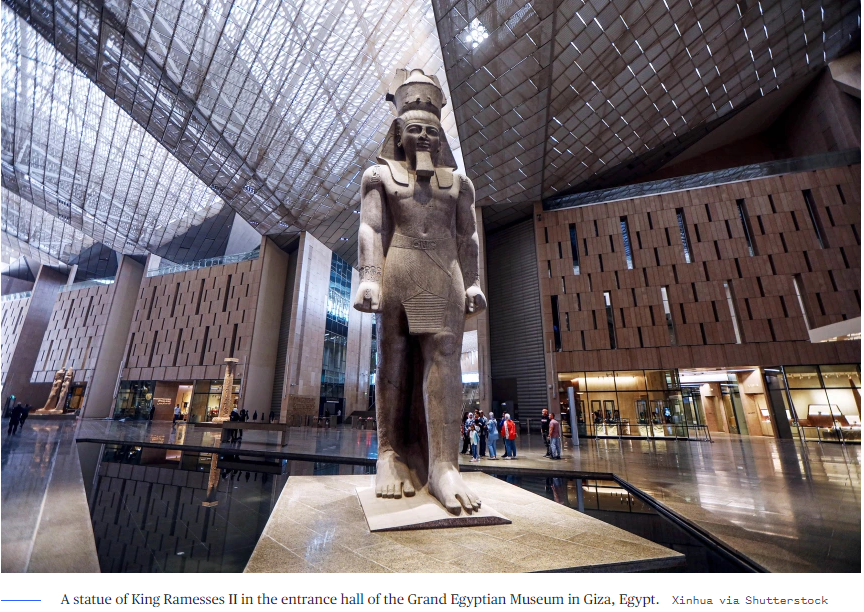
Giza, Egypt –In a monumental milestone for global archaeology, Egypt’s long-awaited Grand Egyptian Museum (GEM) flung open its doors to the public on November 4, just days after its star-studded inauguration on November 1. Attended by Egyptian President Abdel Fattah el-Sisi, First Lady Entissar el-Sisi, and an array of international dignitaries—including Belgium’s King Philippe, Spain’s King Felipe VI, Jordan’s Queen Rania, and leaders from Greece, Hungary, and Germany—the ceremony marked the culmination of a $1.2 billion project that spanned over three decades of planning and construction.
Nestled just two kilometres from the iconic Pyramids of Giza, the GEM stands as the world’s largest archaeological museum dedicated to a single civilization, spanning 490,000 square meters and boasting 24,000 square meters of permanent exhibition space. Its 12 main galleries chronicle seven millennia of Egyptian history, from prehistoric times through the Greco-Roman era, with artifacts organized by theme and chronology to illuminate ancient daily life, spirituality, royalty, and innovation.
At the heart of the collection—estimated at over 100,000 artifacts, with more than 50,000 on permanent display—is the complete Tutankhamun trove of 5,398 items, showcased together for the first time since British archaeologist Howard Carter unearthed the boy king’s tomb in Luxor’s Valley of the Kings in 1922.
Highlights include the pharaoh’s legendary gold funerary mask, chariots, jewellery, and personal effects, all relocated from the cramped Egyptian Museum in Cairo’s Tahrir Square. Another centrepiece is the restored 4,600-year-old Khufu solar boat—a 43-meter cedar vessel unearthed in the 1950s beside the Great Pyramid—transported to the GEM in 2021 via a specialized Belgian vehicle for its afterlife journey display.
The museum’s scale is staggering: It features a 10,000-square-meter Grand Hall atrium with a towering Ramses II obelisk, a children’s museum, a conservation centre—the largest in the Middle East—and spaces for conferences, libraries, shops, and restaurants. At least 20,000 artifacts are debuting publicly, including mummies, sarcophagi, monumental sculptures, and everyday relics like pottery and tools that offer glimpses into ancient Egyptian society.
Yet, as excitement builds— with bookings already surging ahead of the 103rd anniversary of Tutankhamun’s tomb discovery on November 4—a U.S. media report has highlighted the sheer ambition of the endeavour. According to a recent broadcast by an American network, a single visitor would require a full 70 days to thoroughly examine every exhibit, underscoring the GEM’s unparalleled depth.
This estimate aligns with visitor feedback from the museum’s partial openings since October 2024, where trial guests noted that even half-day tours (3–4 hours) barely scratch the surface of the 15,000+ items in the main galleries alone.
“It’s not just a museum; it’s a time machine,” said one early visitor, an Egyptologist from Cairo. “You could spend weeks on Tut’s hall and still miss details.
“The GEM’s debut comes amid Egypt’s push to revitalize tourism, a vital economic pillar battered by regional instability. Officials project up to 8 million annual visitors, dwarfing the 1.5 million who flocked during the 10-month soft launch.
Entry for foreign adults is set at 1,450 Egyptian pounds (about €27 or $29), with 90-minute guided tours in English and Arabic available seven times daily from 9 a.m. to 6 p.m.
For those short on time, themed itineraries focus on eras like the New Kingdom or daily life Delays plagued the project since its 1992 inception under President Hosni Mubarak—pushed back by funding woes, the 2011 Arab Spring, and a brief 2025 closure amid regional tensions—but the result is a modern marvel blending cutting-edge restoration with sweeping desert views of the pyramids.
As Prime Minister Mostafa Madbouly declared at the opening, “This is a dream realized, a new golden age for Egyptology.”
For travellers, the GEM promises not just artifacts, but a profound reconnection to humanity’s oldest stories. As one guide quipped, “Seventy days? That’s the point—Egypt’s wonders were built to last lifetimes.” Bookings are live now, but with lines forming, history buffs are advised to plan ahead.