News Desk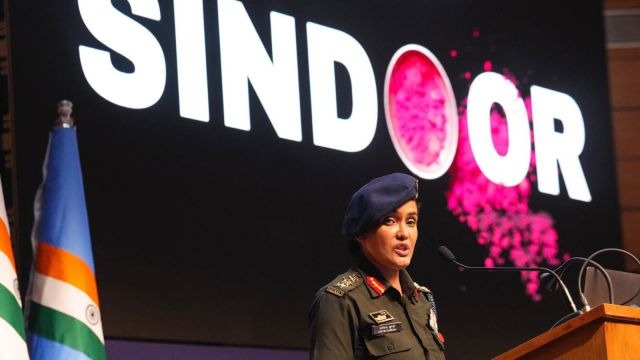
NEW DELHI — On Wednesday, India’s military delivered a powerful statement of resolve, precision, and inclusivity as it detailed Operation Sindoor, a retaliatory strike launched in response to the recent Pahalgam terror attack. At the forefront of the briefing were two women officers, Colonel Sofiya Qureshi and Wing Commander Vyomika Singh, whose presence underscored the Indian armed forces’ commitment to gender equality and operational excellence.
Standing alongside Foreign Secretary Vikram Misri, Colonel Qureshi and Wing Commander Singh presented a meticulous account of the operation, complete with maps of terrorist camps in Pakistan and Pakistan-occupied Kashmir and footage of the strikes. Their briefing highlighted the seamless integration of India’s tri-services — army, navy, and air force — in executing a mission that targeted nine terrorist camps, all of which, Colonel Qureshi emphasized, were “successfully destroyed.”
Operation Sindoor, Colonel Qureshi explained, was driven by a singular purpose: “to deliver justice to the victims of the terror attack and their families.” The targets, she noted, were selected with “credible intelligence inputs” and a focus on their role in orchestrating terror activities. In a nod to India’s commitment to minimizing collateral damage, she added, “The locations were so selected to avoid damage to civilian infrastructures and loss of any civilian lives. This was done with due diligence.”
The briefing was more than a recounting of military strategy; it was a moment of visibility for women in India’s armed forces, who have steadily risen through the ranks in a traditionally male-dominated institution. Colonel Qureshi, an officer with the Corps of Signals, is no stranger to breaking barriers. In 2016, as a 35-year-old lieutenant colonel, she became the first woman to lead an Indian Army contingent in a multinational military exercise, the Field Training Exercise (FTX) – Exercise FORCE 18, which involved ASEAN Plus countries. The exercise, themed around humanitarian mine action and peacekeeping operations, was the largest ground forces drill ever conducted on Indian soil at the time.
A postgraduate in biochemistry, Colonel Qureshi has a distinguished record, including service in the United Nations Peacekeeping Operation in Congo in 2006. Her leadership in the 2016 exercise earned praise from the late General Bipin Rawat, then the Army Commander of Southern Command and later India’s first Chief of Defence Staff. “In the Army, we believe in equal opportunity and equal responsibility,” General Rawat said at the time. “She has been chosen not because she is a woman but because she has the abilities and leadership qualities to shoulder the responsibility.”
During the 2016 exercise’s closing ceremony, Colonel Qureshi’s pride was palpable. “I feel proud, of course,” she said, urging young women to “work hard for the country and make everyone proud.” Her message to the nation’s youth was succinct: “Join the Army.”
The Indian Army itself heralded her achievement, noting in a press statement that she held the “rare distinction of becoming the first woman officer to lead an Indian Army training contingent in such a large multinational exercise.” She was also the only woman officer contingent commander among all ASEAN Plus contingents present.
Colonel Qureshi’s role in Wednesday’s briefing, alongside Wing Commander Singh, carries forward this legacy of trailblazing leadership. Their poised and authoritative presentation not only detailed a successful military operation but also sent a broader message about the evolving role of women in India’s defense forces. As the country navigates complex security challenges, the inclusion of women like Colonel Qureshi in high-stakes operations and public-facing roles signals a military that is as forward-thinking as it is formidable.
For a nation watching closely, the image of these two women officers at the podium was a reminder that courage, competence, and leadership know no gender. As Colonel Qureshi herself might put it, the call to serve — and to lead — is open to all who are willing to answer it.