News Desk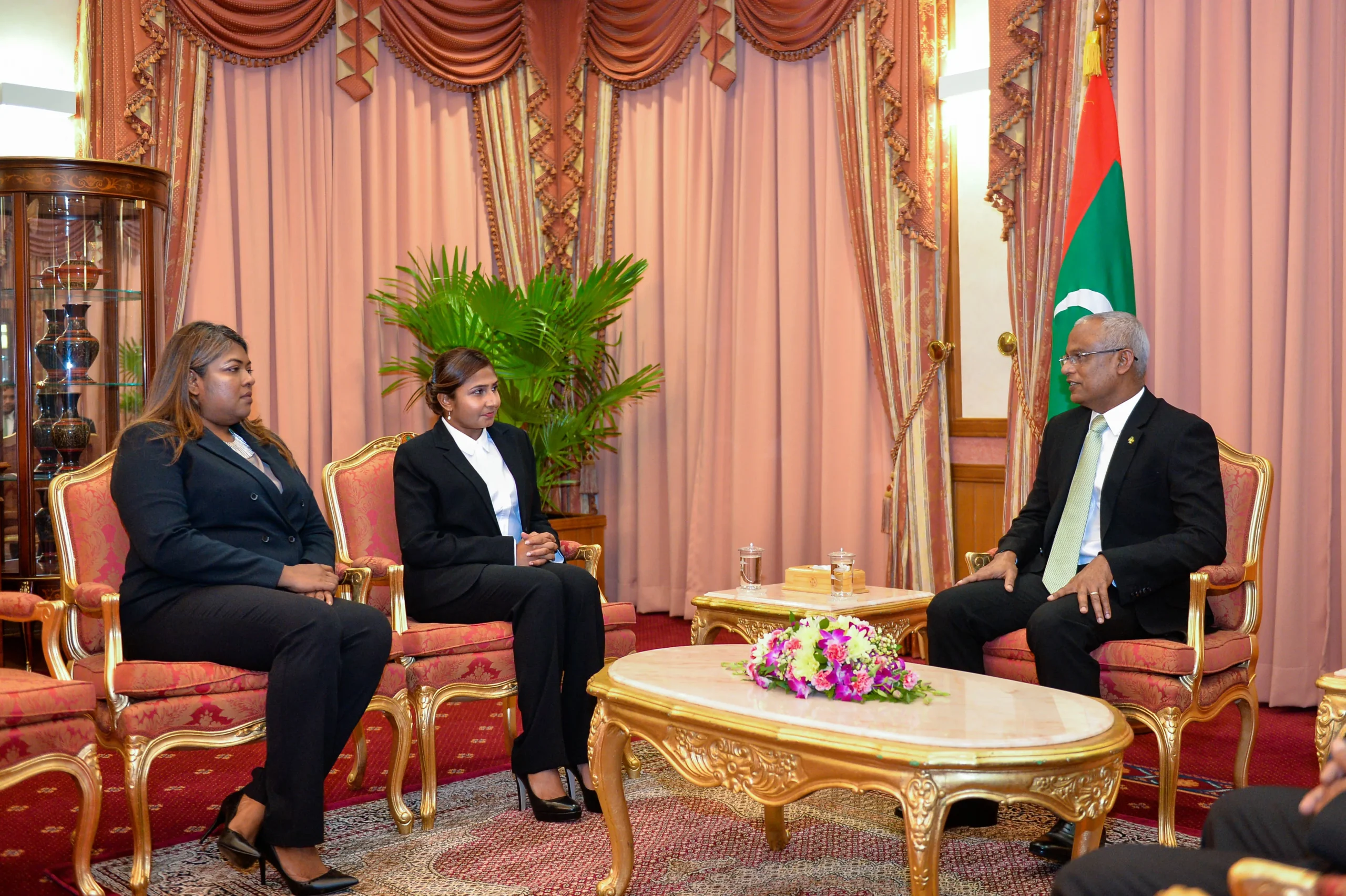
MALE’, Maldives — A storm is brewing in the Maldives, and it’s not the kind that churns the Indian Ocean. This time, it’s a fierce social media debate over whether women should sit on the Supreme Court, reignited by supporters of President Mohamed Muizzu’s government as it moves to trim the court’s bench from seven justices to five.
The timing is no coincidence: with a pivotal constitutional hearing stalled, three justices suspended, and the judiciary in partial paralysis, the push against the court’s two female justices—Dr. Azmiralda Zahir and Aisha Shujoon Mohamed—feels less like a theological dispute and more like a calculated political maneuver.
The spark came on February 27, 2025, at 11:34 a.m., when X user @shiuna_m posted a three-page edict from the Maldives Supreme Council on Fatwa, dated July 9, 2019. Issued under the administration of then-President Abdulla Yameen of the Progressive Party of Maldives (PPM), the edict argues that women cannot serve as judges under Islamic law. It cites historical debates, leans on the Shafi’i school of jurisprudence prevalent in the Maldives, and declares that appointing women to judicial roles is a sin, rendering their verdicts unenforceable.
Shiuna, a known ally of the influential religious NGO Salaf—whose leaders include the first lady’s half brothers and a sitting MP—thrust this old ruling back into the spotlight, igniting a firestorm online.
Background here is key. In 2019, President Ibrahim Mohamed Solih, of the opposition Maldivian Democratic Party (MDP), nominated Zahir and Shujoon to the Supreme Court, making them the first women to serve on the bench since its creation in 2008. Their appointments, approved by a parliament dominated by Solih’s MDP, stirred fierce opposition from religious conservatives who echoed the fatwa’s stance.
Clerics and scholars argued that, some schools in Islam, barred women from such roles, setting off debates that raged across mosques and social media. Yet the appointments stood, a milestone for gender representation in a country where conservative Islamic currents often clash with modern governance.
Fast forward to today. Muizzu, who took power in 2023 with PPM backing and a pro-China tilt, has overseen a government flexing its muscle. His People’s National Congress (PNC) coalition holds a supermajority in parliament—73 of 93 seats—giving it the clout to amend the constitution or oust judges.
On February 26, 2025, parliament passed a bill to shrink the Supreme Court to five justices, a move critics say is aimed at sidelining dissent ahead of a constitutional challenge to controversial anti-defection clauses enacted last November. Hours later, the Judicial Service Commission (JSC) suspended three justices—Husnu Al-Suood, Mahaz Ali Zahir, and Dr. Azmiralda Zahir—leaving the court hobbled just as it was set to hear the case.
Enter the gender debate. With Dr. Azmiralda Zahir now among the suspended, attention has turned to Aisha Shujoon, the lone woman left on the bench. On X, voices aligned with Muizzu’s camp have pounced.
@MVNoosBreaking, a ruling party-affiliated account, decried the MDP’s “secular vision” for ignoring the 2019 edict. Meanwhile, @silgarn, unearthed a 2019 post by rebel rouser Azaan who is PNC MP from Hithadhoo constituency, accusing Justice Shujoon of ties to the Maldives Democracy Network (MDN), a group critical of hardline Islamic practices. The insinuation? She’s not just a woman in a forbidden role—she’s a secularist threat.
The subtext is hard to miss. Of the seven justices after this upheaval, only four remain active: Chief Justice Muthasim Adnan, (who’s hinted at retiring), Justice Shujoon, Justices Dr. Mohamed Ibrahim and Ali Rasheed.
If the trimming succeeds and the suspensions hold and retiring package is granted to Chief Justice and if Fatwa council verdict enforced against remaining lady Justice Aisha Shujoon, the top court could be left with just Rasheed and Ibrahim—both men, and both seen as less likely to challenge Muizzu’s agenda.
Rasheed who delivered an earlier verdict against Yameen before his elevation to Supreme court and Ibrahim who enters the judiciary without any known legal activism or practice by way of MDP affiliation will definitely be under axe.
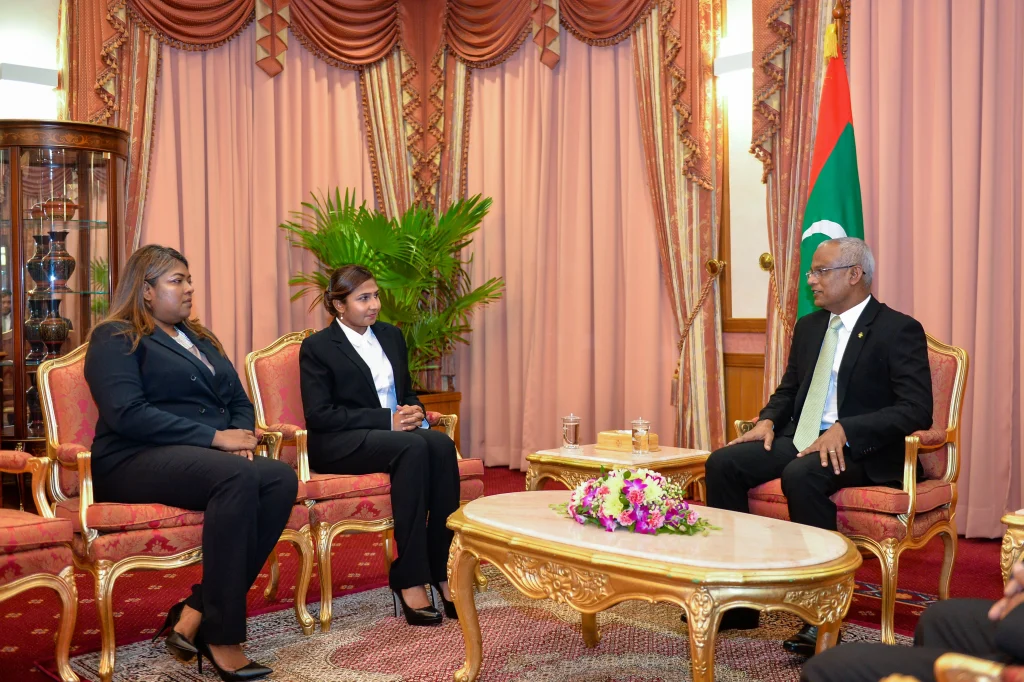
The targeting of Zahir and Shujoon, then, looks like a two-birds-one-stone strategy: shrink the court and purge its women, all while cloaking it in religious rhetoric.
Shiuna’s role adds another layer. One of three officials suspended in 2024 for derogatory remarks about Indian Prime Minister Narendra Modi—an episode that strained Maldives-India ties—she’s since landed a cushy job at a state-owned enterprise. Her proximity to Salaf, a group woven into Muizzu’s power base, fuels speculation that this isn’t just a grassroots debate but a coordinated push. X user @miyadhu weighed in, calling the anti-women stance a narrow Shafi’i view, not a universal Islamic one—a reminder that the fatwa’s authority isn’t uncontested.
Malaysia’s Chief Justice, Tengku Maimun Tuan Mat, is a woman, and the sudden debate in the Maldives over women justices is clearly more about politics than religion.
The stakes are high. The stalled constitutional hearing, which questions the anti-defection clauses bolstering Muizzu’s parliamentary grip, could reshape the balance of power.
A weakened Supreme Court—especially one stripped of justices seen as independent—tilts the scales toward the executive. Opposition figures, like MDP leaders, have condemned the suspensions as a “direct attempt to influence the judiciary,” but with Muizzu’s supermajority, legislative pushback seems unlikely.
He may not even need to sign the trimming bill; the JSC’s actions already signal other levers at his disposal.
On X, the debate rages—part theology, part politics, all personal. Old posts are weaponized, loyalties questioned, and the two women justices stand at the center of a storm they didn’t start.
For now, the Maldives’ judiciary hangs in limbo, its future as uncertain as the fate of its female justices. What’s clear is this: the fight over their seats isn’t just about gender—it’s about control.