
 News Desk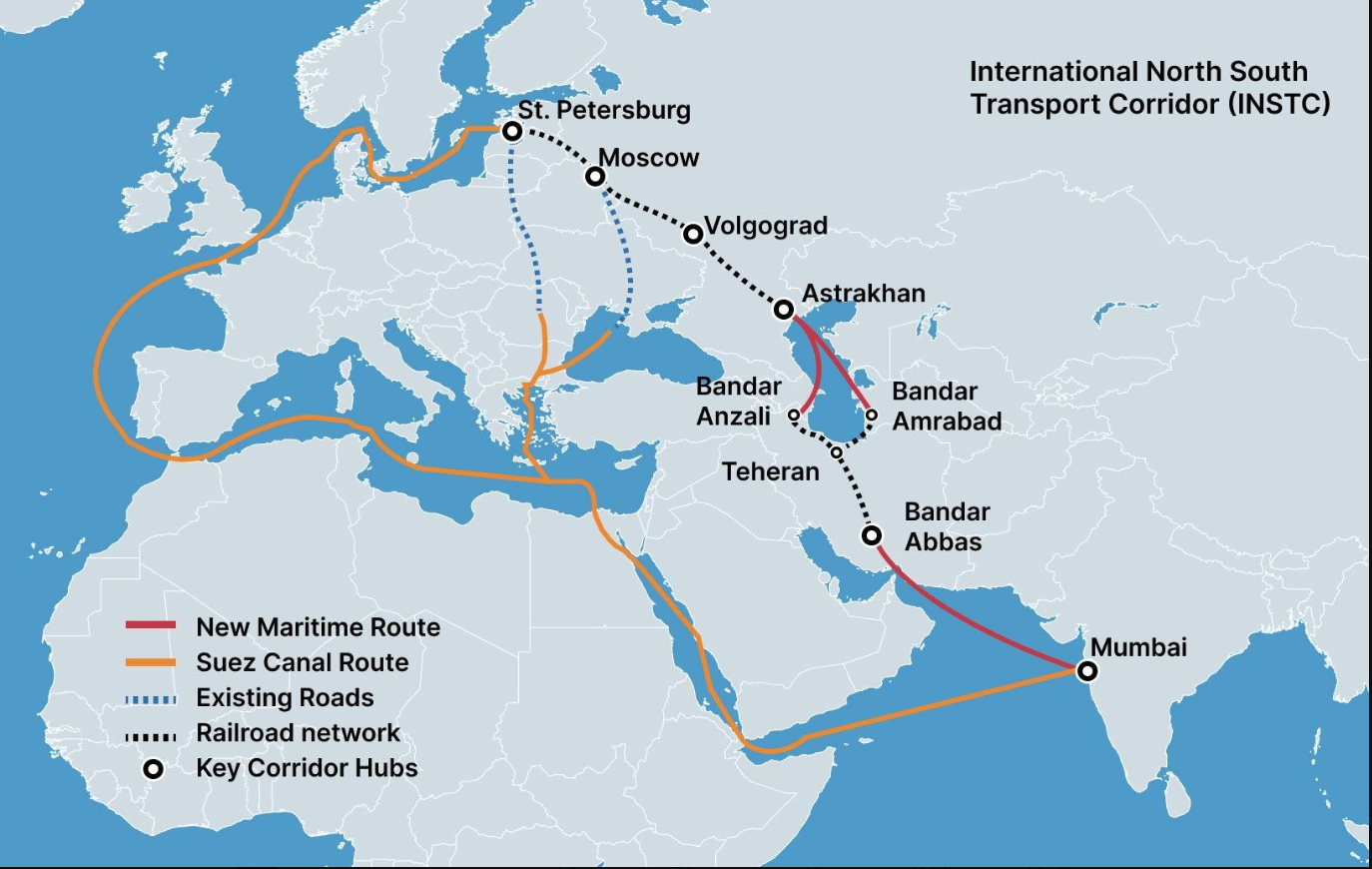
MOSCOW — The first Russian freight train carrying 62 containers dispatched from Moscow has arrived in Iran after traversing 9,000 kilometers through Kazakhstan and Turkmenistan, marking a landmark activation of the International North–South Transport Corridor (INSTC).
The rail convoy reached its Iranian destination in just 12 days, significantly faster than the traditional maritime route through the Suez Canal, which typically takes 40-45 days to connect Russia to the Persian Gulf. The containers are now proceeding toward the Persian Gulf corridor, where they will access port facilities for further distribution to markets in India, the Middle East, and East Africa.
“This is not a test run — this is the corridor already running hot,” said a senior official from Russian Railways, who spoke on condition of anonymity because they were not authorized to comment publicly. “We are seeing real demand materialize immediately.”
The INSTC, a 7,200-kilometer multi-modal network of ships, rail, and roads, has been under development for two decades but gained renewed momentum following shifts in global trade patterns and Western sanctions against both Russia and Iran. The corridor is projected to eventually handle 15 million tons of cargo annually, creating a vital north-south artery linking Saint Petersburg to Mumbai.
The successful 12-day journey validates Russia’s strategic pivot toward overland trade routes with Asia, bypassing traditional Western-controlled shipping lanes. For Iran, the corridor strengthens its position as a critical transit hub and offers economic relief amid its own sanctions regime.
Kazakhstan and Turkmenistan, both key Central Asian partners, facilitated customs and infrastructure coordination to ensure seamless rail connectivity across their territories. The route utilizes existing Soviet-era rail lines upgraded with modern logistics systems.
Industry analysts note that the 62-container shipment, while modest in volume, represents a proof of concept that could attract major commercial shippers. The route’s primary advantage lies in its time efficiency and insulation from maritime chokepoints like the Suez Canal and Strait of Hormuz, where geopolitical tensions can disrupt global supply chains.
The INSTC’s next phase involves expanding gauge-standardization facilities, increasing rolling stock, and integrating digital customs clearance systems to reduce transit times further toward the target of 10 days between Moscow and Mumbai.
Shipping and logistics companies are now reportedly scrambling to secure capacity on subsequent departures, with Russian authorities announcing weekly departures beginning next month.


