 News Desk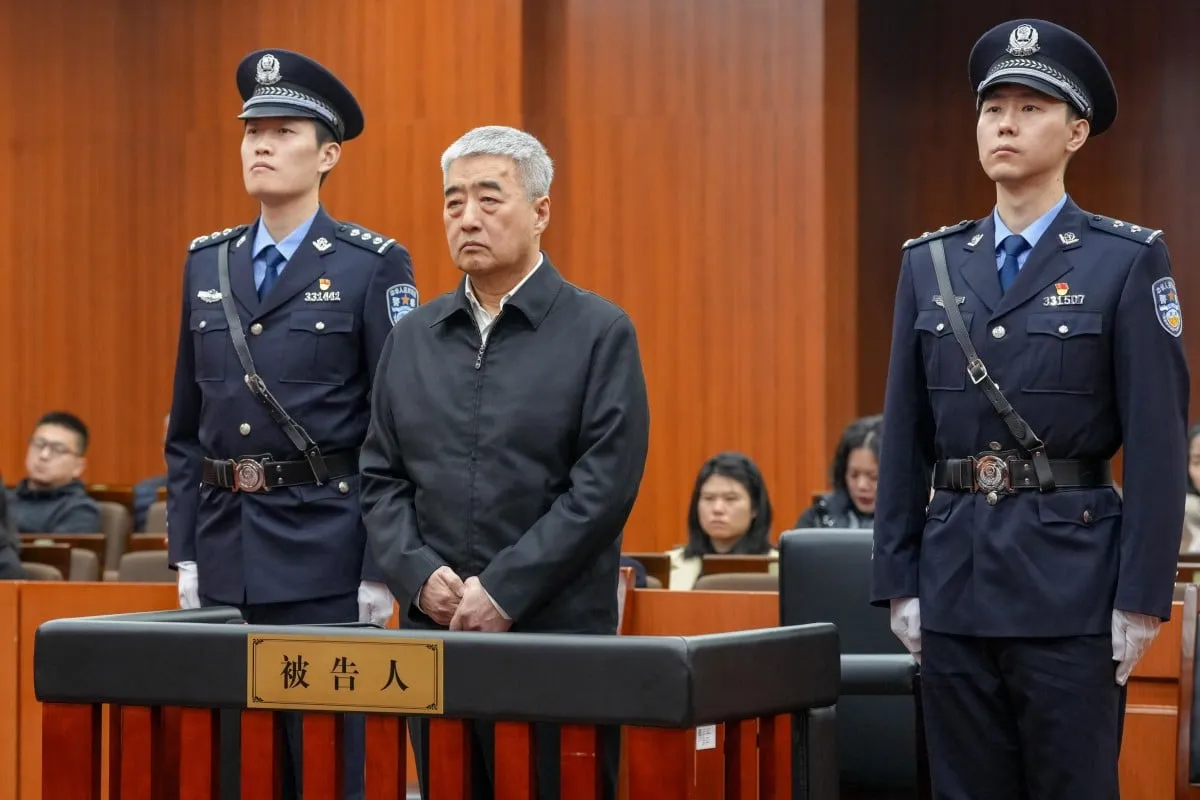
In a striking display of China’s unrelenting war on corruption, Zhang Hongli, a former vice-president of the Industrial and Commercial Bank of China (ICBC), was sentenced to death with a two-year reprieve for accepting more than 177 million yuan ($24.3 million) in bribes.
The verdict, delivered by a court in Hangzhou, Zhejiang province, marks another chapter in Beijing’s high-stakes campaign to purge graft from its financial elite. Yet, beneath the headline-grabbing sentence lies a deeper, more troubling story: a tale of systemic corruption among China’s ruling class, an opaque judicial system shaped by political whims, and an anti-corruption drive that critics say is as much about power as it is about purity.
Zhang Hongli’s case is a textbook example of how power and privilege can turn toxic in China’s elite circles. As a senior executive at ICBC—the world’s largest bank by assets—Zhang held sway over decisions that could make or break fortunes. Between 2011 and 2022, he allegedly leveraged that influence, accepting bribes in exchange for facilitating loan financing and securing plum job placements, according to state media reports. The scale of his corruption, over $24 million, is staggering, even by the standards of China’s financial sector, where high-profile scandals have become all too common.
His punishment is severe: a death sentence, albeit with a two-year reprieve, a legal quirk in China that often leads to commutation to life imprisonment if the convict demonstrates good behavior. This blend of harshness and leniency is emblematic of China’s approach to corruption—part spectacle, part pragmatism.
The death penalty grabs headlines and projects an image of zero tolerance, while the reprieve ensures flexibility, allowing the state to adjust the outcome as it sees fit.
Zhang’s story is not an isolated incident but a symptom of a broader malaise afflicting China’s elite. The country’s meteoric rise to economic superpower status has created unprecedented opportunities for wealth accumulation—and for graft.
The elite, a privileged caste of Communist Party officials, state-owned enterprise executives, and connected business leaders, sit at the nexus of power and money. At ICBC, Zhang’s ability to approve multi-million-dollar loans or hand out coveted positions made him a prime target for bribery.
His case echoes others: Zhou Yongkang, a former Politburo Standing Committee member convicted in 2015 of taking bribes worth millions, or Lai Xiaomin, a former state asset manager executed in 2021 for corruption on an even grander scale.
The numbers tell a stark story. According to Transparency International’s Corruption Perceptions Index, China ranks 76th out of 180 countries, a middling score that belies the scale of graft at its highest levels. The elite’s wealth is often shrouded in secrecy, but occasional leaks—like the 2016 Panama Papers, which exposed offshore holdings linked to relatives of top officials—hint at the vast fortunes amassed through illicit means. For Zhang and his ilk, corruption is not just a personal failing; it’s a byproduct of a system where transparency is scarce, accountability is selective, and power is concentrated in the hands of a few.
Several factors fuel this epidemic of graft. China’s breakneck economic growth over the past four decades has outpaced the development of robust oversight mechanisms. State-owned enterprises like ICBC, which dominate key sectors, operate as extensions of the Communist Party, blurring the lines between public duty and private gain.
The absence of an independent judiciary or a free press, both stifled under Party control, means corruption can fester unchecked until it becomes too blatant to ignore.
Then there’s the culture of guanxi, the intricate web of relationships that underpins Chinese society. What might be deemed bribery in the West, or lobbying in USA, is often framed as reciprocity in China, a way to grease the wheels of business and politics.
For Zhang, accepting bribes may have seemed less a crime than a perk of his position, a norm among peers who saw their roles as gateways to personal enrichment. This entrenched mindset, combined with a lack of institutional safeguards, creates a perfect storm for corruption to flourish.
Enter President Xi Jinping, who has made anti-corruption a cornerstone of his tenure since taking power in 2012. His campaign has been sweeping, targeting both “tigers” like Zhang and “flies”—lower-tier officials—in a bid to cleanse the Party’s ranks.
The statistics are impressive: millions investigated, thousands punished, and dozens of high-profile cases like Zhang’s dominating headlines.
In 2023 alone, 45 senior officials faced probes, state media reported, a testament to the campaign’s unrelenting pace.
Yet, for all its ferocity, Xi’s crackdown raises as many questions as it answers. Critics, including scholars like Minxin Pei of Claremont McKenna College, argue that it doubles as a political weapon. “The anti-corruption campaign has been extraordinarily effective in eliminating Xi’s rivals,” Pei said in an interview. “But it’s less clear that it’s addressing the root causes of corruption.” Zhang’s sentencing fits this pattern: a senior figure felled, his punishment a warning to others, yet the system that enabled his crimes remains largely intact.
The financial sector, where Zhang operated, has been a particular focus. As China grapples with slowing growth and mounting debt, corruption in banking poses a systemic risk. By targeting figures like Zhang, the Party aims to restore confidence in an industry vital to economic stability. But the selective nature of these prosecutions, where some are scapegoated while others escape scrutiny, undermines the effort’s legitimacy.
Zhang’s case also exposes the theatricality of China’s judicial process. The death sentence with reprieve is a carefully choreographed act: severe enough to signal resolve, flexible enough to avoid alienating the elite en masse.
Legal scholars note that such sentences are rarely carried out, with most convicts seeing their penalties reduced over time. This ambiguity reflects a broader truth about China’s rule of law—or lack thereof. “The judiciary is an arm of the Party,” said Donald Clarke, a professor at George Washington University Law School. “Outcomes are determined by political needs, not legal principles.”
This arbitrariness erodes trust. If Zhang’s fate hinges on his behavior during the reprieve—or, more cynically, on his political usefulness—what does that say about justice in China? The answer matters not just for the elite but for the public, whose faith in the system is already strained by inequality and unaccountable governance.
Zhang Hongli’s downfall is a cautionary tale, but it’s unlikely to be a turning point. Corruption in China’s elite persists because it’s woven into the fabric of a system that prizes loyalty over reform. Xi’s crackdowns may deter some, but without addressing the structural flaws, opaque governance, unchecked power, and a muzzled media, they’re little more than a Band-Aid on a festering wound.
For the financial sector, Zhang’s case is a wake-up call, yet the prognosis is uncertain. The Party wants a clean industry to support its economic ambitions, but it’s unwilling to cede the control that fuels corruption in the first place. Meanwhile, the elite walk a tightrope, their wealth and status shadowed by the threat of a sudden fall.
In Hangzhou, where Zhang’s sentence was pronounced, the message is clear: no one is untouchable. But as long as China’s anti-corruption efforts remain a tool of politics rather than a path to systemic change, the gilded cage of its elite will continue to breed greed—and the crackdowns will go on, one tiger at a time.
Some details in this report were sourced from various international media.