News Desk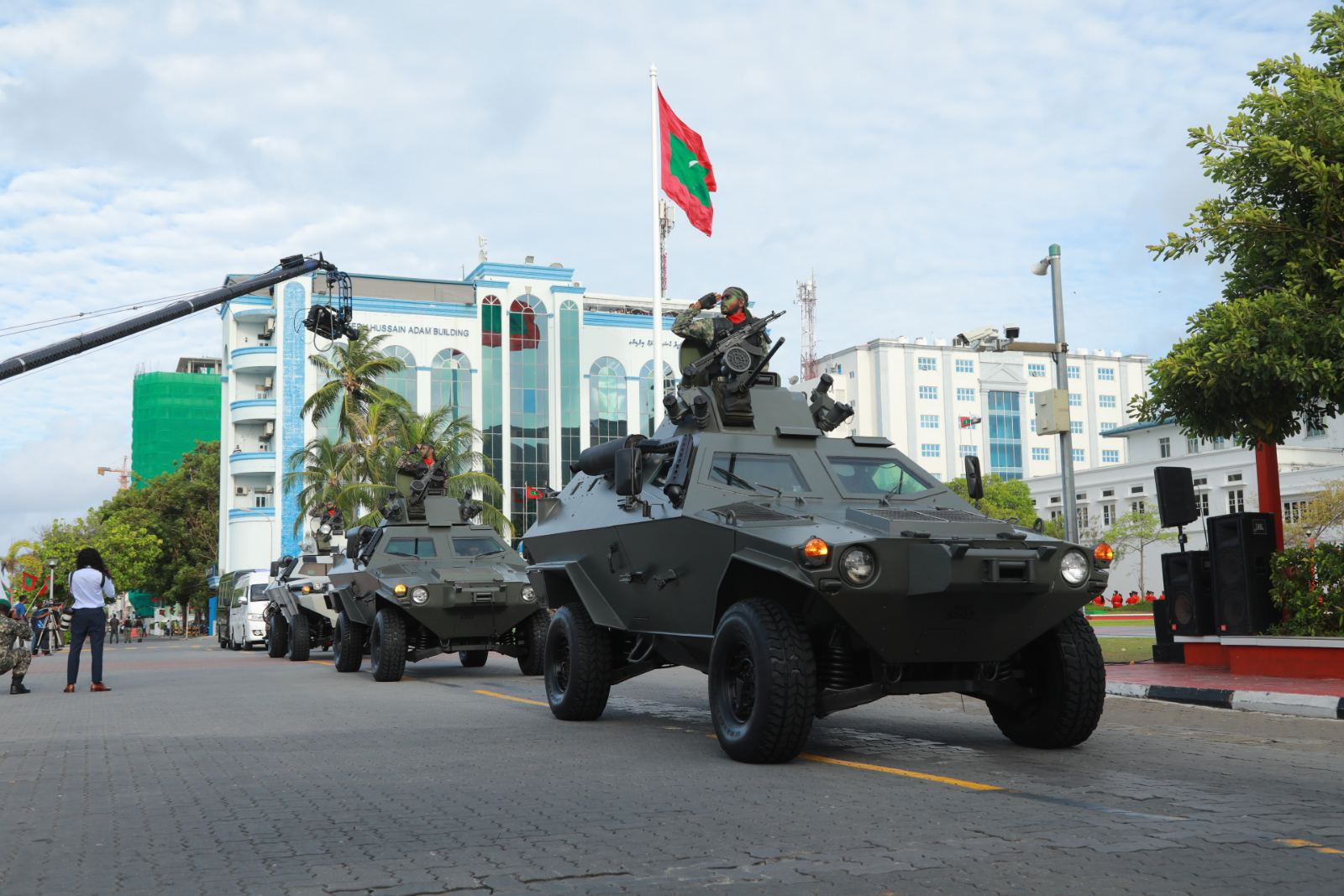
MALE’, Maldives — On a humid, swelteringly unbearable afternoon in the capital, the MNDF marked its 133rd anniversary with a parade that rolled through the sunbaked street opposite the President’s office, a display of martial pride presided over by President Mohammed Muizzu and First Lady Sajida Mohammed. The centerpiece of the event was the unveiling of five new armored vehicles, freshly imported, their polished hulls glinting under the relentless tropical sun, a jarring contrast to the turquoise waters that define this island nation. Yet, as the military band played and drones hummed overhead, a deeper question simmered in the heavy air: In a country of scattered atolls and pressing human needs, what does it mean to prioritize defense spending?
The Maldives, a nation of fewer than 500,000 people, is not a place one associates with military might. Its strategic perch in the Indian Ocean, astride vital shipping lanes, has long made it a geopolitical chessboard for powers like India, China, and the United States. But its own defense capabilities have historically been modest, focused on maritime security and coast guard operations to patrol its sprawling exclusive economic zone (EEZ), which spans nearly a million square kilometers. The recent acquisitions—armored vehicles, military drones from Turkey, and a forthcoming Dogan-class missile-capable ship donated by Ankara—signal a shift, one that has sparked both pride and unease among Maldivians.
The armored vehicles, showcased prominently in the parade, are a novelty for the Maldives National Defence Force (MNDF). Command Surgeon Major Abdullah Saeed described them as a first for urban deployment, intended for use in “area commands” across the country. But their purpose remains opaque. Are they for internal control, to manage crowds or quell unrest in a nation where political protests have occasionally flared? Or are they a hedge against external threats, a symbolic deterrent in a region where India and China vie for influence? The MNDF has not disclosed the cost or specific capabilities of these vehicles, leaving citizens to speculate about their utility in a country with no history of conventional warfare.
Public sentiment, as voiced in online comments, crackles with skepticism and frustration. “Very nice but we are out of Panadol in the island right now,” wrote one user, Nice Fehendo, on a news site, the sarcasm palpable. Another, Thefaasa, vented, “Large cities are not well electrified. Cetrizan is not available in pharmacies. Inflation is out of reach. But buying heavy weapons and parading the streets is the top priority? North Korea vibes!!!!” These voices, raw and unfiltered, underscore a broader tension: the chasm between the government’s military ambitions and the daily struggles of its people.
Consider the state of healthcare in the Maldives, where long queues for internal medicine appointments are as much a fixture as the ocean itself. In Male’, the Indira Gandhi Memorial Hospital (IGMH) is the country’s primary tertiary care facility, but it is stretched to breaking. A 2023 Reddit thread painted a grim picture of healthcare beyond the capital: “The most advanced facilities are located in Male’ but if it’s more than a cold or a fever, you’ll have to head out to another country to consult.” The Maldives has just three CT scanners—one at IGMH, Treetop Hospital and another at the private ADK Hospital—serving a population scattered across hundreds of islands. Access to basic medications like antihistamines or pain relievers is often unreliable in remote atolls, where pharmacies frequently run dry.
Compare this to the MNDF’s growing arsenal. The armored vehicles, though few, are part of a broader military buildup that includes drones patrolling the EEZ since March 2024 and the anticipated Turkish missile ship, a 44-year-old vessel to be delivered with two weeks of training by July. A post on X by user MP @MickailNaseem quantified the scale: “MVR 569 million from the state’s contingency budget for military drones from Turkey. AJBAN 442A armored vehicles from UAE.” The cost of these acquisitions, though not fully transparent, looms large against the meager budget for healthcare infrastructure. The International Monetary Fund noted in 2023 that the Maldives’ health sector budget was boosted to cover COVID-19-related expenses, but capital investments in regional hospitals and diagnostic equipment remain woefully inadequate.
This juxtaposition—armored vehicles rumbling past hospitals with overburdened waiting rooms—crystallizes the Maldives’ dilemma. The government’s narrative frames these acquisitions as essential for national security, a bulwark against unspecified threats in a volatile region. Yet, the public’s response suggests a different calculus. “The national security strategies of this country should be based on the geography of the country,” wrote user Safia. “I don’t think these vehicles will be of any use.” Others, like Salim Idris, mock the strategy outright: “If you are bringing heavy weapons to defend yourself from a war, talk to Israel and bring the country’s missile defense system Irondome and put it in the city to defend the water plants!”
The Maldives’ geography—low-lying, fragmented, and vulnerable—demands a nuanced approach to security. Its greatest threats are not invading armies but climate change, economic precarity, and the fragility of its healthcare system. The parade, with its heat-soaked pomp, may project strength, but it also lays bare a disconnect. As drones soar and vehicles gleam, the people wait—for medicine, for scans, for a government that sees their needs as clearly as it sees its own ambitions.
In Male’, the humidity clings like a second skin, and the questions linger longer than the parade itself. What is the true cost of these machines? And in a nation so small, so delicate, what are they meant to defend?