News Desk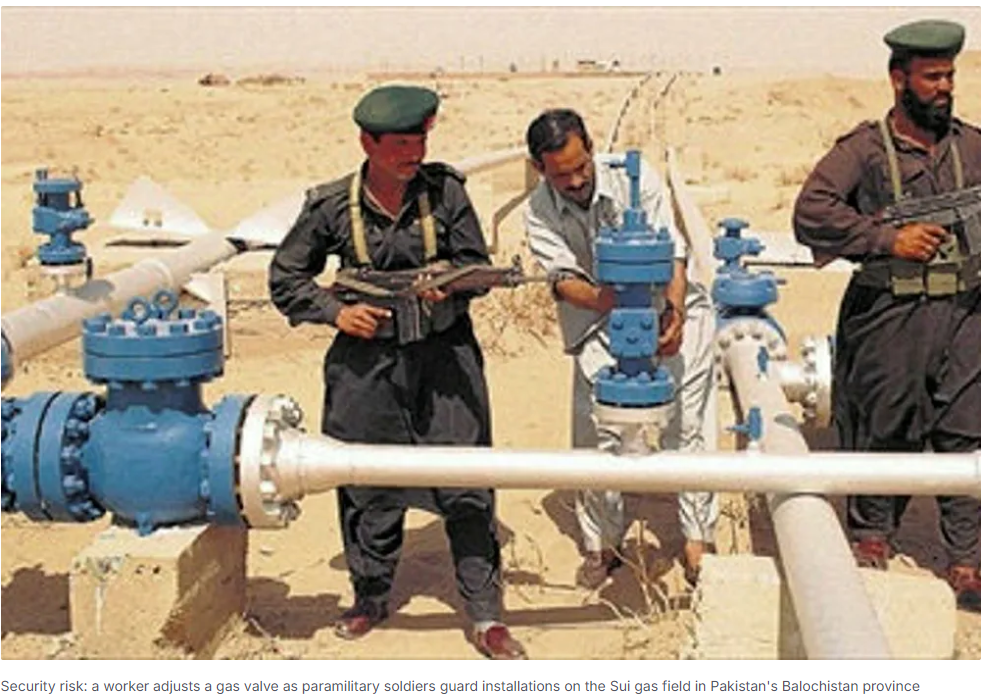
DERA BUGTI, Pakistan — The flame that first flickered above the Sui Gas Field in December 1952 was hailed as a triumph of modern Pakistan. Discovered in the rugged district of Dera Bugti, Balochistan, it promised to fuel the nation’s industrial ambitions, much as the jute fields once sustained East Pakistan before 1971. Operated by Pakistan Petroleum Limited, the state-owned giant, Sui became the country’s first major natural gas discovery — and for decades supplied as much as 70 percent of Pakistan’s needs.
But the story of Sui is not one of shared prosperity. It is instead a parable of extraction without inclusion, of wealth siphoned to Punjab and Sindh while the land that hosts the wells remains in darkness. Production has dwindled to about 334 million cubic feet per day, yet the field still contributes 6 to 8 percent of national output. Its revenues — billions in royalties, bonuses, and surcharges — have powered factories far away. In Dera Bugti, the Bugti tribe’s ancestral lands, the benefits have been meagre.
For the Bugti, custodians of this land since before partition, the gas field became a symbol of betrayal. Nawab Akbar Khan Bugti, the tribe’s formidable chieftain, once embraced Pakistan’s accession. By the 2000s, he was its fiercest critic.
His complaints were precise: royalties fixed at 1950s rates, never adjusted for inflation; gas priced at Rs. 47 per unit for federal sales, compared to Rs. 171–240 in Sindh and Punjab. Balochistan, he argued, received only 12 to 13 percent of proceeds while Sui supplied nearly half the nation’s gas. “Gas is the property of the Baloch which is used by others without our consent,” he told the BBC in 2005.
The disputes were not merely fiscal. They were tribal, pitting Bugti against rival clans like the Kalpars, and political, as federal officials accused him of pocketing millions in personal royalties. Promises of jobs, scholarships, and development projects went unfulfilled. Violence followed: pipelines sabotaged, infrastructure attacked. The rape of Dr. Shazia Khalid in 2005, allegedly by a military officer, became a rallying cry for Bugti, who saw it as emblematic of Punjabi dominance.
The state’s response was not negotiation but militarization. Troops poured into Dera Bugti. Rival factions were armed.

Akbar Bugti was killed in August 2006 during a military operation ordered under General Pervez Musharraf’s rule, a decision that cemented Musharraf’s association with the Baloch leader’s death and deepened Balochistan’s insurgency.
His grandson, Brahamdagh Bugti, now exiled in Switzerland, carries forward the demand for resource sovereignty.
The formulas for revenue distribution — royalties, Gas Development Surcharge, wellhead values — have consistently favoured older fields like Sui, pegged to outdated costs. Balochistan’s share has hovered around 12 to 13 percent, translating to billions in arrears that remain unpaid. Even when bonuses were promised — Rs. 42 billion in 2025 for a lease extension — locals saw little trickle-down.
By late 2025, Balochistan produced 285 billion cubic feet annually but consumed only 119 billion, less than 6 percent of national usage. The paradox was stark: a province rich in gas, yet starved of it.
Perhaps the most galling fact is that the town of Sui itself, a mere four miles from the wells, has no piped gas. Families rely on wood and coal, accelerating deforestation. Of Balochistan’s 34 districts, only 14 have access. When a pipeline rupture near Mach in November 2025 cut supplies to Quetta and beyond, rural areas endured full blackouts while urban centres were rationed cooking hours.
As Dawn once editorialized: “While the industries in Sindh… need natural gas, the Pakistanis living in [Balochistan’s rural areas] also have the right — if not the first right — to benefit from this basic utility. They are the natives, after all.”
The Sui saga is not merely about gas. It is about the politics of neglect, the refusal to negotiate, the reliance on coercion. It recalls the Hamoodur Rahman Commission’s warnings after 1971, when East Pakistan broke away under similar grievances of extraction without benefit.
Unless Pakistan enforces fairer shares, builds local infrastructure, and ends the cycle of disappearances and militarization, Sui risks becoming not just a depleted field but a lasting metaphor for alienation. In the words of Akbar Bugti, “If such things happen for long, people rise up for their right.”