News Desk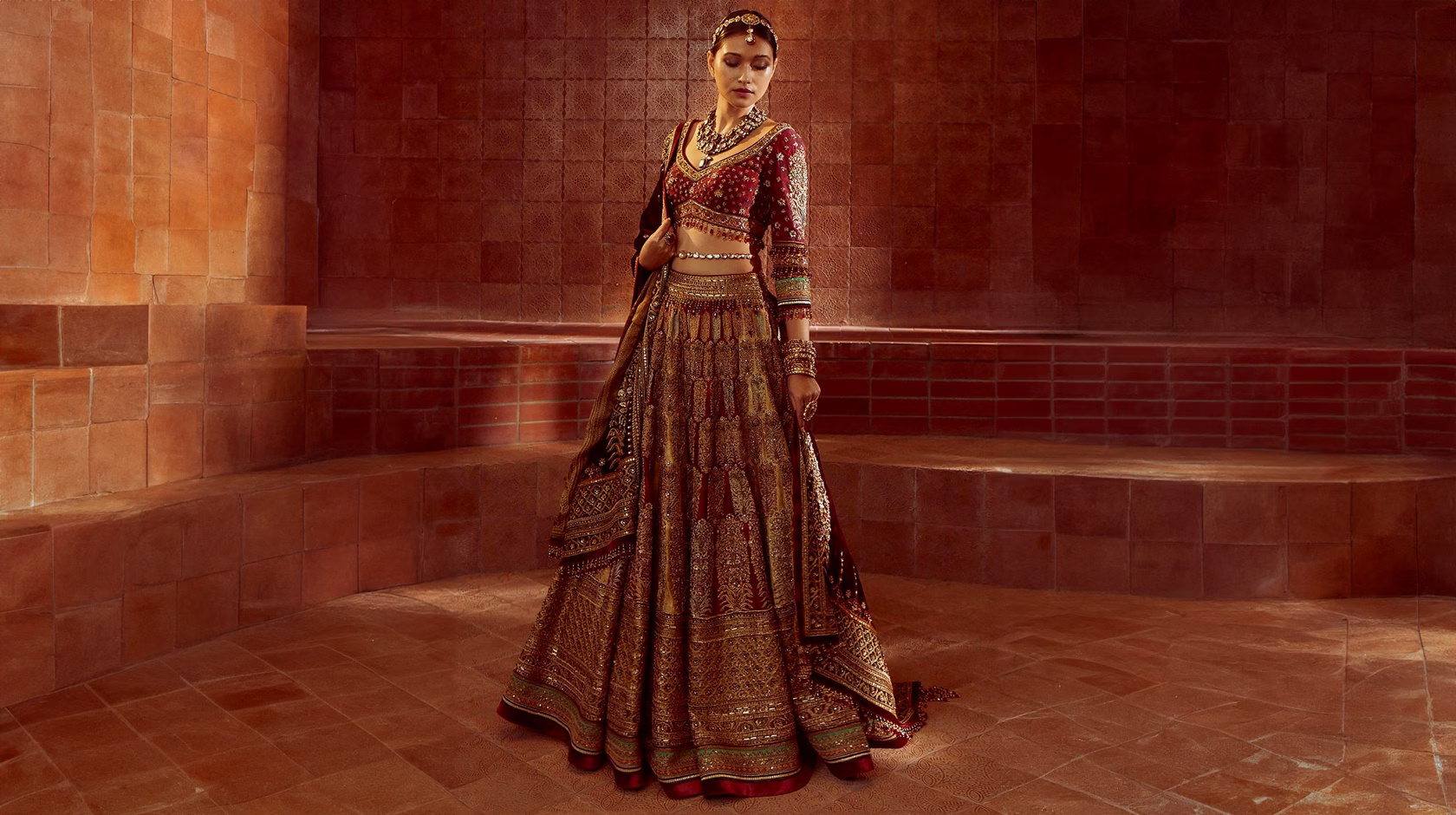
This article is part 4 of our series on the evolution of Indian design, exploring how creativity and tradition shape the country’s everyday objects and global influence.
NEW DELHI, India — Inside a sunlit atelier in Hauz Khas Village, Sabyasachi Mukherjee adjusts the drape of a crimson lehenga, its gold embroidery catching the light like a whispered secret. It’s a wedding piece, destined for a bride in Manhattan, but its roots stretch back centuries—to Mughal courts, Rajput looms, and village dye pots.
This is Indian fashion today: a tapestry of the old and the new, spun by designers who’ve turned saris and sherwanis into global currency. From Delhi’s dusty markets to Paris runways, India’s couturiers are dressing the world, one thread at a time.
Fashion here isn’t young. The dhoti, a 15-foot cloth knotted with quiet elegance, dates to the 5th century BCE, its pleats a geometry of grace. Indus Valley figurines from 2500 BCE wore draped robes—proof India’s style predates Rome. Fast forward to the 1800s: British mills flooded the subcontinent with cotton, but handwoven khadi fought back, a fabric of defiance under Gandhi’s call. By independence in 1947, India had a wardrobe—saris, kurtas, turbans—ripe for reinvention. Enter the designers.
The modern era kicked off with pioneers like Ritu Kumar. In 1969, she opened a tiny shop in Kolkata, reviving block prints and zardozi embroidery when synthetics threatened to bury them. Her clients? India’s elite, craving heritage with a twist.
A trivia nugget: Kumar’s first big break was dressing actress Meena Kumari for Pakeezah (1972), her ivory anarkalis stealing scenes. Today, at 80, she’s the grande dame of Indian fashion, her label raking in $10 million yearly, with stores from Mumbai to New York.
Then there’s Sabyasachi, the rockstar. Born in Kolkata, he launched his label in 1999 with $250 and a sewing machine. By 2017, he was selling a lehenga for $100,000—velvet, silk, and 80 artisans’ hands. His trick? Marrying nostalgia—think Bengal’s handlooms—with excess, like crystal-studded belts.
A little-known feat: in 2021, he partnered with H&M, selling out a 70-piece collection in hours, proving Indian chic could go mass. His Instagram, with 5 million followers, is a mood board of moody palettes and vintage vibes—reds, golds, ivories—that scream India without shouting.

Manish Malhotra, meanwhile, owns Bollywood. He started as a costume designer in 1990, stitching A-list dreams—think Karisma Kapoor’s blue lehenga in Dil To Pagal Hai (1997), a frothy hit. By 1998, he’d launched his label, dressing stars like Deepika Padukone and Alia Bhatt in mirror-work sarees and sequined gowns.
Fun fact: his 2015 show with 100 models took two years to plan, a logistical marathon ending in a standing ovation. Today, his Mumbai flagship buzzes with brides and billionaires, his net worth nudging $20 million.
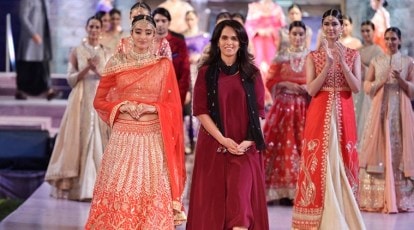
The numbers stack up. India’s fashion industry, worth $70 billion in 2023 per McKinsey, employs 45 million—second only to agriculture. Weddings alone—12 million a year—drive $50 billion in spending, much of it on couture. Designers like Anita Dongre tap this goldmine. Her label, launched in 1995, blends sustainability with style—organic cottons, handwoven silks. Her Pink City line, sold at Anthropologie, rakes in $100 million annually.
A quirky detail: Dongre’s first design was a kurta for her sister, sewn on a borrowed Singer at 18.
Heritage fuels it all. Take the sari—six yards of possibility. Tarun Tahiliani, a Parsons grad, reimagines it with pre-stitched drapes for the jet set, his 2023 Paris Haute Couture debut a swirl of capes and corsets. Or Rohit Bal, the “master of opulence,” whose 1990s anarkalis—lotus motifs, velvet hems—revived Kashmiri embroidery.

A hidden gem: Bal once dyed a collection with tea leaves, chasing an earthy beige no factory could match. His shows, often in crumbling havelis, feel like theater, not commerce.
Craftsmanship is the backbone. India’s 7 million artisans—weavers, dyers, embroiderers—stitch the magic. In Varanasi, a Banarasi sari takes 15 days, its gold zari threads handwoven on looms older than the workers. Kutch’s mirror work, born from nomadic tribes, dots Dongre’s jackets.
Lesser known: Phulkari, Punjab’s floral embroidery, uses a single thread strand, unbroken, for luck—a technique Malhotra’s bridal line swears by.
The government’s 2022 Handloom Census pegs these crafts at $5 billion yearly, a lifeline for rural women.
Global eyes notice. In 2018, Priyanka Chopra wore a Sabyasachi lehenga to her wedding, its 110 embroiderers clocking 3,720 hours—news that crashed his site. Vogue dubbed him “India’s Dior.” Malhotra’s gowns graced Met Gala red carpets, while Tahiliani’s fusion wear hit Milan.
A stat: Indian designers exported $12 billion in apparel in 2023, up 20% from 2019, per the Apparel Export Promotion Council. Even Gucci tapped India, collaborating with Mumbai’s Chamar Studio in 2022 for leather-free bags—a nod to vegan roots.
It’s not all silk and sequins. Fast fashion—Zara, H&M—floods malls, undercutting artisans. A 2021 study found 60% of Gen Z prefers $10 tees to $100 kurtas. And counterfeits plague—knockoff Sabyasachis sell for $50 in Delhi’s Sarojini Nagar. Yet designers fight back. Dongre’s Grassroot initiative trains 10,000 rural women, while Tahiliani’s Tashkent Foundation revives dying weaves.
A sweet snippet: Ritu Kumar’s son, Amrish, once swapped a design sketch for a mango in a village barter—now he runs her empire.
The classroom feeds the future. NID’s textile program, started in 1961, birthed talents like Rahul Mishra, whose 2014 Woolmark Prize win stunned Paris with handwoven lattices. Pearl Academy and NIFT, with 17 campuses, churn out 5,000 grads yearly—think Shantanu & Nikhil, whose military-inspired jackets sell for $1,000. A trivia bit: NIFT’s first show in 1986 used bedsheets for lack of fabric, a scrappy start to a $50 million network.
In Mumbai’s Chor Bazaar, vintage saris fetch $30, their paisleys faded but fierce. Across town, a Dongre store hums with millennials trying bandhgalas—jackets with Nehru collars, a 1940s relic reborn. India’s fashion isn’t static—it bends, blends, blooms. From Kumar’s quiet revival to Sabyasachi’s loud luxury, these designers don’t just dress bodies; they dress a nation’s soul, proving threads can tell stories louder than words.