News Desk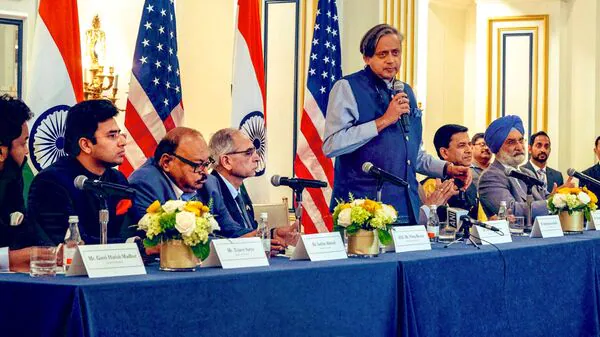
WASHINGTON — The United States has reiterated its solidarity with India in its battle against terrorism, following a high-level meeting between an Indian parliamentary delegation and U.S. Deputy Secretary of State Christopher Landau. The talks, part of a broader Indian diplomatic push after the April 22, Pahalgam terror attack that killed 26 people, underscored the deepening strategic partnership between the two nations.
The delegation, led by Congress MP Shashi Tharoor, wrapped up a three-day visit to Washington on June 7, the final leg of a multi-nation tour that included Guyana, Panama, Colombia, and Brazil. The group, which included MPs from diverse political parties—Sarfaraz Ahmad (Jharkhand Mukti Morcha), Ganti Harish Madhur Balayogi (Telugu Desam Party), Shashank Mani Tripathi (Bharatiya Janata Party), Bhubaneswar Kalita (BJP), Milind Deora (Shiv Sena), and Tejasvi Surya (BJP)—along with former Indian Ambassador to the U.S. Taranjit Sandhu, aimed to highlight India’s resolve to combat Pakistan-linked terrorism following Operation Sindoor, a retaliatory strike targeting terror infrastructure in Pakistan and Pakistan-occupied Kashmir.
In a statement, the U.S. State Department affirmed its stance. “The Deputy Secretary of State reaffirmed the United States’ strong support of India in the fight against terrorism and the strategic partnership between the two countries,” said spokesperson Tammy Bruce. Landau emphasized the broader U.S.-India relationship, noting, “We discussed the U.S.-India strategic relationship, including expanding trade and commercial ties to foster growth and prosperity for both countries.”
The Indian Embassy in Washington confirmed that the delegation briefed Landau on the Pahalgam attack’s atrocities and India’s precise response through Operation Sindoor, launched on May 7. The embassy’s statement highlighted India’s “firm resolve to counter cross-border terrorism in all its forms,” a message echoed in meetings with Vice President J.D. Vance, leaders of the House Foreign Affairs Committee, the India Caucus, and the Senate Foreign Relations Committee, as well as think tanks, media, and the Indian-American community.
Tharoor described the meeting with Vance as “excellent,” telling PTI that the vice president expressed “complete understanding, first of all, outrage of what happened in Pahalgam and support and respect for India’s restrained response in Operation Sindoor.” The delegation’s engagements also included a productive meeting with Senator Chris Van Hollen, who expressed sympathy for the victims and backed India’s right to defend itself, and a phone call with Senator Cory Booker, who condemned the attack and reiterated U.S. support.
Amid the diplomatic discussions, the delegation paid homage to Mahatma Gandhi at his statue opposite the Indian Embassy in Washington. Tharoor, reflecting on the visit, posted on X: “It is striking how many world capitals are adorned with statues or busts of the Mahatma, the 20th century’s greatest apostle of peace, nonviolence, and human freedom.” In a Hindi post, he added, “On behalf of all the members, I express my gratitude to the motherland and the lovers of India in the country and abroad who listened with open ears and accepted with open heart that we are lovers of non-violence but only until someone… Jai Hind.”
India’s outreach comes against the backdrop of heightened tensions with Pakistan, which New Delhi accuses of harboring terrorists responsible for the Pahalgam attack. The delegation’s visit to 33 global capitals, including Washington, was part of a concerted effort to counter Pakistan’s narrative, particularly as Islamabad holds influential roles in the U.N. Security Council’s counter-terrorism committees.
Still, the U.S. leg of the tour marked a significant moment in India-U.S. relations, reinforcing a shared commitment to counterterrorism and economic cooperation. As Tharoor noted after meeting Senate Foreign Relations Committee members, the discussions strengthened the “India-U.S. strategic partnership, regional security, and global cooperation.” For India, the visit was both a diplomatic offensive and a testament to its unified stance against terrorism, projected through a diverse delegation representing the nation’s pluralistic ethos.