News Desk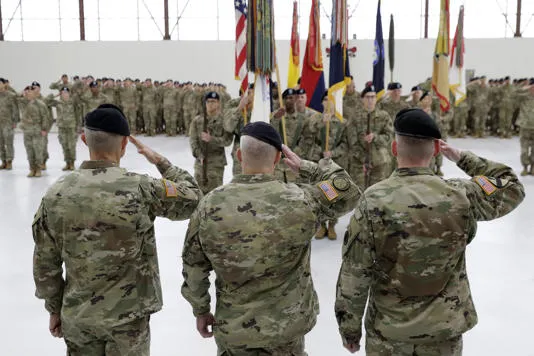
SEATTLE — In a stunning breach of national security, three American soldiers—two still serving on active duty—were arrested on March 6, 2025, accused of selling classified military secrets to China, a nation whose aggressive espionage tactics have long alarmed U.S. officials. Sgt. Jian Zhao and 1st Lt. Li Tian, both stationed at Joint Base Lewis-McChord in Washington State, along with Ruoyu Duan, a former soldier now residing in Oregon, face a litany of federal charges for feeding Beijing sensitive data on U.S. weapons systems and military exercises in exchange for cash. The arrests, detailed in court documents unsealed this week, lay bare the lengths to which China will go to undermine American defenses.
According to the indictments, Zhao, a battery supply sergeant with access to over $55 million in military property, allegedly pocketed at least $15,000 from July to December 2024 while trafficking secrets to a contact in Changchun, China. Among his haul: 20 government hard drives—some conspicuously labeled “secret”—stuffed with details on missile-launcher technology and U.S. operations in the Indo-Pacific, mailed directly to his Chinese handler. Meanwhile, Tian, a first lieutenant with secret-level clearance, teamed up with Duan to peddle technical manuals and intelligence reports on American armored vehicles like the Bradley and Stryker. Prosecutors say Duan, who left the Army in 2017, acted as a middleman, raking in tens of thousands of dollars via PayPal from unnamed Chinese buyers and doling out payments to Tian and others with security clearances.
The F.B.I., sounding the alarm, has pinned this scheme on Beijing’s sprawling intelligence apparatus, which it says thrives on exploiting American service members with offers of quick cash. “China’s Communist Party has turned bribery and corruption into an art form,” F.B.I. Director Kash Patel said in a statement, vowing to root out such betrayals. The Justice Department echoed that sentiment, with Attorney General Pamela J. Bondi declaring the trio’s actions a “betrayal of our country” that “empowers our adversaries in China.” She promised “swift, severe, and comprehensive justice” for those caught in Beijing’s web.
This isn’t the first time China’s shadow has fallen over U.S. military ranks. In 2023, two Navy sailors—Jinchao Wei and Wenheng Zhao, both with Chinese-sounding names—were charged in separate cases for handing over photographs, technical manuals, and classified plans of U.S. naval operations to Chinese intelligence agents. Like the current trio, their motives appeared rooted in financial gain rather than any proven allegiance to China as a homeland, though their heritage fueled speculation. Another case that year saw Joseph D. Schmidt, a retired soldier from the same Washington base, charged with offering surveillance secrets to Chinese authorities after decamping to Hong Kong. These recurring incidents paint a grim picture: Beijing’s playbook—lavishing money on insiders with access—works with alarming consistency.
The latest indictments hint at a broader conspiracy. Zhao’s Chinese contact allegedly offered to broker his stolen goods to additional buyers, while Duan is accused of cultivating a network of clearance-holding soldiers willing to sell out. Security footage from Joint Base Lewis-McChord shows Tian snapping photos of his computer screen, capturing sensitive data to fulfill specific requests from Duan’s buyers. Zhao, meanwhile, boasted in intercepted messages about fetching $3,000 to $4,000 for missile-related files tied to the HIMARS system—a weapon pivotal in conflicts like Ukraine’s—and even offered an encrypted military computer for $1,800. Such audacity, prosecutors say, reflects China’s confidence in its ability to corrupt from within.
Critics argue these cases expose gaping vulnerabilities in America’s military, where soldiers entrusted with national defense secrets can be swayed by relatively modest sums. The Army’s Counterintelligence Command, led by Brig. Gen. Rhett R. Cox, called it a “persistent and increasing foreign intelligence threat,” fueled by a thriving private market for U.S. secrets in China—a market tacitly encouraged by the state. This week’s arrests come on the heels of unrelated charges against 12 Chinese hackers-for-hire, accused of breaching U.S. agencies for Beijing’s police and intelligence services, further highlighting China’s multifaceted assault on American security.
At Joint Base Lewis-McChord, Col. Jennifer J. Bocanegra, a public affairs officer, pledged full cooperation with the investigation, though questions linger about how such breaches went undetected. The soldiers’ backgrounds—particularly whether Zhao, Tian, and Duan, with their Chinese-sounding names, have ties to the mainland—remain murky, as court documents sidestep their origins. Regardless, their actions have handed Beijing a dangerous edge, amplifying calls for tighter vetting and oversight. For now, the U.S. military braces for the fallout as China’s shadow looms larger than ever.