
 News Desk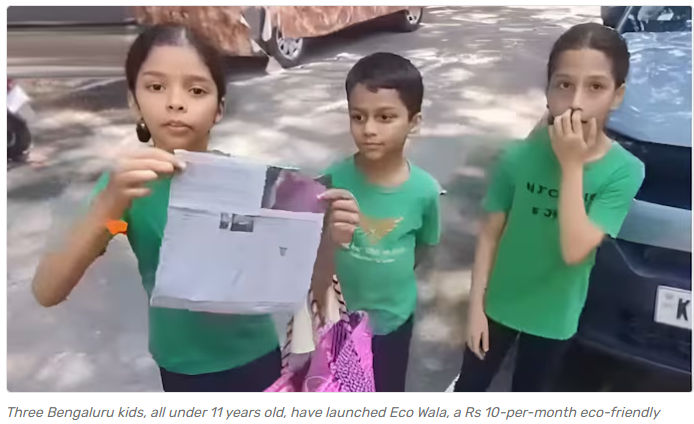
What began as a classroom project has quickly grown into a story of youthful ingenuity. The children, students at a Bengaluru primary school, devised a way to fold and fasten paper bags without adhesive, relying instead on interlocking folds. Their method not only reduces production costs but also eliminates the use of synthetic glues, which are often derived from chemicals harmful to the environment.
A short video of the children demonstrating their technique spread rapidly on social media this week, drawing praise from educators, environmentalists, and business leaders. Within days, the group had formalized their idea into a small startup, producing bags for local shops and community events.
India has struggled with plastic waste despite repeated bans and restrictions. Paper bags are often touted as an alternative, but their production can be resource-intensive, especially when adhesives are involved. By removing glue from the equation, the children’s design offers a more sustainable option.
Parents and teachers say the project has also become a lesson in entrepreneurship. The children have begun tracking costs, revenues, and orders, learning the basics of business while promoting an eco-friendly product. “They’re not just making bags,” one teacher said. “They’re learning how to solve problems that adults have failed to fix.”
The video has sparked conversations about the role of schools in fostering innovation. Several local businesses have already placed orders, and environmental groups are urging policymakers to support such grassroots initiatives. Some commentators have even suggested that the children’s design could be scaled up for industrial use.
For now, the startup remains modest in scope, run out of classrooms and community centers. But its symbolic weight is outsized: in a country where debates over sustainability often stall in bureaucracy, a group of children have shown that solutions can be both simple and effective.
As one parent put it, “They remind us that change doesn’t always come from boardrooms or parliaments. Sometimes it comes from a child folding a piece of paper differently.”


