 News Desk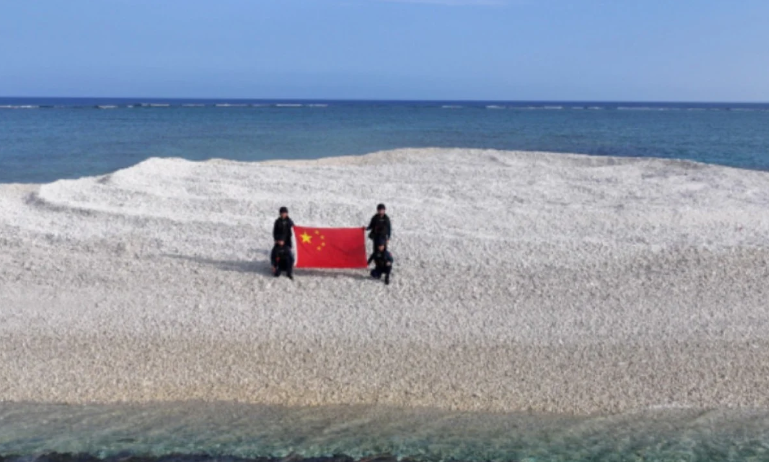
In a provocative act that has heightened tensions in one of Asia’s most volatile flashpoints, the China Coast Guard (CCG) landed on a disputed reef in the South China Sea earlier this month, planting a Chinese flag on an uninhabited sandbank known as Sandy Cay. The reef, which the Philippines calls Pagasa Cay 2 and China refers to as Tiexian Jiao, lies just two nautical miles from Thitu Island, a Philippine-administered outpost in the Spratly Islands. According to China’s state-run Global Times, CCG officers conducted inspections, collected evidence of alleged “illegal activities” by the Philippines, and even cleared debris like plastic bottles to assert Beijing’s “sovereign jurisdiction” over the contested territory.
This brazen move is the latest in a series of aggressive actions by China to enforce its sweeping claims over nearly 90 percent of the South China Sea, a vital waterway through which $3 trillion in annual trade flows. Beijing’s so-called “ten-dash line,” a vague demarcation rejected by a 2016 international tribunal, overlaps with the exclusive economic zones (EEZs) of the Philippines, Vietnam, Malaysia, Brunei, and Taiwan. Yet China continues to dismiss the ruling as “null and void,” deploying its coast guard, navy, and maritime militia to intimidate smaller nations and assert dominance over disputed reefs, shoals, and waters.
For the Philippines, a U.S. treaty ally, the landing on Sandy Cay is a direct challenge to its sovereignty. The reef’s proximity to Thitu Island, Manila’s largest outpost in the Spratlys, makes it strategically significant. In 2017, China accused the Philippines of plotting to occupy Sandy Cay, prompting Beijing to surround the sandbars with navy and coast guard vessels. A tense standoff was defused only after both sides agreed not to set foot on the cays, an understanding China now appears to have violated. Acting Chief Justice Antonio Carpio, a prominent Filipino legal expert, warned in 2018 that allowing China to claim Sandy Cay could legitimize its control over nearby Subi Reef and cost the Philippines a third of its territorial sea around Thitu. “We should be very careful in allowing anything that China would interpret as acquiescence,” he said.
China’s actions at Sandy Cay are part of a broader pattern of maritime coercion. In January 2025, Chinese coast guard ships and a navy helicopter harassed Philippine fisheries vessels conducting a scientific survey near Sandy Cay, forcing them to suspend operations. Videos released by the Philippine Coast Guard showed Chinese vessels sailing dangerously close to Filipino ships, with a military helicopter hovering menacingly overhead. Last August, a Chinese coast guard ship rammed the Philippine Coast Guard’s BRP Teresa Magbanua near Sabina Shoal, another disputed feature, causing damage but no casualties. These incidents, coupled with China’s use of water cannons, military-grade lasers, and floating barriers to block Filipino fishermen, underscore Beijing’s willingness to escalate confrontations to enforce its claims.
For foreign observers, China’s conduct in the South China Sea is a stark reminder of its growing assertiveness and disregard for international law. The 2016 ruling by the Permanent Court of Arbitration at The Hague, which invalidated China’s historical claims, was a landmark victory for the Philippines, yet Beijing has refused to acknowledge it. Instead, it has fortified artificial islands with military installations, airstrips, and ports, transforming reefs like Mischief and Subi into de facto bases to project power across the region. This militarization, coupled with China’s “gray zone” tactics—aggressive but just short of open conflict—has raised fears of a miscalculation that could spark a wider confrontation, potentially drawing in the United States, which has pledged to defend the Philippines under their mutual defense treaty.
The landing on Sandy Cay also sends a chilling message to other Southeast Asian nations. Vietnam, Malaysia, and Brunei, all of which have overlapping claims, have faced similar Chinese pressure, from fishing bans to coast guard harassment.
In April 2025, a Chinese research vessel was spotted operating without permission near the Philippines’ northern waters, prompting Manila to deploy a coast guard plane to challenge it. Such incidents highlight China’s strategy of using its maritime might to intimidate smaller neighbors into submission, a tactic critics say undermines the rules-based international order.
As Beijing tightens its grip on the South China Sea, the international community faces a dilemma. The United States has condemned China’s actions, with Ambassador MaryKay Carlson calling the use of water cannons and dangerous maneuvers “unlawful” and a threat to a “free and open Indo-Pacific.” Yet diplomatic protests and freedom-of-navigation operations by the U.S. Navy have done little to deter China’s advances. For the Philippines, the stakes are existential: losing control of features like Sandy Cay could erode its maritime rights and embolden further Chinese encroachment.
For now, Manila remains defiant. Commodore Jay Tarriela, a Philippine Coast Guard spokesperson, vowed that the country would continue to challenge Chinese patrols and protect its fishermen. But as China’s flag flies over Sandy Cay, the incident serves as a grim warning: Beijing’s quest for dominance in the South China Sea is far from over, and its neighbors—and the world—must brace for more provocations.