News Desk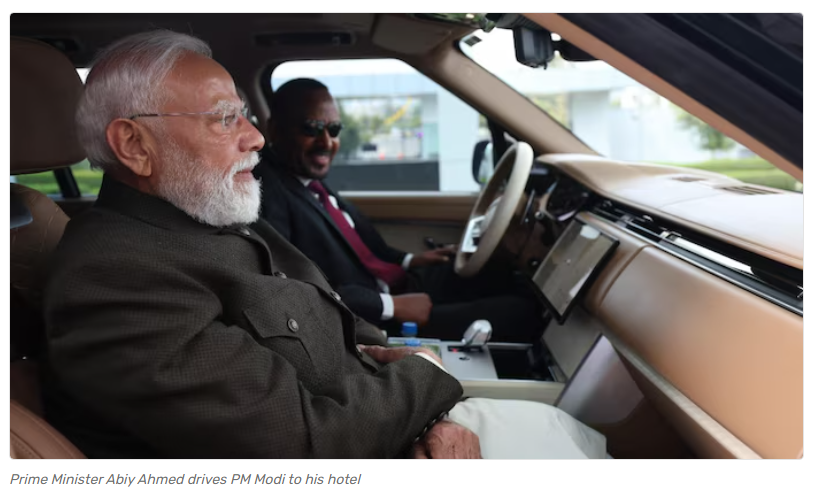
ADDIS ABABA, Ethiopia — In an era of summit fatigue, when leaders shuttle from one conference hall to another, Prime Minister Narendra Modi has found a subtler stage for diplomacy: the passenger seat. His car rides with fellow heads of state remind us that diplomacy is not only written in treaties—it is also spoken in the language of shared journeys.
On Tuesday, Ethiopia’s Nobel Peace Prize–winning Prime Minister Abiy Ahmed greeted Modi at Addis Ababa airport not just with the ceremonial red carpet and military band, but with the keys to his own car. In a gesture heavy with symbolism, Ahmed personally drove Modi to his hotel, making unscheduled stops at the Science Museum and Friendship Park.
It was not the first time Modi has been chauffeured by a counterpart. In recent months, Jordan’s Crown Prince Al Hussein bin Abdullah II drove him to the Jordan Museum, while Russian President Vladimir Putin offered a similar ride during their meeting in China. These moments, seemingly casual, are in fact carefully choreographed acts of what observers are calling “car diplomacy.”
Car diplomacy is not about the vehicle itself—it is about intimacy, trust, and the optics of equality. In a world where summits are often staged in cavernous halls and scripted press conferences, the image of two leaders sharing a car ride conveys a different message: personal rapport, unfiltered conversation, and a willingness to step outside protocol.
For Modi, whose foreign policy has increasingly emphasized India’s role as a bridge between the Global South and major powers, these rides are a way of signalling closeness without words. “Celebrating age-old India-Ethiopia ties,” India’s foreign ministry spokesperson posted after the Addis Ababa ride, underscoring Ethiopia’s new role as a fellow BRICS member and strategic partner.
- Russia, 2024–25: Prime Minister Modi’s shared car rides with Vladimir Putin — first in Tianjin during the September 2025 SCO Summit, and later in Delhi during Putin’s December 2025 state visit — were interpreted as powerful optics of India’s balancing act between Moscow and Washington, signalling that New Delhi would not abandon its historic ties with Russia despite Western pressure.
- China, 2025: In Tianjin, during his first China visit in over seven years, Modi was chauffeured in the Hongqi L5, the flagship limousine favoured by Xi Jinping. Chinese officials highlighted this as a gesture of respect, with analysts noting it symbolized “mutual respect” and a possible thaw in India–China relations.
- Jordan, December 2025: Crown Prince Al Hussein personally drove Modi to the Jordan Museum in Amman, a gesture blending youthful charm with dynastic gravitas. The visit produced wide-ranging agreements in renewable energy, water management, digital technology, and culture, marking a significant expansion of India–Jordan ties.
Each ride has been amplified on social media, often by Modi himself, who understands the power of imagery in an age of instant global circulation.
Diplomacy today is as much about optics as substance. Modi’s car diplomacy comes at a time when India is positioning itself as a leader of the Global South, fresh from its G20 presidency that admitted the African Union as a permanent member. Ethiopia, as the headquarters of the African Union, is a natural stage for such symbolism.
The rides also serve domestic politics. For Modi’s supporters, they reinforce the image of a leader respected abroad, courted by kings and presidents. For critics, they raise questions about whether such gestures substitute for substantive policy shifts.
Yet the strategy is clear: in a fractured world, where alliances are fluid and trust is scarce, Modi is betting that the intimacy of a car ride can do what communiqués cannot—signal friendship, build rapport, and project India as a nation that leaders want to sit beside, not just negotiate with.
Car diplomacy has become a defining hallmark of Modi’s statecraft. While leaders in the past have occasionally turned to informal gestures, Modi has transformed the simple act of sharing a car ride into a recurring symbol of trust and influence — weaving it into a broader narrative of India’s rise.
As he continues his three-nation tour—Oman, Jordan, and Ethiopia—the question is not whether Modi will be driven again, but by whom. In the theatre of global politics, the passenger seat has become one of the most coveted symbols of trust.