 News Desk
ISLAMABAD — In a sharp reminder that geopolitics rarely come without economic consequences, Pakistan’s closure of its airspace to Indian flights is costing the country an estimated $300,000 a day, spotlighting the financial strain of a diplomatic maneuver with limited leverage.
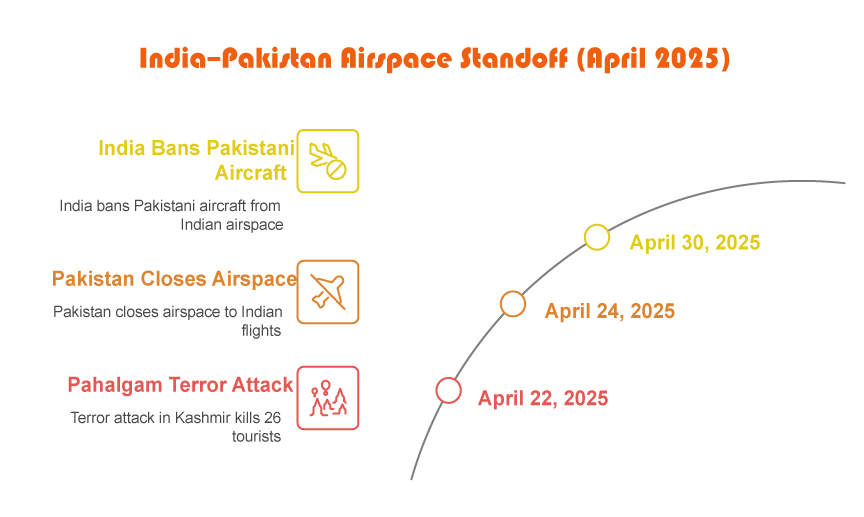
The move, enacted on April 24 in response to the deadly terror attack in Pahalgam, in Kashmir, India, has forced over 70 daily Indian flights—many bound for Europe, North America, and the Middle East—to reroute. Carriers like Air India and IndiGo are absorbing the blow through longer flight paths, rising fuel costs, and scheduling disruptions.
India, in a tit-for-tat response, issued its own Notice to Airmen (NOTAM) on April 30, barring Pakistani aircraft from its skies through May 23. But the impact on India is mostly symbolic. With just a handful of Pakistani commercial flights reliant on Indian airspace and a resilient aviation industry that boasts 9,000 international departures a month, New Delhi’s retaliation has proven economically negligible—while amplifying Islamabad’s financial exposure.
According to estimates from India’s Defence Research Wing, Pakistan’s overflight fee losses alone could exceed $9 million if the closure continues through its scheduled end on May 25. These fees—collected from foreign airlines using Pakistani airspace—have long served as a modest but consistent revenue stream, especially valuable for a cash-strapped economy battling inflation, a depreciating currency, and waning foreign reserves.
Historical context underscores the cost. During the 2019 airspace shutdown after India’s Balakot airstrikes, Pakistan forfeited roughly $232,000 daily in overflight revenue. Pakistan International Airlines, the national carrier, bled an additional $460,000 per day rerouting its few international routes.
This time, the situation is arguably more dire. The April 22 attack in Kashmir that killed 25 tourists and a local man, triggered a swift reaction from India, but the brunt of the economic fallout is being shouldered by Pakistan. Indian carriers are expected to incur $10–15 million in losses over the month, a hit they are better positioned to absorb. Pakistan, by contrast, risks deeper economic isolation at a time when it can least afford it.
“Aviation has always been one of the few sectors where Pakistan could extract revenue without significant investment,” said a senior airline executive based in Delhi. “When you cut off airspace to India, you’re not hurting Delhi—you’re bleeding yourself.”
While Pakistani authorities have defended the closure as a necessary national security measure, critics say it underscores a familiar pattern of reactive policy overshadowing economic pragmatism. Diplomats and analysts alike warn that such moves, while politically resonant, may further erode investor confidence in a country teetering on the edge of economic uncertainty.
With neither side showing signs of backing down, the standoff has become yet another chapter in the region’s uneasy history—where strategic calculus often collides with fiscal reality. As the skies remain tense, it’s Pakistan’s aviation sector—and by extension, its fragile economy—that appears to be paying the higher price.