News Desk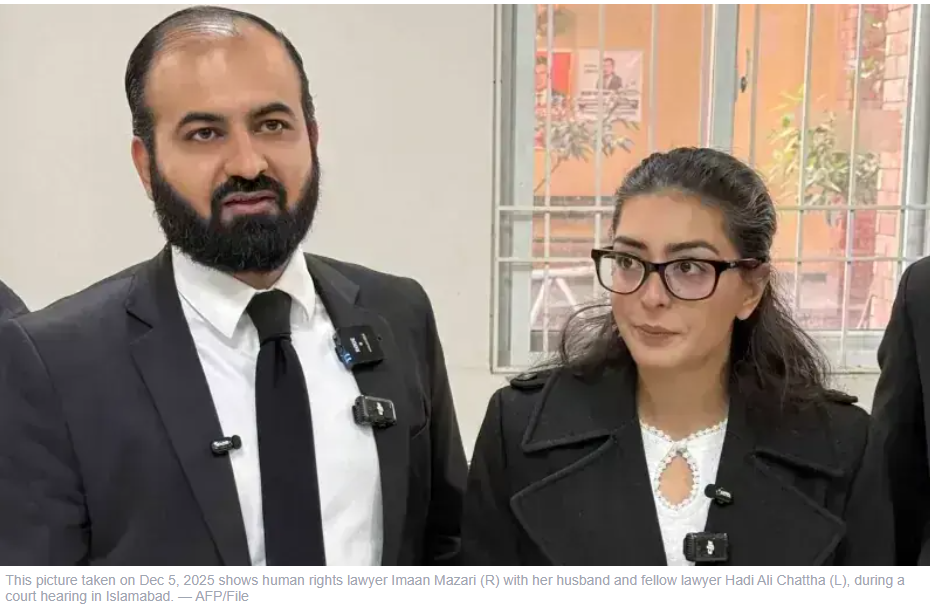
In Pakistan, posting on social media and criticising the state can land citizens in prison — and the case of Imaan Zainab Mazari‑Hazir and Hadi Ali Chattha has become a stark example of how dissent is criminalised.
The couple has now approached the Supreme Court, seeking an immediate hearing of their appeals against a conviction widely viewed by rights groups as part of Pakistan’s deepening crackdown on online speech.
They were sentenced in January to 17 years in prison under the Prevention of Electronic Crimes Act (PECA), a law repeatedly used to target activists, journalists and critics. Their appeals were admitted by the Islamabad High Court in February, but the court did not suspend the sentence, leaving both incarcerated for nearly 100 days with no hearing date in sight.
Filed through senior counsel Faisal Siddiqi, the petition urges the Supreme Court to fix the case for early May, arguing that prolonged imprisonment without a hearing reflects systemic failure. The plea notes that the IHC has issued notices but taken no further action, effectively leaving the couple without remedy.
The case stems from an August 2025 complaint by the National Cyber Crime Investigation Agency, accusing Imaan of posting content allegedly echoing narratives of proscribed groups and implicating Hadi for reposting her statements. The FIR claimed they had criticised security forces over enforced disappearances in KP and Balochistan — an issue Pakistan routinely suppresses.
The petition calls the trial a “sham” and asks the Supreme Court to suspend the sentence until the IHC hears the main appeal. Rights advocates say the case exposes how Pakistan’s cybercrime law has become a tool to silence critics, with courts slow to intervene.
In a country where online criticism is treated as a threat to the state, the couple’s plea underscores a deeper reality: Pakistan punishes dissent far more swiftly than it protects fundamental freedoms.