News Desk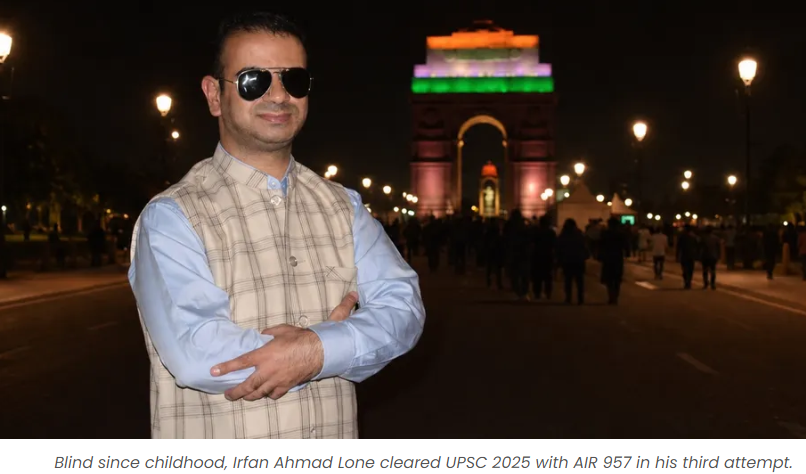
In Naidkhai, a small village in north Kashmir, the front room of a modest home has not been still for days. Neighbours walk in unannounced. Relatives arrive from nearby towns. Children gather at the doorway, whispering before they slip inside. There is no wedding, no festival, no public celebration. The visitors come for one reason: to see 30‑year‑old Irfan Ahmad Lone, the son of a casual labourer who has done something no one from Bandipora district has ever done.
He has cleared India’s Civil Services Examination, securing an All‑India Rank of 957 — without ever seeing the question paper.
His story begins decades earlier, in accidents so ordinary they could have happened to any child. Irfan was four when a syringe slipped during play and pierced his eye. A few years later, a pencil took the other. His father, Bashir Ahmad Lone, sold whatever the family owned — land, household items, anything that could be turned into hospital fees. There were 18 surgeries, including one at AIIMS in Delhi. For a brief period, Irfan regained a sliver of sight. Then it faded again.
By 2002, the family suffered another blow: Irfan’s mother died. The house fell quiet. Money was gone. Hope, too.
With nothing left to sell, Bashir made a decision that would alter the course of his son’s life. He sent Irfan to a school for visually impaired children in Dehradun — hundreds of kilometres away, far beyond what the family could afford. Irfan remembers the fear of leaving home, but also the slow return of confidence. In Dehradun, he learned Braille, screen‑reading software, and the rhythms of a world built for those who navigate without sight. “That school was the turning point,” he says.
From there, the path widened. Irfan made his way to Hindu College in Delhi, studying Political Science. Later, he completed a master’s degree in International Relations at Jawaharlal Nehru University. He studied through audio notes and screen readers, often late into the night, while classmates scribbled in notebooks he could not see.
But the family’s finances were never far from his mind. He cleared a banking exam on the first attempt, joined Punjab National Bank, then passed the LIC officers’ exam, becoming an Assistant Administrative Officer. For most families in Naidkhai, that would have been the end of the story — a son with two government jobs, a father’s sacrifices redeemed.
/filters:format(webp)/english-betterindia/media/media_files/2026/04/30/dehradun-2026-04-30-18-54-51.webp)
Bashir thought otherwise.
“My father told me to prepare for UPSC. No one from our district had ever qualified,” Irfan says. So he studied after office hours, listening to NCERTs and current affairs through a screen reader. The first attempt failed. The second too. He kept going. On his third attempt, he made it.
His service allocation is still unknown, but in Naidkhai, that detail feels secondary. Children now lead visitors to his door. Elders recount his journey at tea stalls. A district that had never appeared on the UPSC map now has a name to point to.
Irfan hopes his story travels further than his rank. “If I, despite being visually impaired, can crack this exam, others can do it too,” he says. “Education is a right for everyone. Disability should not become a barrier.”
Somewhere in the house, Bashir watches the visitors come and go. Years ago, he sold his land to save his son’s eyes. He could not give Irfan his sight back. He gave him something else — a belief that the future could still be larger than the village lanes he once ran through.
It was enough to carry him all the way to the UPSC list.