 News Desk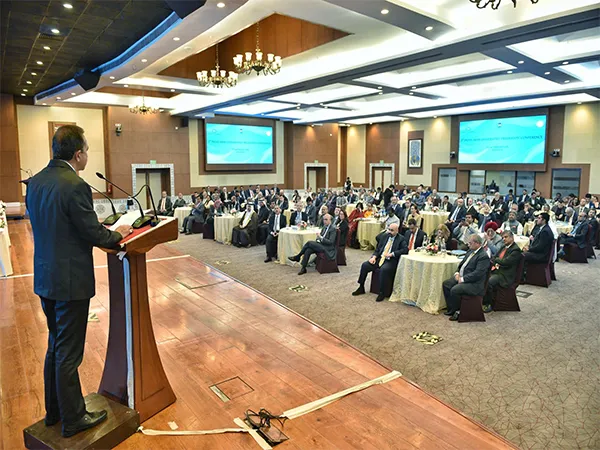
NEW DELHI, Feb. 6 — India and the Arab world took a decisive step toward deepening academic cooperation as university leaders from both regions gathered for the first-ever India-Arab Universities’ Presidents’ Conference, held in New Delhi from February 5-6.
The conference, hosted at Sushma Swaraj Bhawan, was organized under the education framework of the Executive Program for implementing the Memorandum of Cooperation between India and the League of Arab States (LAS). India’s Ministry of External Affairs (MEA) and University Grants Commission (UGC), in collaboration with the LAS, spearheaded the initiative.
Kirti Vardhan Singh, India’s Minister of State for External Affairs, inaugurated the conference, emphasizing India’s growing role as an education hub and the need for greater collaboration in knowledge-sharing, research, and innovation. From the Arab world, Libya’s Minister of Education, Imran Muhamed Al-Qeeb, delivered a special address, highlighting the importance of academic linkages in strengthening Indo-Arab ties.
Senior officials and education leaders, including UGC Chairman Mamidala Jagadesh Kumar, Association of Arab Universities Secretary-General Amr Ezzat Salama, and LAS Director of Education and Scientific Research Farraj Aljmi, also addressed the gathering.
The two-day conference featured discussions on some of the most pressing issues in higher education and skill development, with sessions dedicated to:
- Enhancing Higher Education and Skill Development to drive prosperity in both regions.
- Innovative Academic Collaboration, including digital education platforms.
- Mutual Recognition of Degrees, a key step toward greater student mobility.
- Scientific Research and Innovation, focusing on cutting-edge fields like Artificial Intelligence (AI), Quantum Computing, and Biotechnology.
Another major highlight was a breakout session between universities, facilitating direct engagement and collaboration. A session on faculty and student exchange programs and curriculum development further underscored efforts to foster deeper institutional ties.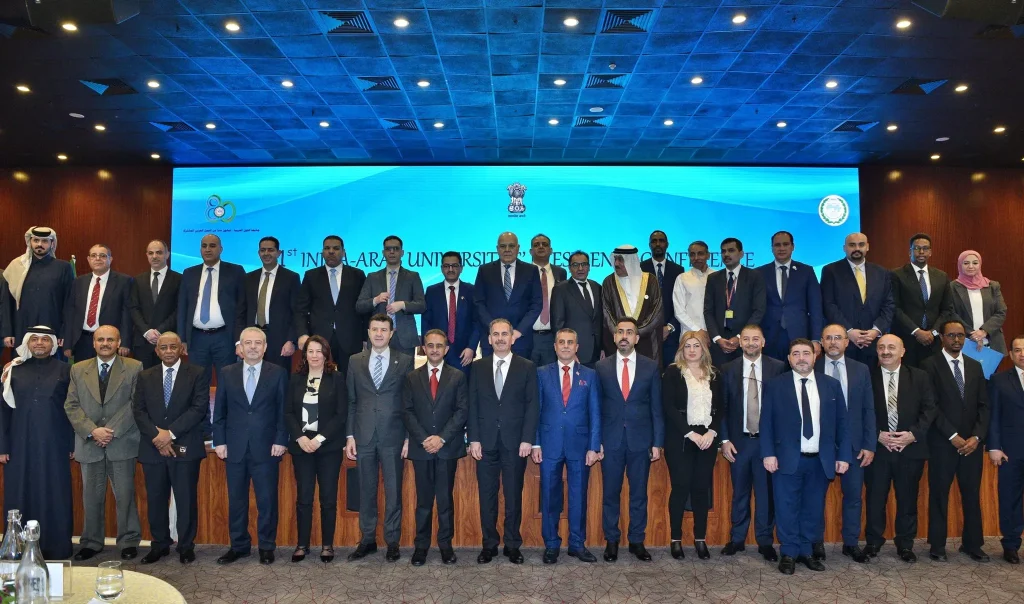
MEA spokesperson Randhir Jaiswal hailed the conference as a step toward “further strengthening cooperation between India & the Arab world,” emphasizing that it provided a robust platform for exchange of ideas in higher education and research.
“The conference served as a platform for universities from India and the Arab world to engage meaningfully, bringing together a collective vision for the future of higher education,” the MEA stated in a press release. The goal, it added, is to harness the transformative power of education beyond national borders and lay the groundwork for long-term academic cooperation.
As India strengthens its diplomatic and economic partnerships across the Arab world, the growing role of education as a bridge between civilizations signals a new era of engagement—one that extends beyond trade and security to the heart of human capital development.