News Desk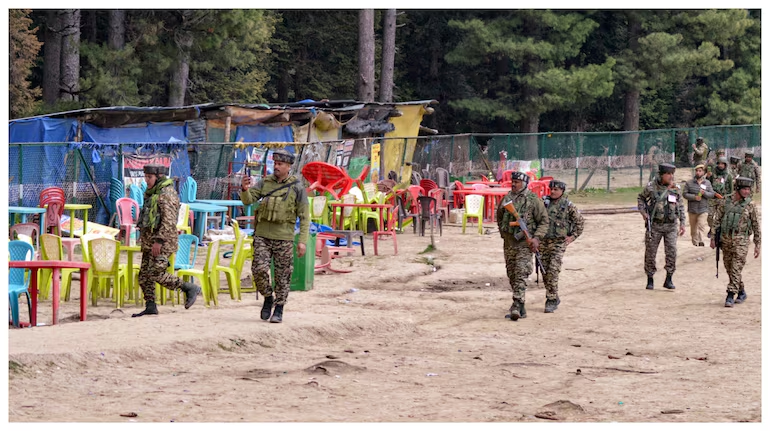
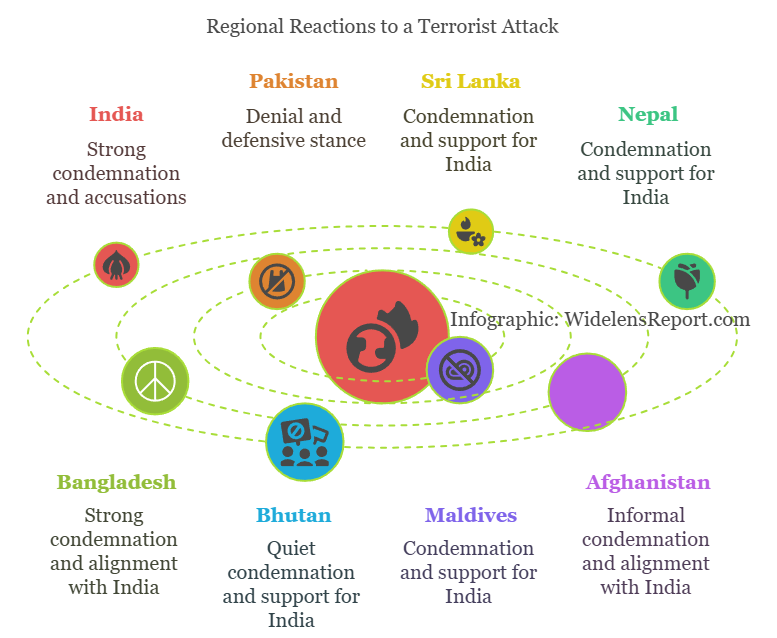
The Pahalgam terror attack on April 22, which killed 26 people and injured over 20 in Jammu and Kashmir’s Baisaran Valley, sent shockwaves across South Asia, prompting varied reactions shaped by geopolitical dynamics. As one of India’s deadliest attacks since the 2008 Mumbai massacre, it drew universal condemnation, but responses diverged in tone and intent. India’s government and media unequivocally labeled it a terrorist act linked to Pakistan, with Prime Minister Narendra Modi vowing to punish the perpetrators and implementing retaliatory measures, including suspending the Indus Waters Treaty and closing borders. Pakistan deflected blame, denying involvement and suggesting a “false flag” operation, while other South Asian nations—Sri Lanka, Nepal, Bangladesh, Bhutan, Maldives, and Afghanistan—expressed solidarity with India, condemning terrorism but navigating regional sensitivities in their media coverage. This country-by-country analysis explores these responses, highlighting India’s unified resolve, Pakistan’s denials, and the nuanced support from neighboring nations.
Media Coverage:
Indian media outlets, such as The Hindu, The Economic Times, Times of India, News18, and Outlook India, uniformly labeled the attack a “terrorist attack,” emphasizing its brutality and Pakistan’s alleged role. The Hindu reported extensively on India’s diplomatic and military responses, including the treaty suspension and border closures, framing them as necessary to counter Pakistan’s support for terrorism. The Economic Times highlighted the social media trend “All eyes on Pahalgam,” reflecting public outrage and solidarity, with AI-generated visuals amplifying the victims’ stories. Times of India detailed security operations, including the razing of terrorists’ homes and the National Investigation Agency’s (NIA) probe, which linked the attackers to Lashkar-e-Taiba and Pakistan-based operatives. News18 noted the silence of Pakistan, China, and Canada, contrasting it with global condemnation from leaders like U.S. President Donald Trump and Russian President Vladimir Putin. Outlook India reported protests in Kashmir and Delhi, underscoring local anger and demands for justice.
The media also highlighted the human cost, with stories of victims like Indian Navy Lieutenant Vinay Narwal and Intelligence Bureau official Sushil Nathaniel, fueling national grief and resolve.
Coverage emphasized India’s proactive measures, such as intensified security operations, a Rs 60 lakh bounty on three suspected terrorists (Adil Hussain Thoker, Ali Bhai, and Hashim Musa), and the NIA’s investigation tracing digital evidence to Pakistan.
Public and Social Sentiment:
Protests erupted across India, including in Delhi, Srinagar, and Muslim-majority areas of Kashmir like Pulwama and Anantnag, with residents chanting “Stop terrorism.” Social media platforms saw the hashtag “All eyes on Pahalgam” trend, drawing parallels to global campaigns like “All eyes on Rafah,” with users expressing anger and solidarity. The Indian diaspora protested outside Pakistan’s High Commission in London, reflecting global Indian outrage.
Pakistan: Denials and Deflections
Government and Official Reactions:
Pakistan’s response was characterized by denial and deflection, with officials rejecting India’s accusations of involvement. Prime Minister Shehbaz Sharif offered a “neutral” investigation on April 26, expressing concern for the loss of lives but avoiding the term “terrorism.”
Defence Minister Khawaja Asif dismissed India’s claims, asserting the attack was “home-grown” and part of “revolutions” against India in states like Kashmir, Nagaland, and Manipur.
In an interview with Sky News, Asif suggested the attack could be a “false flag” operation by India, even claiming The Resistance Front (TRF) no longer existed, despite its initial claim of responsibility. He acknowledged Pakistan’s historical support for terrorist groups, citing its role in “doing the dirty work” for the U.S. and the West, but denied current involvement.
Pakistan’s National Security Committee, meeting on April 24, reiterated its stance on Kashmir as an “unresolved dispute” and emphasized the Kashmiri right to self-determination, indirectly justifying insurgent actions. Pakistan retaliated to India’s measures by suspending visas for Indian nationals, closing its airspace to Indian aircraft, and labeling the Indus Waters Treaty suspension an “act of war.” Asif proposed involving Russia and China in an investigation, a move seen as an attempt to internationalize the issue and deflect blame.
Media Coverage:
Pakistani media coverage was limited and defensive, often echoing official narratives. Outlets like Dawn and Geo News reported the attack but avoided labeling it as terrorism, instead focusing on Pakistan’s denials and India’s “aggressive” responses. For instance, Geo News quoted Asif’s claim that the attack was unrelated to Pakistan, emphasizing “local uprisings” in India. Pakistani journalist Mona Alam, speaking on India Today, expressed sadness for the loss of lives but insisted Pakistan had “nothing to do” with the attack, aligning with the government’s stance.
Coverage often framed India’s treaty suspension and border closures as escalatory, with little reflection on the attack’s civilian toll or Pakistan’s historical links to groups like Lashkar-e-Taiba. The retraction of TRF’s claim was highlighted to question India’s accusations, though without addressing the group’s initial admission.
Public and Social Sentiment:
Public reactions in Pakistan were muted, with no significant protests reported. Social media posts on social media X and FB from Pakistani users were sparse, and those available often echoed official denials or criticized India’s retaliatory measures. The lack of widespread public condemnation contrasted with India’s vocal outrage, reflecting Pakistan’s complex relationship with terrorism issue and its domestic narrative of denying terrorist affiliations.
Sri Lanka: Solidarity with India
Government and Official Reactions:
Sri Lanka’s government condemned the Pahalgam terror attack, expressing solidarity with India. Representatives, including the Sri Lankan ambassador, issued statements condemning the “inhumane act” and offering condolences to the victims’ families. The Ministry of Foreign Affairs emphasized Sri Lanka’s stance against terrorism in all forms, aligning with India’s position. No specific remarks were made about Pakistan, but the condemnation implicitly supported India’s narrative of cross-border terrorism.
Media Coverage:
Sri Lankan media, such as Daily Mirror and Ceylon Today, reported the attack as a “terrorist attack,” focusing on its impact on regional stability. Coverage highlighted India’s retaliatory measures, including the Indus Waters Treaty suspension, as justified responses to terrorism. Daily Mirror noted Sri Lanka’s historical experience with terrorism (e.g., the LTTE), drawing parallels to India’s struggle and reinforcing support for India’s security measures. The media avoided speculative commentary on Pakistan’s role but acknowledged India’s claims of cross-border linkages, presenting them neutrally.
Public and Social Sentiment:
Public sentiment in Sri Lanka, as reflected on social media, was sympathetic to India, with users expressing condolences and condemning terrorism. Posts on X and FB from Sri Lankan accounts supported India’s fight against terrorism, with some referencing Sri Lanka’s own history of combating insurgency. No significant anti-Pakistan sentiment was reported, reflecting Sri Lanka’s neutral foreign policy stance.
Nepal: Condolences Amid Regional Concerns
Government and Official Reactions:
Nepal’s government condemned the attack, with one Nepali citizen among the 26 victims, heightening national concern. The Ministry of Foreign Affairs issued a statement expressing condolences to India and the victims’ families, calling for justice against the perpetrators. Nepal reiterated its opposition to terrorism, aligning with India’s stance without directly addressing Pakistan’s alleged role.
Media Coverage:
Nepali media, including The Kathmandu Post and Himalayan Times, described the attack as a “terrorist attack,” emphasizing the loss of a Nepali citizen and the broader threat to South Asian stability. The Kathmandu Post reported on India’s diplomatic measures against Pakistan, framing them as a response to cross-border terrorism, though with a cautious tone to avoid straining Nepal’s relations with Pakistan.
Coverage also highlighted the economic impact on Kashmir’s tourism, noting parallels with Nepal’s tourism-dependent economy. The media called for regional cooperation against terrorism, implicitly supporting India’s actions.
Public and Social Sentiment:
The death of a Nepali citizen sparked public grief in Nepal, with social media posts expressing solidarity with India and demanding accountability. Users condemned terrorism broadly, with some referencing Nepal’s own security challenges. Anti-Pakistan sentiment was minimal, as Nepal maintains balanced relations with both India and Pakistan.
Bangladesh: Support for India’s Anti-Terrorism Stance
Government and Official Reactions:
Bangladesh’s government strongly condemned the Pahalgam terror attack, expressing solidarity with India. The Ministry of Foreign Affairs issued a statement denouncing terrorism and offering condolences, emphasizing Bangladesh’s zero-tolerance policy toward terrorist acts. Given Bangladesh’s own history of combating Islamist extremism, the statement implicitly supported India’s accusations against Pakistan-based groups like Lashkar-e-Taiba, though it avoided direct criticism of Pakistan.
Media Coverage:
Bangladeshi media, such as The Daily Star and Prothom Alo, labeled the attack a “terrorist attack,” focusing on its civilian toll and India’s robust response. The Daily Star highlighted India’s suspension of the Indus Waters Treaty as a significant escalation, framing it as a justified reaction to Pakistan’s failure to curb terrorist groups. Coverage also noted the regional implications, warning that the attack could undermine South Asian cooperation, including the South Asian Association for Regional Cooperation (SAARC). The media praised India’s security operations and the NIA’s investigation, presenting India as a regional leader in counterterrorism.
Public and Social Sentiment:
Public sentiment in Bangladesh, as seen on social media, was overwhelmingly supportive of India, with users condemning the attack and expressing solidarity. Posts on social media highlighted Bangladesh’s own struggles with terrorism, drawing parallels to India’s situation. While some users criticized Pakistan’s alleged role, the focus remained on supporting India’s fight against terrorism.
Bhutan: Quiet Condemnation
Government and Official Reactions:
Bhutan’s government issued a brief statement condemning the Pahalgam terror attack, expressing condolences to India and reaffirming its stance against terrorism. As a close ally of India, Bhutan aligned with India’s narrative but maintained a low-profile response, typical of its reserved foreign policy. No specific mention of Pakistan was made.
Media Coverage:
Bhutanese media, such as Kuensel, reported the attack as a “terrorist attack,” focusing on its impact on India and the region. Coverage was limited but supportive of India, noting the attack’s threat to tourism and stability. Kuensel echoed India’s claims of cross-border terrorism without delving into Pakistan’s role, reflecting Bhutan’s cautious approach to regional disputes.
Public and Social Sentiment:
Public reactions in Bhutan were minimal, with few social media posts. Those available expressed sympathy for India and condemned terrorism, aligning with the government’s stance. Bhutan’s small digital presence limited broader public discourse.
Maldives: Solidarity with India
Government and Official Reactions:
The Maldives condemned the terror attack, with the President issuing a statement expressing solidarity with India and condolences to the victims’ families. The statement denounced terrorism in all forms, aligning with India’s position. Given the Maldives’ reliance on India for security and economic support, the response was unequivocally supportive.
Media Coverage:
Maldivian media, such as SunOnline and Mihaaru, described the attack as a “terrorist attack,” focusing on India’s retaliatory measures and the regional security implications. Coverage highlighted the attack’s impact on tourism, a critical sector for the Maldives, and praised India’s decisive actions against Pakistan-linked terrorism. The media avoided direct criticism of Pakistan but supported India’s counterterrorism efforts.
Public and Social Sentiment:
Public sentiment in the Maldives, as reflected on social media, was sympathetic to India, with users condemning the attack and expressing support for India’s security measures. The tourism angle resonated strongly, given the Maldives’ own dependence on the sector. Anti-Pakistan sentiment was minimal, reflecting the Maldives’ focus on bilateral ties with India.
Afghanistan: Limited but Supportive Response
Government and Official Reactions:
Afghanistan’s government, under Taliban control, issued no formal statement, but Taliban Foreign Minister Amir Khan Mottagi meeting Indian top diplomat in Kabul said ‘This undermines regional security and stability’ and the same was echoed by Taliban spokesperson Abdul Qahar Balkhi. After Kabul meeting Indian diplomatic sources indicated condemnation of the attack and support for India’s anti-terrorism efforts. Afghanistan’s historical tensions with Pakistan over cross-border militancy aligned its interests with India, though the Taliban’s reticence reflected its delicate regional balancing act.
Media Coverage:
Afghan media, such as TOLOnews, reported the attack as a “terrorist attack,” noting India’s accusations against Pakistan and the suspension of the Indus Waters Treaty. Coverage was limited due to Afghanistan’s internal challenges, but it supported India’s stance, drawing parallels to Afghanistan’s own struggles with Pakistan-based terrorist groups. The media avoided extensive commentary on Pakistan to prevent diplomatic fallout.
Public and Social Sentiment:
Public reactions in Afghanistan were sparse, with few X posts available. Those present condemned terrorism and expressed sympathy for India, reflecting shared concerns about regional instability. Anti-Pakistan sentiment was evident in some posts, given Afghanistan’s grievances against Pakistan’s support for militant groups.
Regional Implications and Media Narratives
The Pahalgam terror attack has deepened the India-Pakistan divide, with India’s decisive actions—suspending the Indus Waters Treaty, closing borders, and expelling diplomats—reshaping South Asian geopolitics.
All most all South Asian nations, except Pakistan, aligned with India’s narrative, condemning the attack as terrorism and supporting its counterterrorism efforts. This reflects India’s regional influence and shared concerns about terrorism, particularly in countries like Bangladesh and Sri Lanka, which have faced similar threats.
Media coverage across South Asia, barring Pakistan, consistently used “terrorist attack,” aligning with India’s framing and the U.N.’s condemnation.
Pakistani media’s reluctance to label it as terrorism and its focus on India’s “escalation” highlight a defensive posture, undermined by TRF’s initial claim and Pakistan’s historical links to Lashkar-e-Taiba. The attack’s impact on SAARC, already dormant due to India-Pakistan tensions, was noted by regional media, with Chatham House warning of further regional disintegration.
Public sentiment in India was marked by anger and unity, amplified by protests and social media campaigns like “All eyes on Pahalgam.” Other South Asian countries showed sympathy and condemned terrorism, with minimal anti-Pakistan rhetoric except in Bangladesh and Afghanistan, where historical grievances surfaced. Pakistan’s muted public response and official denials failed to counter the international narrative, isolating it further.