 News Desk
Bengaluru—In a significant milestone for India’s burgeoning artificial intelligence sector, Saram AI’s homegrown language model has demonstrated superior performance over ChatGPT in three critical areas: multilingual capabilities, affordability, and contextual understanding of Indian cultural nuances.
The findings, highlighted in a report by a panel of AI researchers and industry experts, underscore the growing relevance of India-specific AI solutions in a global market dominated by Western tech giants. Sarvam model, trained on diverse Indian linguistic datasets, reportedly outperformed ChatGPT in processing queries in 11 regional, including Tamil, Hindi, and Bengali, with higher accuracy in dialect recognition and colloquial responses.
Cost efficiency emerged as another key differentiator. While ChatGPT’s subscription plans remain prohibitively expensive for many Indian users, Sarvam’s pricing model—tailored for local affordability—offers comparable services at roughly one-third the cost. “This isn’t just about competition; it’s about accessibility” said Dr. Anika Rao, an AI ethicist at the Indian Institute of Technology.
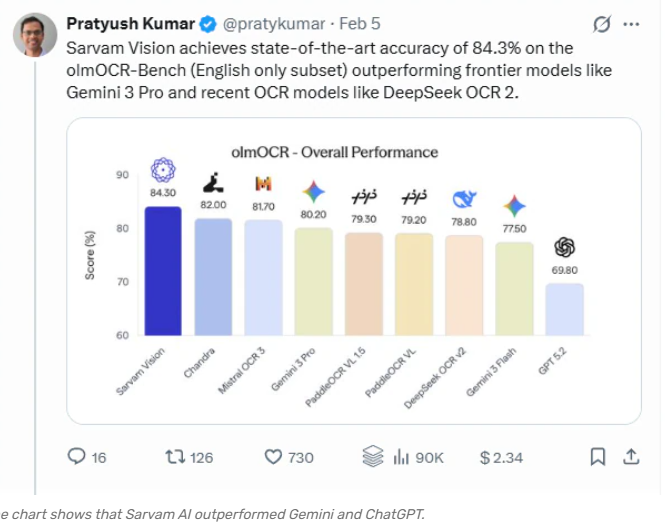
Cultural contextualization proved Sarvam’s standout feature. In tests simulating queries about regional festivals, legal frameworks, or local idioms, the model generated responses with greater relevance and sensitivity to India’s-cultural fabric. ChatGPT, while adept at generic tasks, occasionally misinterpreted context or defaulted to Western-centric perspectives, the report noted.
Sarvam AI’s CEO, Vive Raghavan, emphasized the company’s focus on “building for Bharat, not just India.” Our priority is solving real problems—from farmers seeking weather updates in Marathi to small businesses drafting contracts in Gujarati,” he said.
The results have sparked optimism among policymakers, with some urging the government incentivize homegrown AI innovation. “This is a wake-up call for tech leaders,” said Rajesh Mehta, a venture capitalist. “India’s AI ecosystem isn’t just catching up—it’s redefining the rules.”
As debates over AI regulation and localization intensify, Sarvam rise signals a quiet revolution: the emergence of technology built not for the world, but by and for India.