News Desk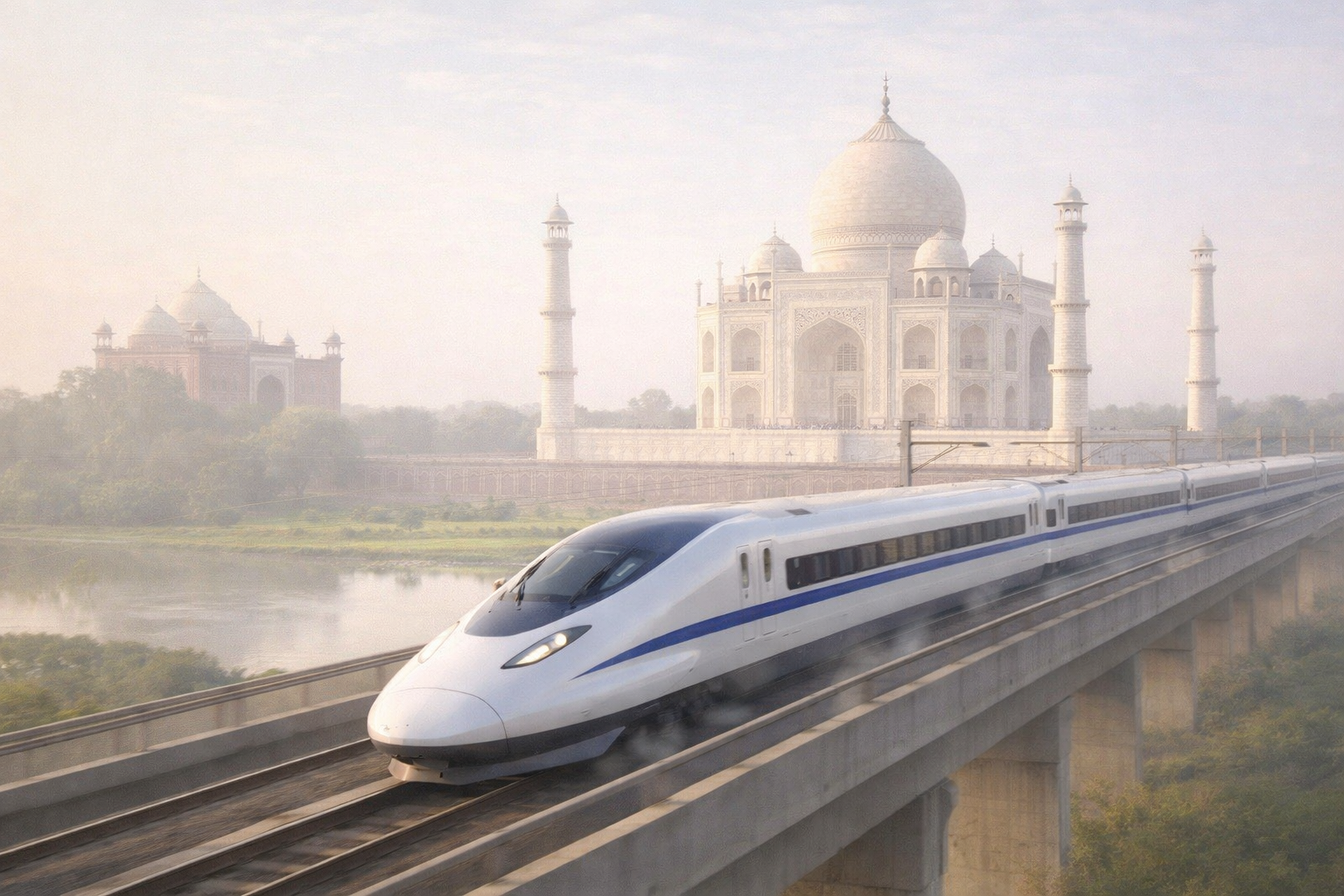
India’s first bullet train corridor between Mumbai and Ahmedabad is moving steadily toward completion, positioning the country alongside Japan, France and China in the global high‑speed rail network. The project, designed for a top speed of 320 km/h, will cut end‑to‑end travel time on the 508 km route to about two hours.
Officials describe the corridor as one of India’s most ambitious infrastructure undertakings. It is being built with Japanese Shinkansen technology, the same system known for its long safety record and punctuality. The National High Speed Rail Corporation says civil works have crossed major milestones, with viaducts, stations and track systems progressing in phases.
A 320 km/h operating speed places India in the same category as Japan’s N700S Shinkansen and France’s TGV services. China’s Fuxing trains run slightly faster at 350 km/h, but India’s corridor remains within the global high‑speed benchmark. Italy’s Frecciarossa and Germany’s ICE networks operate at similar speeds.
For India, the project is not only about speed. It is intended to modernise inter‑city travel, reduce congestion on existing rail lines and introduce new standards in safety and passenger comfort. The corridor will use dedicated tracks, advanced signalling and automatic train control systems.
Key Dates and Timeline
- 2017: India and Japan sign the agreement to build the Mumbai–Ahmedabad High Speed Rail corridor.
- 2018–2020: Land acquisition and preliminary works begin across Maharashtra and Gujarat.
- 2021–2023: Major civil construction starts, including viaducts and station foundations.
- 2024: First full‑span girder launches and track‑related works accelerate.
- 2025: Trial runs expected on completed stretches.
- April 2027: Government target for the first operational service, as stated by Railway Minister Ashwini Vaishnaw.
India sees the corridor as the first step toward a wider high‑speed rail network. Plans for additional routes, including Delhi–Varanasi and Mumbai–Nagpur, are under study. Officials say the technology transfer from Japan will help India develop its own high‑speed manufacturing ecosystem.
The project is also expected to stimulate economic activity along the western corridor, create skilled jobs and support new urban clusters around the stations. For passengers, the two‑hour journey between Mumbai and Ahmedabad will replace the earlier six‑to‑seven‑hour trips on Shatabdi, Duronto and Double Decker services, marking a major shift in how the sector moves people.
India’s entry into high‑speed rail marks a shift in long‑term transport planning. With construction advancing and trial runs approaching, the Mumbai–Ahmedabad corridor is set to become a defining symbol of the country’s infrastructure modernisation drive.