 News Desk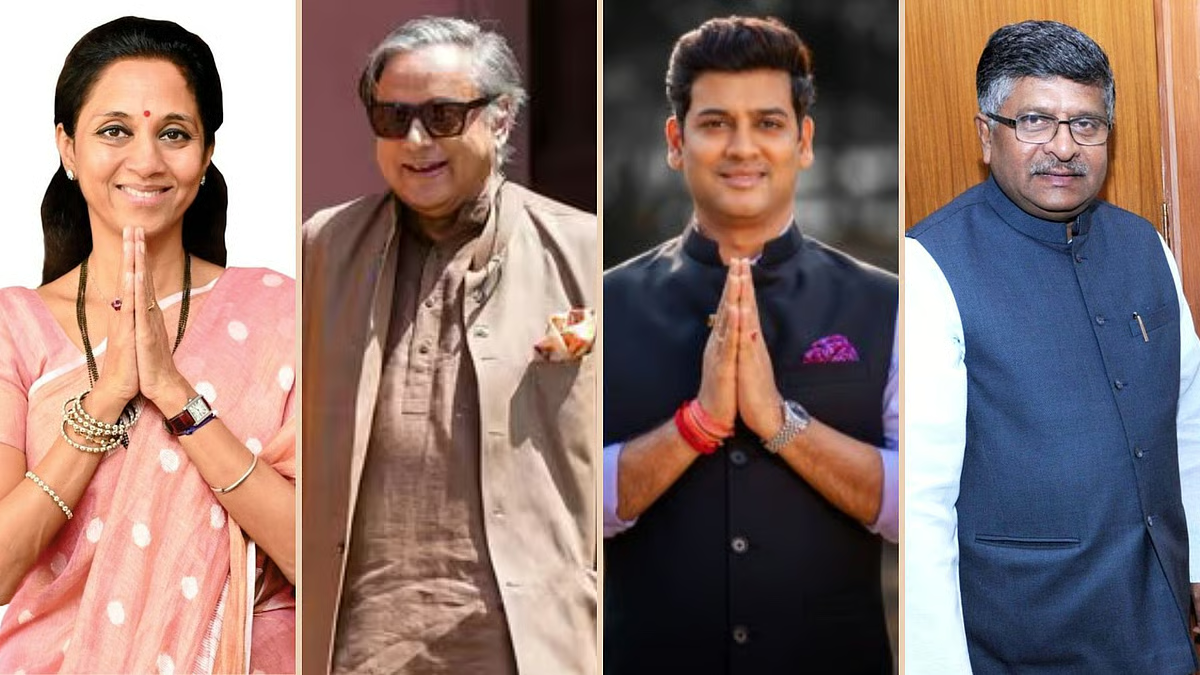
NEW DELHI — In the wake of Operation Sindoor, India’s military retaliation to a devastating terror attack in Pahalgam on April 22, attributed to Pakistan-backed terror groups, New Delhi has launched an ambitious diplomatic campaign to rally global support. Deploying seven delegations comprising 59 Members of Parliament and seasoned former diplomats to 32 countries, India is working to reshape the international narrative around the attack, Pakistan’s alleged complicity, and the precision of its own strikes on terrorist infrastructure.
The Pahalgam attack, claimed by The Resistance Front (TRF), a group India says operates with Islamabad’s tacit support, killed dozens and reignited tensions in a region long scarred by cross-border violence. India’s response—targeted strikes on terrorist camps—drew international attention, including a controversial claim by President Donald Trump that he mediated a ceasefire to avert a “nuclear conflict.” New Delhi, bristling at the suggestion of external mediation, moved swiftly to assert its position on the world stage.
India’s delegations, a diverse mix of lawmakers from various states, faiths, and political parties, were strategically chosen to project a unified, pluralistic front against terrorism. India’s diplomatic effort was a significant undertaking for a government often scrutinized internationally for perceived democratic challenges and majoritarian policies. The delegations, led by prominent figures such as Shashi Tharoor of the Indian National Congress, Baijayant Panda of the Bharatiya Janata Party, and other lawmakers like Supriya Sule of the Nationalist Congress Party and Kanimozhi Karunanidhi of the Dravida Munnetra Kazhagam, reflected a broad political spectrum. These diverse teams traveled to key capitals, engaging foreign governments, parliamentarians, and media outlets to articulate India’s stance on the Pahalgam attack and its response.
Their mission: to underscore Pakistan’s role in fostering terrorism while defending India’s measured retaliation.
A particular focus was placed on members of the United Nations Security Council, where Pakistan, a non-permanent member for 2025-26, has flexed its diplomatic muscle. India also targeted members of the Organisation of Islamic Cooperation, a bloc that has historically leaned toward Pakistan on issues like Kashmir. Delegations to Saudi Arabia, Kuwait, Bahrain, and Algeria reported encouraging responses, with some OIC nations expressing openness to India’s call for economic sanctions against Pakistan. These engagements signal New Delhi’s growing confidence in navigating complex Islamic-world diplomacy, bolstered by its strong economic ties with Gulf states.
The United States, a critical audience, saw visits to New York and Washington as India sought to smooth over tensions sparked by Trump’s mediation claims. Indian opposition leaders like Shashi Tharoor of the Congress party have downplayed the remarks diplomatically while reinforcing New Delhi’s unwavering stance against terrorism. “India’s actions were precise and necessary,” Tharoor said in a statement, reflecting a rare domestic consensus on national security.
Pakistan’s diplomatic clout, bolstered by allies like China, remains a formidable obstacle. Its UNSC roles give it leverage to shield terror groups from scrutiny, a dynamic that frustrates Indian officials. “How can a country that harbors terrorists chair global counter-terrorism efforts?” asked one Indian lawmaker, echoing a sentiment widely shared in New Delhi.
Despite these challenges, India’s campaign underscores its determination to hold Pakistan accountable. The delegations’ diversity—spanning political and religious lines—sends a powerful message of national unity in the face of external threats. Whether this translates into tangible diplomatic gains remains uncertain, but New Delhi’s resolve is clear: it will not let Pakistan’s narrative go unchallenged.
As the dust settles from Operation Sindoor, India’s outreach reflects a broader strategy to cement its role as a responsible global power, one that fights terrorism with both military precision and diplomatic tenacity. For now, the world is watching—and New Delhi is making sure its voice is heard.