 News Desk
For nearly eight decades, Pakistan’s political history has been defined by a familiar oscillation between civilian rule and military intervention. Four times since independence in 1947, the army seized power outright, suspending constitutions and ruling by decree before eventually retreating to the barracks under domestic or international pressure. Yet the transformation that has unfolded in Islamabad over the past two years represents something far more consequential than another turn of that well-worn wheel. Pakistan has not suffered a coup; it has engineered a constitutional metamorphosis.
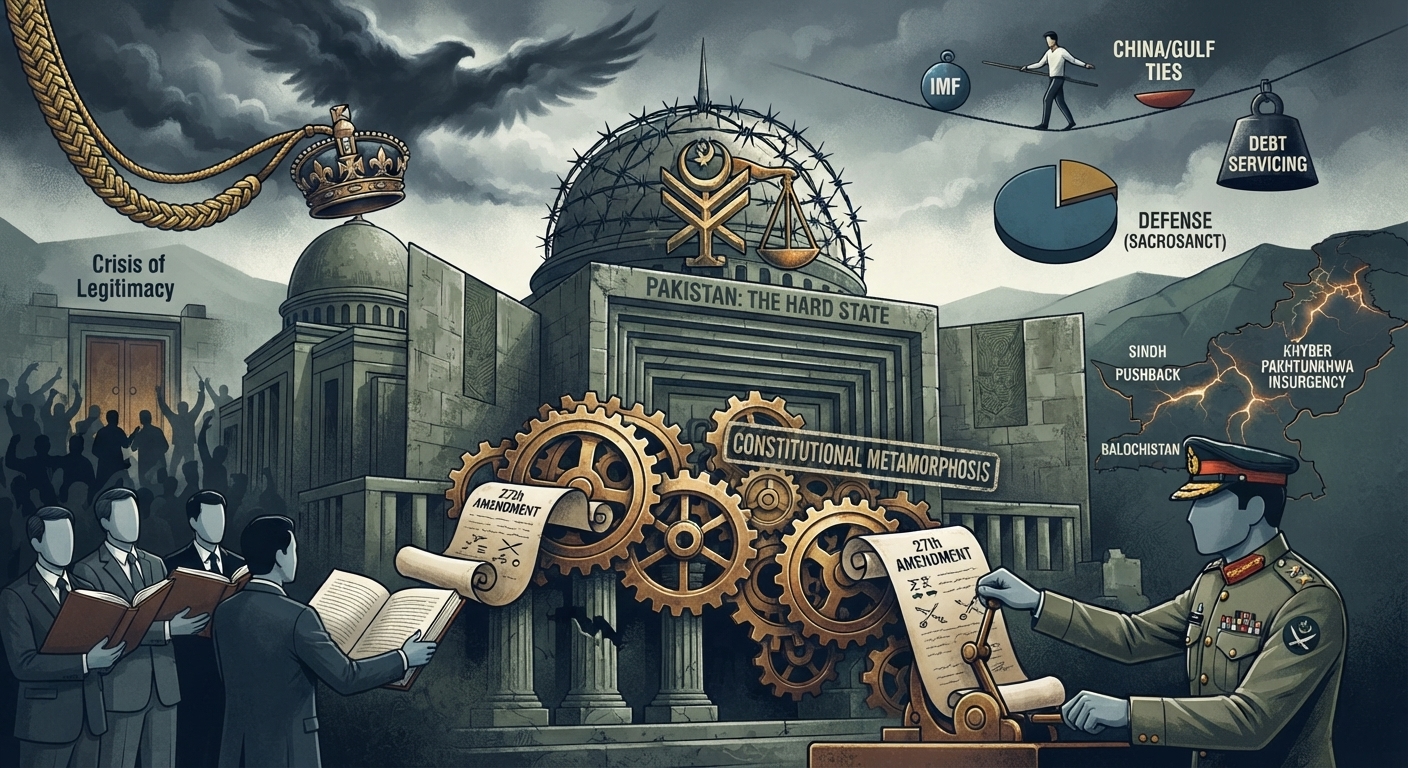
By systematically subordinating the judiciary, centralising military command, and co-opting a compliant parliamentary coalition, Pakistan’s establishment has transitioned the country from a contested “hybrid” polity into what political analysts increasingly describe as an entrenched hard state.
In doing so, Rawalpindi and Islamabad have resolved the immediate question of who governs. They have left unanswered a far more perilous one: whether a state built around institutionalised praetorian dominance can deliver economic solvency, federal cohesion, and long-term stability for 240 million people.
The defining feature of Pakistan’s current order is that it no longer requires tanks in the streets. Parliament still convenes, courts still issue rulings, and Prime Minister Shehbaz Sharif leads a civilian cabinet. Yet real sovereign authority—over national security, foreign policy, judicial appointments, and strategic economic planning—has been consolidated under the Chief of Army Staff and Chief of Defence Forces, Field Marshal Syed Asim Munir.
The instruments of this consolidation were forged not in military headquarters, but in the National Assembly. Through the 26th Constitutional Amendment in 2024 and the sweeping 27th Amendment in November 2025, lawmakers stripped the Supreme Court of its original constitutional jurisdiction, transferring it to a newly constituted Federal Constitutional Court whose appointments are heavily shaped by the executive. Simultaneously, parliament elevated Munir to the rank of Field Marshal—the first active officer to hold the title since Ayub Khan—and enshrined overarching tri-service command alongside lifetime rank and legal immunity.
Within the ruling coalition, institutional friction is now routinely portrayed as economic sabotage. Through bodies such as the Special Investment Facilitation Council, the military sits directly alongside civilian ministers to fast-track foreign investment in mining, agriculture, and energy—a model officials insist is essential to bypass bureaucratic paralysis.
Yet the central flaw in Pakistan’s praetorian model lies in economics. Authoritarian centralisation can suppress street protests and enforce fiscal austerity, but it cannot manufacture sustainable productivity.
On paper, macroeconomic indicators have stabilised. The State Bank of Pakistan projects gross domestic product growth of 3.5 to 4.5 per cent for the 2026–27 fiscal year, buoyed by steady remittances and a contained current-account deficit. However, beneath that surface calm lies a structural fiscal trap. In the 2026–27 federal budget, debt servicing alone consumes more than 8 trillion rupees—nearly half of total federal expenditure—while defence and military pension outlays remain sacrosanct.
Foreign investors remain wary of an environment in which the rule of law is subordinate to executive convenience, and where internet shutdowns and political lockdowns are deployed as routine instruments of crowd control. Meanwhile, high taxation on the formal sector and persistent underinvestment in health and education have accelerated a quiet brain drain among Pakistan’s educated youth. Stabilisation, in short, has been bought on credit rather than achieved through structural reform.
As Pakistan looks toward the remainder of the decade, its current trajectory points toward three acute vulnerabilities:
-
A Crisis of Legitimacy:
By sidelining the country’s most popular opposition movement and neutralising judicial recourse, the state has closed off institutional safety valves. History suggests that when political grievances are denied ballot-box and courtroom outlets in Pakistan, they do not disappear; they migrate to the streets or harden into regional alienation. -
Federal Strain and Peripheral Insurgency:
Centralising power in Islamabad and Rawalpindi risks reigniting ethno-nationalist fissures. Growing debate within government circles over carving out new provinces—which Defence Minister Khwaja Asif recently suggested could materialise as early as the new year—has already provoked fierce pushback in Sindh, where the provincial assembly passed a resolution rejecting any division. At the same time, escalating militancy in Khyber Pakhtunkhwa and Balochistan continues to exact a heavy human and economic toll along the western frontier. -
The Peril of the Two-Front Trap:
Abroad, Islamabad’s generals are attempting a delicate balancing act—maintaining deep strategic and infrastructure ties with China, courting Gulf sovereign wealth, managing tense relations with Kabul’s Taliban authorities, and preserving security cooperation with Washington and London. Yet external patrons are increasingly transactional. Neither Beijing nor Gulf capitals are willing to write blank cheques for an economy that resists fundamental restructuring.
The old adage—originally applied to eighteenth-century Prussia—that while most states possess an army, Pakistan is an army that possesses a state, has rarely felt more literal. By wrapping military supremacy in constitutional parchment, Pakistan’s ruling establishment has insulated itself from immediate institutional challenge.
In doing so, however, it has also stripped away its buffers. When civilian governments enjoyed genuine autonomy, the military could exercise power from behind the curtain while leaving elected politicians to absorb public anger over inflation, unemployment, and power shortages. Today, that separation no longer exists. Having claimed credit for the nation’s stability and embedded itself at the heart of economic decision-making, the establishment now owns the outcomes. Pakistan may have achieved order in the short term, but without consent, institutional accountability, or broad-based economic renewal, it remains a brittle equilibrium—one crisis away from testing the limits of command.