News Desk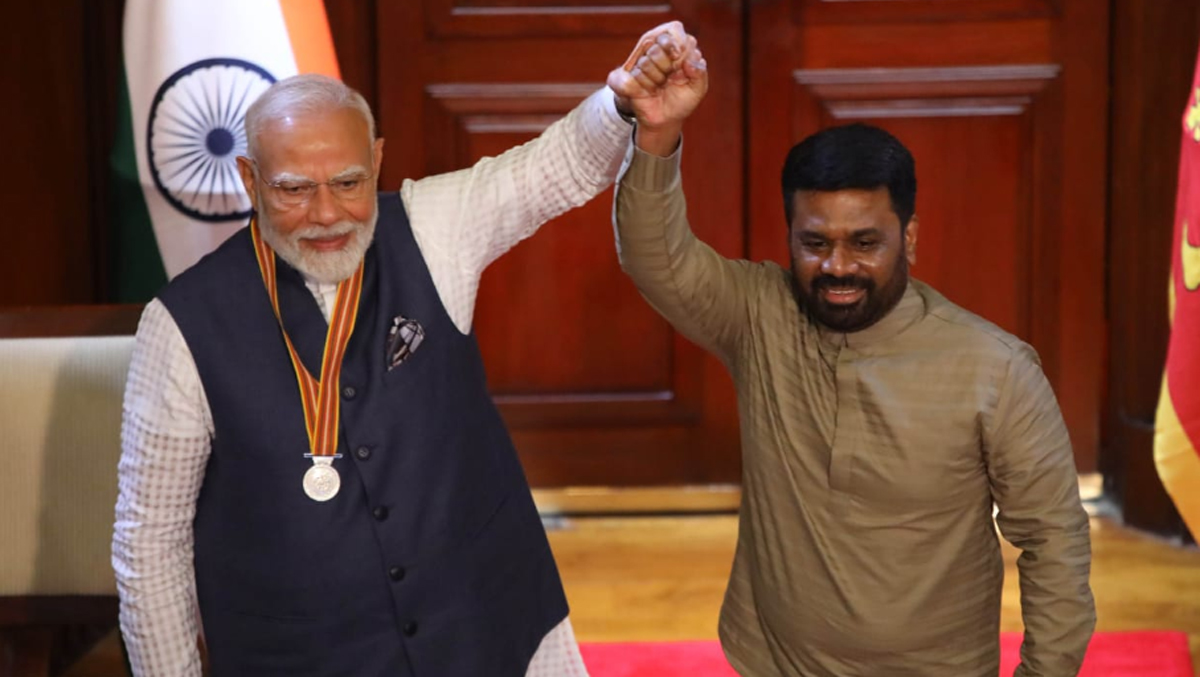
COLOMBO, Sri Lanka — Prime Minister Narendra Modi’s two-day state visit to Sri Lanka has drawn a complex blend of scrutiny, silence, and symbolism across the international media landscape, casting India’s regional diplomacy into the center of a broader strategic theater.
Modi, the first foreign dignitary to be received by Sri Lanka’s newly elected president, Anura Kumara Dissanayake, concluded the visit with seven bilateral agreements spanning defense, energy, and economic cooperation—most notably, the signing of India’s first defense pact with the island nation and the launch of a 120-megawatt solar project in Sampur.
Yet it is not just the agreements that have drawn attention. The media’s portrayal—or in some cases, its pointed absence—reveals a narrative as layered as the visit itself.
Pakistan Watches, Without Provoking
In Islamabad, Pakistan’s English-language press responded with cautious coverage. Dawn, the country’s oldest English daily, offered headlines noting the defense and energy deliverables without delving into the deeper strategic implications.
There was no mention of Kashmir, no editorial saber-rattling—only a subdued acknowledgment of India’s expanding regional presence. For a country locked in perennial tension with India, the restraint is striking. It may reflect both pragmatism and a quiet recognition of shifting power balances in South Asia.
China’s Strategic Silence
More conspicuous is China’s silence. Beijing’s English-language state outlets—Xinhua, Global Times, and China Daily—offered no reporting on Modi’s trip by April 5. In a country known for swift propaganda pivots, this absence is not an oversight but a statement.
With billions of dollars tied up in Sri Lanka’s infrastructure—from the controversial Hambantota Port to expressways and power plants—China’s reticence signals discomfort at India’s increasingly visible footprint. Where India pledges grants and capacity-building, Beijing faces global criticism for saddling nations with debt.
If Sri Lanka is a pawn in the Indo-Pacific contest, China appears unwilling to acknowledge its latest maneuver—perhaps fearing the optics of ceding ground.
Western Coverage: A Lone Voice Carries the Load
Among Western outlets, it was the Associated Press that stepped forward with weight and frequency. Its two reports emphasized the visit’s geopolitical context, India’s $4.5 billion aid package during Sri Lanka’s 2022 economic meltdown, and the broader shadow cast by China’s presence in the Indian Ocean.
Yet major players like BBC, CNN, and Deutsche Welle have so far remained on the sidelines, offering limited or delayed coverage. The reasons may vary—editorial bandwidth, prioritization of other conflicts, or simply a wait-and-watch approach—but the gap underscores how India’s neighborhood diplomacy often slips beneath the radar of global media giants.
A Stage Carefully Set
Domestically, Indian media gave the visit the kind of attention it reserves for high diplomacy. India Today and The Times of India ran live updates, while News18 struck an editorial tone of cautious optimism. “The visit offers an opportunity to drive forward key connectivity and energy projects, and hopefully address lingering issues like the fishermen’s conflict,” wrote News18’s Sohil Sinha, signaling that not all diplomatic wins come without unfinished business.
Indeed, unresolved matters remain. The Tamil Nadu fishermen dispute, the delicate balancing act of regional alliances, and the sustainability of large-scale infrastructure projects—all lie beyond the fanfare.
A Power Triangle Tightens
The visit unfolded a day after the BIMSTEC summit in Thailand, itself a signal of India’s growing interest in multilateral Asian cooperation beyond SAARC, where Pakistan looms large. Modi’s Colombo stopover serves as a subtle, strategic reaffirmation: India is willing to underwrite stability in the region, not just rhetorically, but with concrete aid, energy investments, and a rare willingness to ink a defense agreement.
Sri Lanka, still reeling from its financial crisis, is the stage—and the prize—of this tightening triangular tension between India, China, and Pakistan. In choosing to engage early with a leftist Sri Lankan administration that has pledged not to allow its soil to be used against India, Modi is signaling continuity wrapped in confidence.
A Visit Watched, Ignored, and Interpreted
Across capitals and newsrooms, Modi’s Sri Lanka visit was watched with calibrated interest. In Islamabad, it was parsed for signs of strategic encroachment. In Beijing, it was ignored, perhaps to avoid drawing attention to a rival’s progress. In Western bureaus, it was acknowledged—but only just. And at home, it was wrapped in flags, speeches, and symbolism.
In a world where media attention often defines diplomatic success, the varied coverage of Modi’s trip says as much about global perceptions of India as it does about the visit itself.
The message from Colombo was clear: India is here to stay in the Indian Ocean. The world, in parts, is beginning to listen. Others are still deciding how.