News Desk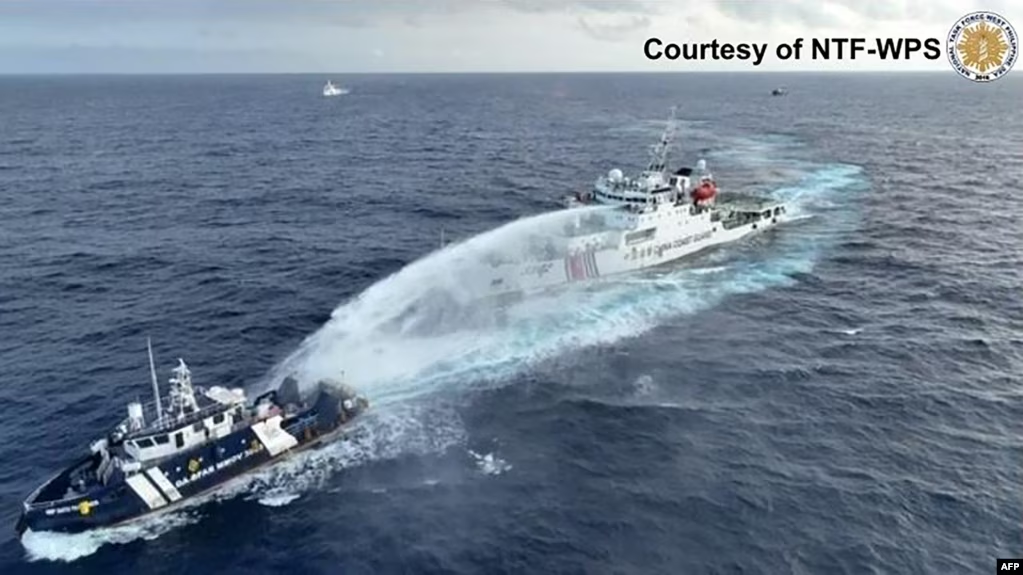
Manila— For years, China’s creeping expansion in the South China Sea has played out in the form of bullying tactics, maritime incursions, and the relentless harassment of Philippine vessels. The latest move by Philippine President Ferdinand Marcos Jr.—offering to remove a U.S. missile system in exchange for an end to Chinese coercion—underscores the desperation of a nation besieged in its own waters.
China’s fishing militias, backed by an assertive coast guard, have turned Philippine waters into a theater of intimidation. Filipino fishermen, once the lifeblood of coastal communities, find themselves chased away by Chinese water cannons. Philippine supply boats ferrying provisions to soldiers stationed on remote, contested outposts are rammed or blasted with military-grade lasers. Each day, the standoff escalates—an asymmetric war of nerves that China appears determined to win.
“We do not comment on China’s missile systems, which are a thousand times more powerful than what we have,” Marcos said, responding to Beijing’s demand for the removal of the U.S. Army’s Typhon mid-range missile system, installed in the Philippines last April. His retort was sharp, but his offer—dismantling the American launchers if China ceases its aggression—was a sign of just how untenable the situation has become.
That offer, however, is likely to fall on deaf ears in Beijing. China has shown no interest in diplomatic off-ramps; instead, it has ramped up hostilities, deploying an ever-growing fleet of gray-zone operatives—fishing militias that are anything but civilian and a coast guard behaving with the impunity of a navy. For Filipino fishermen, the reality is stark: the waters they once relied on for their livelihood have become a perilous battleground.
Yet, Beijing insists that Manila is the provocateur. Chinese Foreign Ministry spokesperson Mao Ning has accused the Philippines of “creating tensions” and “inciting geopolitical confrontation” by hosting the American missile system. The irony is palpable: a nation defending its own sovereignty is labeled an aggressor, while the true aggressor masquerades as a victim.
Despite China’s protests, the Philippines has no plans to dismantle the missile system. Defense Secretary Gilberto Teodoro has made it clear: Beijing has no right to dictate Manila’s security choices. And with the U.S.-Philippines alliance strengthening, Washington has signaled that it will not allow its oldest treaty ally in Asia to be bullied into submission.
The South China Sea is a strategic fault line, a place where territorial ambition collides with national survival. The question now is not whether the Philippines can tolerate China’s maritime belligerence—it is how long it can endure before it is forced to take a more drastic stand. Beijing’s daily transgressions are testing the limits of Philippine restraint. One miscalculation, one crisis too many, and the region could be plunged into a conflict neither side can afford.
For now, Manila waits. But patience, like sovereignty, has its limits.