News Desk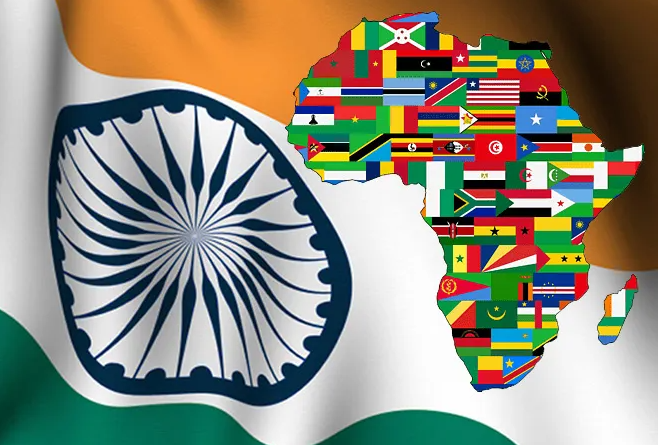
NEW DELHI — As Africa navigates an increasingly contested geopolitical landscape in 2025, India has emerged as a distinctive partner, offering a model of engagement that prioritizes African agency, mutual benefit, and sustainable development. Unlike powers that deploy coercive tools—such as opaque loans or private militias—India’s approach is defined by transparency, capacity-building, and solidarity. From health initiatives to economic partnerships, India’s quiet but deliberate strategy is reshaping Africa’s development trajectory, positioning it as a reliable ally in a multipolar world. India’s engagement with Africa rests on a framework of South-South cooperation, emphasizing five key pillars: economic empowerment, human capital development, security cooperation, health and humanitarian solidarity, and global advocacy.

This approach, rooted in India’s post-colonial ethos of non-alignment and mutual respect, contrasts sharply with models that saddle African nations with debt or erode sovereignty. While India’s trade and investment volumes lag behind those of China, its principled stance is earning trust across the continent, from the mineral-rich lands of eastern Congo to the coastal waters of the Mozambique Channel.
Economic Empowerment through Transparent Financing
India’s economic engagement prioritizes African-led development over extractive arrangements. In August 2025, the ECOWAS Bank for Investment and Development (EBID) secured a $40 million line of credit from India’s Exim Bank to fund infrastructure, energy, agriculture, and health projects across West Africa. Unlike models that tie governments to foreign contractors, this financing flows through African institutions, aligning with local priorities. In the critical minerals sector, India’s partnerships with Zambia, Zimbabwe, Mozambique, Malawi, and Côte d’Ivoire emphasize transparent contracts, research collaboration, and skills transfer, fostering downstream industrial growth.This approach stands in contrast to China’s resource-for-infrastructure deals, such as the Sicomines agreement in the Democratic Republic of Congo, which has faced scrutiny for governance and environmental risks. The International Monetary Fund’s warning that Zambia remains at “high risk of debt distress” underscores the long-term costs of such arrangements. India’s model, by contrast, avoids debt traps, offering concessional credit that empowers rather than encumbers.
Building Human Capital for Self-Reliance
Central to India’s strategy is its investment in African human capital. Through initiatives like the Indian Technical and Economic Cooperation (ITEC) program, India has trained thousands of African professionals, equipping them with skills for sustainable development. In 2025, this commitment continues with technology transfer in critical minerals and industrial collaboration, as seen at DefExpo 2025 in Tanzania, where Indian firms showcased solutions tailored to African needs. By prioritizing education and expertise, India fosters self-reliance, echoing its own post-independence focus on institution-building.
Security Cooperation without Coercion
India’s security partnerships emphasize capacity-building over intervention. Its naval training programs, spanning the Gulf of Aden to the Mozambique Channel, equip African forces to secure their waters. In June 2025, India and South Africa signed submarine cooperation agreements, strengthening maritime security in the Indian Ocean. Unlike Russia’s “Africa Corps,” which has been linked to human rights abuses in Mali and the Central African Republic, India’s approach avoids mercenary deployments, focusing instead on empowering local forces. This aligns with India’s non-interventionist principles, offering a stark contrast to models that trade regime protection for resource concessions.
Health as a Cornerstone of Solidarity
India’s role as a global health leader is particularly pronounced in Africa. In 2025, the African Union and India launched initiatives in affordable medicines, digital health, and telemedicine, building on India’s reputation as the “pharmacy of the Global South.” The nationwide rollout of the R21/Matrix-M malaria vaccine in Uganda, produced by India’s Serum Institute, marks a milestone in population-level disease prevention. During the COVID-19 pandemic, India’s supply of vaccines to dozens of African nations demonstrated a commitment to humanitarian solidarity, free of the strategic strings often attached by other powers.
Advocating for Africa’s Global Voice
India’s advocacy for African inclusion in global governance is a hallmark of its partnership. As G20 president in 2024, India championed Africa’s permanent membership, addressing longstanding calls for equitable representation. This diplomatic stance, rooted in India’s non-aligned movement legacy, positions it as a partner that amplifies African voices rather than dictating terms. Such advocacy resonates deeply in a continent seeking greater agency in international forums.
An Implicit Africa Doctrine?
While India has not formalized an “Africa Doctrine,” its consistent engagement suggests an implicit strategic framework. Grounded in the principles of non-alignment, mutual respect, and South-South cooperation, India’s approach reflects a deliberate rejection of neo-colonial practices. Scholars argue that this framework draws from India’s own development experience, emphasizing self-reliance and human-centric growth.
However, India’s approach is not without challenges. Its trade and investment volumes remain modest compared to China’s, and project execution can be slow. Yet, as African business media note, the character of engagement matters. India’s hospital ships, training missions, and concessional loans leave a lighter footprint, fostering trust where others breed dependency.
A Path Forward for Africa
As Africa confronts rising stakes in 2025—from debt burdens in Kenya to mineral politics in Congo—India’s partnership offers a compelling alternative. By respecting sovereignty, empowering institutions, and investing in people, India aligns with African aspirations for self-determination. For African leaders, the lesson is clear: partnerships that prioritize agency and resilience, as India does, are critical to building a stronger, more sovereign continent.
India’s model is not flashy, but its impact is profound. In a world of competing visions for Africa’s future, India stands out as a partner that delivers not just infrastructure or security, but hope for a more equitable global order. As one African diplomat remarked, “India doesn’t just build roads; it builds futures.” For a continent charting its path, that distinction makes all the difference.