News Desk
In contemporary Chinese society, love and relationships are often overshadowed by transactional expectations. Marriages are frequently seen as negotiations and business deals rather than genuine connections. This materialistic approach has been exacerbated by economic pressures and societal norms, leading to a culture where romantic ideals are sidelined. The emphasis on financial stability and social status over emotional bonds highlights the deep-seated issues within Chinese society, where love is frequently compromised for material gain.
In China, high expectations from both genders make finding a life partner difficult. Traditionally, it is said that a man should marry when he grows up and a woman should be wedded. This reflects societal pressure for young adults to start families at a certain age, adding to the challenge of meeting these high standards.
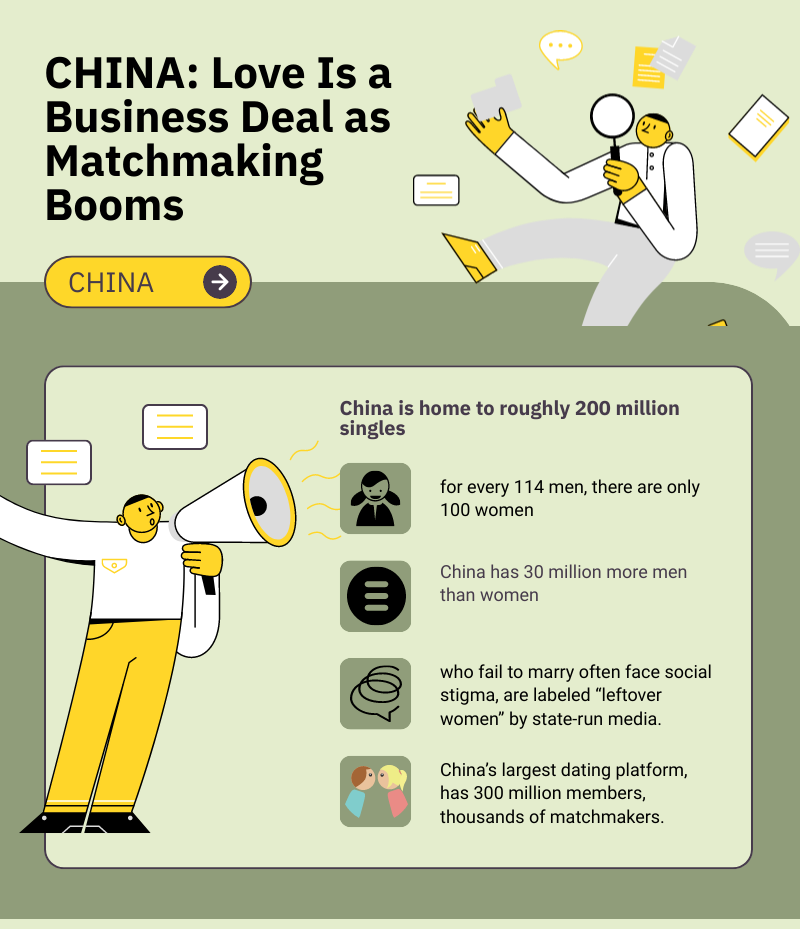
As the Lunar New Year starts, young people working away from home begin their journeys back to their hometowns, and their families start worrying about their marriage prospects. Decades of strict enforcement of the one-child policy have created a severe gender imbalance in China. In rural areas, this imbalance has made it particularly challenging for young men to find suitable brides. One woman revealed the reality in her area, explaining that girls are so scarce that even married women, like herself, are treated like hot property. She mentioned that if she argued with her husband and stayed at her parents’ house for about ten days, matchmakers would start knocking, inquiring if she had divorced. Despite considering herself as plain as a winter-melon, she received this kind of attention, implying how much more intense the interest would be for young unmarried girls.
When young women walk down the street, they often attract attention from random elderly men and women trying to set them up. One man explained that during the New Year, the two girls in his village attract a long line of suitors. The family’s entrance becomes crowded with over a dozen cars, and they remain busy all day.
Rural bachelors, dressed in their finest clothes, patiently wait for their chance to meet the girls. Due to China’s gender imbalance, high bride prices are the norm. In many places, these prices can reach hundreds of thousands of dollars, making it impossible for a farmer’s hard-earned and limited wages to meet the demands.
Among older unmarried women, some steadfastly maintain high expectations, continuing to demand substantial bride prices from potential husbands, which has led to much debate. However, this perspective isn’t universal. Many older women face their own unique challenges and struggles as well. One woman, now 37 and still unmarried, expressed her concerns. She noted that while life isn’t particularly miserable, she doesn’t want younger girls to end up like her. At her age, it’s not about lack of desire to get married, but rather the difficulty in finding someone suitable. She emphasized that the issue isn’t her looks, income, education, or achievements, but the limited pool of unmarried men her age with good conditions. Most of these men prefer younger women. Her alternative is to marry a divorced man, but many of them have children, and becoming a stepmother would require significant mental preparation. She questioned whether the man’s family would think she’s capable of being a good stepmother, given that she’s never been married or had children herself.”So, when you’re young and have options, it’s better to get married. It’s not as big a risk as you think,” she advised.
A woman who studied abroad summarized the current matchmaking expectations in China. She observed that both men and women have specific criteria for their potential partners. Men typically desire women who have a job, can manage household duties, care for their parents, raise children, demand a low bride price, contribute to the mortgage, look attractive, and support themselves without asking for money. On the other hand, women generally seek men who are at least 1.75 meters tall, have a stable job, look decent, and preferably have a degree, a house, and a car. They also prefer men without siblings, and it’s ideal if the man’s parents have a pension.
These dynamics highlight the mindset of many older singles during matchmaking. Some netizens have remarked that in China, love has taken a backseat to negotiations, bargaining, and business transactions. “In China, there’s no love, only negotiations, bargaining, and business transactions,” they said. They contrasted this with young people abroad, who fall in love by discussing interests, careers, dreams, and sports, which they consider real love. Others echoed this sentiment, stating, “It’s all just business deals.”
Many Chinese women set high, materialistic standards for partners. Yet, with China’s economy faltering, layoffs and pay cuts are on the rise. Some business owners now deliver food or drive for ride-hailing services. In rural regions, young men often encounter harsher economic conditions than their urban peers.
The gender imbalance and women’s materialistic expectations have made marriage challenging for men. This stems from years of the Chinese government eroding traditional culture and promoting materialism, coupled with the harsh economic decline. Ordinary people are finding survival increasingly tough in this difficult economic climate.