News Desk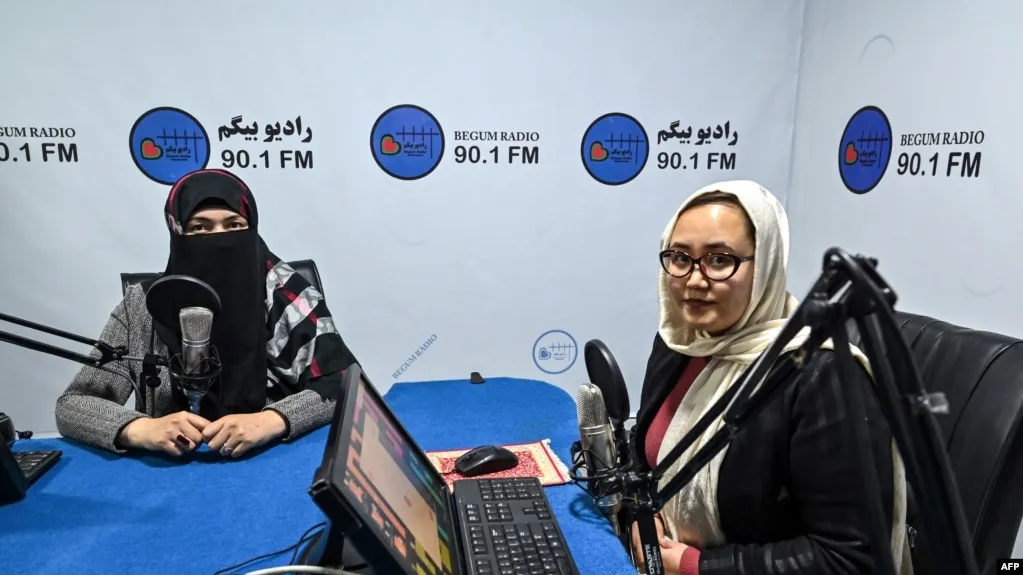
KABUL, Afghanistan — In a rare flicker of defiance against the Taliban’s unrelenting suppression of women and free expression, an Afghan women’s radio station, Radio Begum, is set to resume broadcasts after months of enforced silence. The station, a beacon of female voices in a country where such voices have been systematically stifled, was shut down by the Taliban earlier this year for what the regime called the “unauthorized provision” of content to an overseas television channel and misuse of its broadcasting license.
The announcement of its return, made late Saturday by the Taliban’s Information and Culture Ministry, underscores the precarious tightrope that independent media must walk under the group’s draconian rule.
Radio Begum first crackled to life on International Women’s Day in March 2021, just five months before the Taliban swept back into power following the chaotic withdrawal of U.S. and NATO forces. Its all-female staff produced programming that ranged from education to cultural discussions, offering a lifeline to Afghan women and girls increasingly marginalized by the Taliban’s policies. Its sister outlet, Begum TV, now broadcasts from France, delivering lessons aligned with the Afghan school curriculum for grades seven through 12 — an act of quiet rebellion against the Taliban’s ban on education for girls beyond the sixth grade.
The Taliban’s decision to allow Radio Begum back on air comes with strings attached. According to the ministry’s statement, the station “repeatedly requested” to resume operations and secured approval only after pledging to adhere to “the principles of journalism and the regulations of the Islamic Emirate of Afghanistan.”
The development is as surprising as it is tenuous in a country where the Taliban’s leadership — many of whom face international arrest warrants from the International Criminal Court for crimes against humanity — have shown little tolerance for dissent or intellectual freedom. Since seizing Kabul in August 2021, the group has imposed a suffocating web of restrictions, barring women from universities, workplaces, and public spaces while throttling the media into submission. Female journalists, once a growing presence in Afghan newsrooms, have been particularly hard-hit, with many forced out of their jobs or into exile.
The Taliban’s chokehold on information has plummeted Afghanistan to 178th out of 180 countries in the 2024 Reporters Without Borders press freedom index, a steep fall from its already dismal ranking of 152 the previous year. The regime’s initial justification for suspending Radio Begum — alleging it funneled content to an unnamed foreign TV channel — hints at its paranoia over external influence. Saturday’s statement sharpened the accusation, claiming the station had collaborated with “foreign sanctioned media outlets,” though details remained conspicuously absent.
For the Taliban, control is paramount. The group’s policies reflect a vision of Afghanistan where women are confined to the shadows and intellectual freedom is a threat to be crushed. The ICC warrants, issued against senior Taliban figures for their roles in atrocities including systematic gender-based persecution, have done little to soften their stance. If anything, international condemnation has entrenched their defiance, with leaders like Supreme Leader Hibatullah Akhundzada doubling down on edicts that erase women from public life.
Radio Begum’s return, then, is less a concession than a calculated maneuver — a signal that the Taliban can tolerate limited expression so long as it bends to their will. The station’s promise to avoid “violations in the future” suggests a future of self-censorship, a far cry from its original mission to amplify unfiltered female perspectives. Whether it can still serve as a lifeline for Afghan women, or merely become a mouthpiece for the regime’s propaganda, remains to be seen.
In Taliban-controlled Afghanistan, where the airwaves are as tightly policed as the streets, even a small victory for free expression feels like a mirage. For now, the women of Radio Begum will speak again — but only as loudly as their rulers allow.