 News Desk
In a stunning turn for Pakistan’s powerful military establishment, Lt. Gen. (Ret.) Faiz Hameed, once the head of the country’s feared Inter‑Services Intelligence agency, has been sentenced to 14 years in prison after a court martial found him guilty of abuse of power and violations of the Official Secrets Act.
The verdict, announced Thursday by the Inter‑Services Public Relations, marks the first time a former ISI chief has been tried and convicted by a military court. Hameed, who rose to prominence in 2017 for brokering a deal that ended the Faizabad sit‑in staged by the hardline Tehreek‑e‑Labbaik Pakistan movement, was once considered one of the most influential figures in Pakistan’s political and security landscape. His fall from grace has sent shockwaves through the country’s elite.
Hameed’s conviction carries weight far beyond the courtroom. For years he was regarded as one of the closest allies of former Prime Minister Imran Khan, his tenure at the helm of the ISI overlapping with Khan’s dramatic ascent to power. That association made him a symbol of the military’s hidden hand in politics. Now, analysts say the verdict is more than a personal downfall. It signals a decisive move by Gen. Asim Munir, the current army chief, to reassert control over the institution and to show that even its most powerful figures are not immune to punishment. In a country where generals have long operated above the law, the ruling is being read as both a rare act of accountability and a message that the military is tightening its grip at a moment of political turbulence.
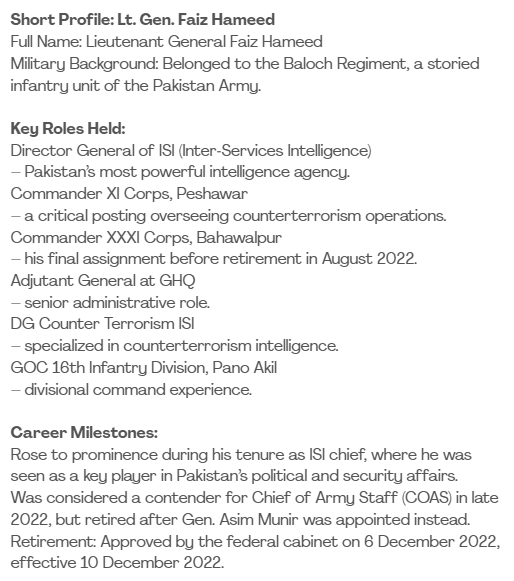
The trial began in August 2024 and stretched over 15 months. Prosecutors accused Hameed of engaging in political activities, misusing state resources, and causing wrongful losses to individuals. He was also charged with violating secrecy laws in ways deemed harmful to national security. According to officials, he was afforded full legal rights, including the ability to appoint his own defence team, and he retains the right to appeal the ruling.
Hameed’s arrest was linked to a petition filed in Pakistan’s Supreme Court by the chief executive of Top City, a private housing society near Islamabad. The petition alleged that Hameed had orchestrated a raid on the property, seizing valuables and engaging in land grabbing. The case became a flashpoint for broader accusations of military interference in civilian affairs. Three other retired officers were also taken into custody in connection with the same housing society scandal.
Observers note that the sentence is unprecedented in a country where generals have often wielded unchecked influence. “This is a watershed moment,” said a senior political analyst in Islamabad. “It shows fractures inside the military establishment and a willingness to punish even those who once shaped political outcomes from behind the scenes.”
Hameed’s career was marked by controversy. Beyond his role in the Faizabad sit‑in, he was accused of meddling in judicial proceedings and influencing political manoeuvring during Khan’s tenure. His later posting as corps commander in Peshawar placed him at the centre of counterterrorism operations, further cementing his reputation as a hard‑edged operator.
The ruling also comes as Pakistan grapples with economic strain and political instability. The government recently secured $1.2 billion from the International Monetary Fund, underscoring the fragility of the country’s finances. Against this backdrop, the conviction of a former spymaster adds another layer of uncertainty to Pakistan’s already volatile landscape.
For now, Hameed sits in military custody, facing years behind bars. His appeal may yet alter the outcome, but the symbolism of the sentence is already clear. Pakistan’s most powerful institution has turned on one of its own, and the reverberations are likely to be felt across the nation’s political and military corridors for years to come.