News Desk
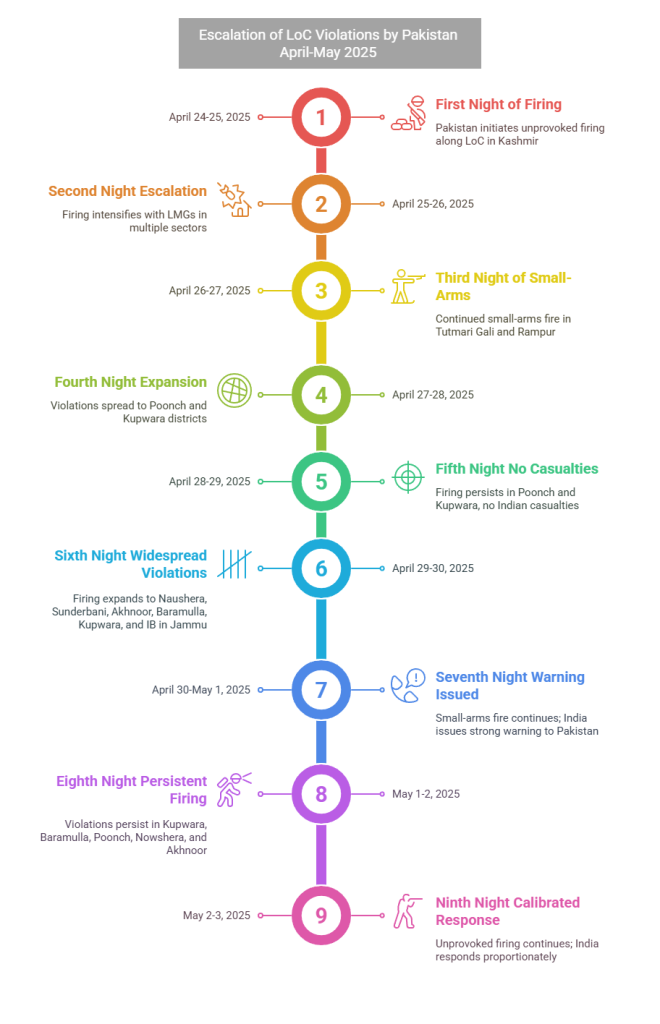
SRINAGAR, India — For nine consecutive nights, Pakistan has shattered the fragile ceasefire along the Line of Control (LoC) and International Border in Jammu and Kashmir, unleashing unprovoked barrages of small-arms fire that threaten to unravel years of relative calm. The brazen violations, which began on April 24, 2025, come on the heels of a deadly terrorist attack in Pahalgam that killed 26 civilians, an act India attributes to Pakistan-backed militants. While Pakistan’s reckless aggression risks plunging the region into deeper instability, India’s measured and resolute response underscores its commitment to defending its sovereignty while maintaining restraint.
The latest spree of violations marks a stark departure from the ceasefire agreement reaffirmed in 2021, which had significantly reduced hostilities along the contested border. Night after night, Pakistani forces have targeted Indian positions in sectors like Kupwara, Poonch, Uri, Akhnoor, and Baramulla, with the most recent firing reported on May 2-3. The attacks, primarily involving small arms and light machine guns, appear designed to provoke or facilitate infiltration by militants—a tactic Pakistan has long employed to destabilize the region. Indian officials and analysts see this as a deliberate escalation, fueled by Pakistan’s frustration over India’s decisive diplomatic moves, including the suspension of the Indus Waters Treaty and the closure of the Attari border crossing following the Pahalgam attack.
Pakistan’s actions are not merely provocative; they are a dangerous gamble that betrays a lack of regard for regional stability. The timing suggests a calculated response to India’s assertive stance, particularly after the April 22 attack, which New Delhi linked to The Resistance Front, a proxy of the Pakistan-based Lashkar-e-Taiba. By resorting to ceasefire violations, Pakistan appears to be doubling down on its support for terrorism, a strategy that has repeatedly isolated it on the global stage. The country’s military establishment, long accused of wielding outsized influence over its foreign policy, seems intent on stoking tensions to distract from domestic challenges, including economic woes and political turmoil.
In contrast, India’s response has been a model of restraint and resolve. Indian forces have retaliated proportionately, using small arms to counter Pakistan’s aggression while avoiding escalation into heavier weaponry. The Indian Army has bolstered its defenses with advanced surveillance tools, including night vision devices and thermal imagers, and launched combing operations to thwart potential infiltrations. No Indian casualties have been reported, a testament to the military’s preparedness and discipline. On the diplomatic front, India has issued stern warnings, including during a hotline conversation between the Directors General of Military Operations on April 29, while engaging with international partners like the United States to press for de-escalation.
India’s broader strategy reflects a deft balance of firmness and diplomacy. The suspension of the Indus Waters Treaty, a bold move, signals that New Delhi will no longer tolerate Pakistan’s proxy war without consequences. Yet, India has stopped short of actions that could spiral into broader conflict, earning praise from observers for its calibrated approach. “India is sending a clear message: it will protect its interests, but it won’t be baited into Pakistan’s trap of escalation,” said Lt. Gen. D.S. Hooda, a retired Indian Army officer who once commanded forces in Kashmir.
Pakistan’s provocations, however, raise troubling questions about its intentions. The ceasefire violations, while limited in scope, fit a pattern of behavior that prioritizes short-term tactical gains over long-term peace. By targeting civilian-heavy areas like Poonch and Kupwara, Pakistan risks alienating the very Kashmiri population it claims to champion. Moreover, its actions undermine the credibility of any diplomatic overtures, such as the DGMO hotline talks, which now appear as little more than a veneer for continued aggression.
As the international community watches, the onus lies squarely on Pakistan to halt its reckless violations and dismantle the terrorist networks that fuel this cycle of violence. The United States and the United Nations have called for restraint, but their appeals will likely fall on deaf ears in Islamabad unless accompanied by stronger pressure. For now, India’s steadfast defense of its borders, coupled with its diplomatic agility, offers a beacon of stability in a region teetering on the edge.