 News Desk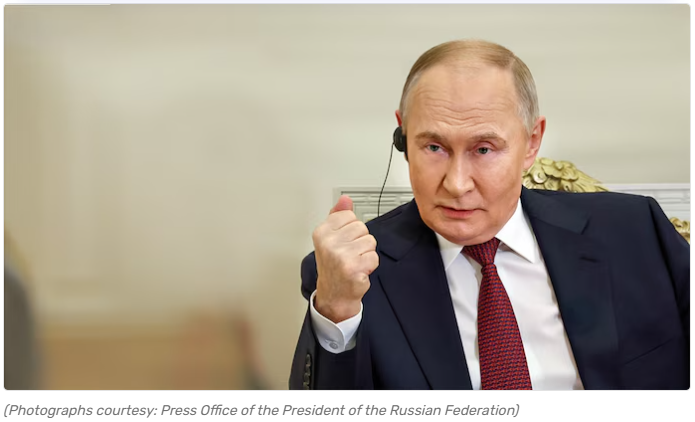
When Vladimir V. Putin sat down with the India Today Group’s TV team of Anjana Om Kashyap and Geeta Mohan at the Kremlin on the eve of his visit, the Russian president was not merely speaking to Indian audiences. He was sending a message to Washington, Brussels, and Beijing: India is no longer a country that can be “arm‑twisted.”
Putin’s remarks, in the 100‑minute interview, were striking in their breadth. He praised Prime Minister Narendra Modi as a “friend” and a leader who sets “challenging tasks” for his nation. He cast India as a central pillar of the Global South, alongside China, Africa, and Indonesia, and insisted that the country’s sovereignty must be respected in a world where power is shifting away from the West. “India is not a British colony anymore,” he declared. “It cannot be treated the way it was 77 years ago.”
Russia’s ties with India have long been defined by military cooperation. Putin reminded his interviewers of India’s reliance on Russian aircraft and the BrahMos missile joint venture and hinted at future collaboration on advanced systems such as the Su‑57 fighter jet and S‑500 air defence. But he was careful to frame the relationship as one of trust, not mere commerce: “We are not simply selling technology—we are sharing it.”
That framing matters. Putin wants India to see Russia not just as an arms supplier but as a partner in high‑technology fields that will shape the future: nuclear energy, space exploration, shipbuilding, aviation, and artificial intelligence. The Kudankulam nuclear project, he noted, is emblematic of Russia’s role in India’s energy sector.
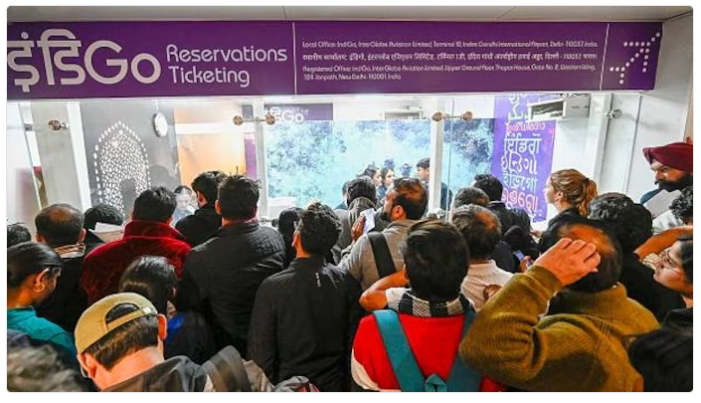
The timing of this interview is no accident. IndiGo’s flight cancellations may dominate domestic headlines, but the larger aviation crisis is mirrored in geopolitics: India is under pressure from Western capitals to reduce its intake of discounted Russian oil. Putin dismissed such tactics as distortions of fair competition. More than 90 percent of bilateral transactions, he pointed out, are already conducted in national currencies.
This is part of a broader push toward de‑dollarization, a theme Putin returned to repeatedly. He argued that India’s growing role in international markets is precisely what some Western actors fear, and that attempts to constrain it will ultimately fail.
On Ukraine, Putin offered familiar talking points: the “special military operation” is a defence of Russian‑speaking populations and a response to NATO expansion. Yet his emphasis was less on the battlefield than on the global order. He dismissed the G8 as irrelevant, preferring platforms like BRICS and the Shanghai Cooperation Organisation, where India sits at the high table.
This is where the interview becomes most revealing. For Putin, India is not just a legacy ally but a symbol of the multipolar world he envisions. He sees New Delhi as a counterweight to Western dominance, a partner in reshaping trade, finance, and technology.
Of course, India’s relationship with China complicates this vision. Putin called both countries Russia’s “closest friends,” and praised Modi and Xi Jinping for applying “maximum effort” to manage disputes. Their “wisdom,” he said, ensures that tensions do not derail broader Asian rebalancing. It was a careful line, designed to reassure both capitals without alienating either.
Putin also reflected on generational tensions, noting that young people are “more mobile, more radical,” and must be engaged through technology. On longevity, he mused that advances in AI and genetic engineering could extend life expectancy, though “everything has an end.” And he recalled the disintegration of the Soviet Union as a cautionary tale against complacency and the accumulation of mistakes. Reintegration, he insisted, is “not on the table.”
Taken together, Putin’s interview was less about India than about the world. By elevating New Delhi as a sovereign power immune to “arm‑twisting,” he sought to position Russia as a partner in India’s rise and to signal to the West that Moscow has alternatives.
For India, the message is flattering but also fraught. Accepting Russia’s embrace means navigating tensions with Washington and Beijing, balancing energy needs with geopolitical risks, and deciding how far to lean into a multipolar order that remains more aspiration than reality.
But one thing is clear: in Putin’s telling, India is no longer a junior partner. It is a major global player, and Russia intends to treat it as such.