News Desk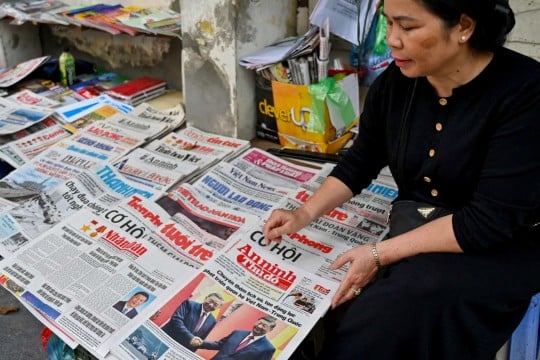
HANOI, Vietnam — As Chinese President Xi Jinping in shuttle trip through Southeast Asia this week, touching down in Vietnam, Malaysia, and Cambodia, his itinerary read like a calculated chess move in a high-stakes trade war. With U.S. President Donald Trump’s tariffs—145% on Chinese goods, 46% on Vietnam, 24% on Malaysia, and 49% on Cambodia—upending global markets, Xi’s visit is less a diplomatic courtesy than a bid to cement China’s grip on a region wary of its ambitions. The tour, starting April 14, 2025, in Hanoi, reveals Beijing’s scramble to offset economic isolation, but it also underscores the limits of its influence in a neighborhood that’s learned to distrust its promises.
Xi’s trip comes as China, the world’s largest exporter, grapples with a $273 billion trade surplus in Q1 2025, fueled by a rush to ship goods before Trump’s tariffs bit harder. In Vietnam, Xi oversaw the signing of 45 agreements, including deals to fund an $8.3 billion railway linking northern Vietnam to China—a project critics say could deepen Hanoi’s reliance on Beijing. Vietnam, which imported $161.9 billion in Chinese goods in 2024, sent $136 billion to the U.S., making it a prime target for Washington’s ire over transshipments. Malaysia, with $101.5 billion in Chinese imports and a $24.8 billion U.S. trade surplus, and Cambodia, whose garments account for 25% of GDP, face similar pressures. Both are expected to ink deals reinforcing trade and infrastructure ties with China, though details remain vague.
Beijing’s pitch is clear: portray itself as a stable counterweight to an erratic Washington. In Hanoi, Xi called for “resisting unilateralism,” a thinly veiled jab at Trump, whose tariffs have forced Southeast Asia to walk a tightrope. Yet, China’s own economic troubles—a sluggish recovery, a property bust, and weak consumer spending—cast doubt on its ability to deliver. The region fears a flood of cheap Chinese goods, rerouted from U.S. markets, could swamp local industries. Vietnam, for instance, has already slapped anti-dumping duties on Chinese steel to protect its factories.
Southeast Asia’s response to Xi’s charm offensive is a study in calculated ambivalence. In Vietnam, where memories of Chinese aggression in the South China Sea linger—Beijing’s ships recently harassed Vietnamese fishermen—public enthusiasm was tepid despite state media’s warm rhetoric. Hanoi’s leaders, practicing “bamboo diplomacy,” signed deals with Xi but sent Deputy Prime Minister Ho Duc Phoc to Washington to negotiate tariff relief, offering to buy U.S. defense gear and deploy Elon Musk’s Starlink. Malaysia, under Prime Minister Anwar Ibrahim, sees Xi’s visit as a trade booster but treads carefully, mindful of its role as 2025 ASEAN chair and the Strait of Malacca’s strategic weight. Cambodia, China’s staunchest ally, will welcome Xi’s largesse but risks becoming a vassal state, with its economy tethered to Beijing’s loans and naval base projects.
“Vietnam welcomes Xi to ease economic pain, but it’s not about to pick sides,” said Khang Vu, a scholar at Boston College. “Hanoi knows China’s help comes with strings.” Malaysia’s Communications Minister Fahmi Fadzil echoed cautious optimism, framing Xi’s visit as a chance for “better trade relations,” but analysts warn of overexposure to Chinese investment. Cambodia’s Prime Minister Hun Manet, inheriting his father’s Beijing tilt, faces little domestic pushback, but regional observers see Phnom Penh’s alignment as a liability in a multipolar world.
Beyond Southeast Asia, Xi’s tour has drawn sharp scrutiny. Trump, never one for subtlety, labeled it an attempt to “screw” the U.S., reflecting Washington’s view that China is exploiting tariff-hit nations to dodge sanctions. The New York Times and The Guardian depict Southeast Asia as caught in a vise, with China’s reliability questioned amid its economic slowdown. “Xi’s promises sound grand, but can China deliver when its own house is shaky?” asked a Guardian editorial. Japan and South Korea, fresh from trilateral talks with China, watch warily, prioritizing their own U.S. ties. India, sees Beijing’s moves as a challenge to its Global South clout.
Online, the reaction is polarized. Posts on X laud Xi’s defiance of Trump—“China’s playing 4D chess,” one user wrote—while others scorn Beijing’s motives: “Vietnam still remembers the Spratlys. Xi’s just buying loyalty.” These sentiments, though inconclusive, mirror a broader unease: China’s outreach may win short-term allies but risks long-term resentment.
Xi’s Southeast Asian tour is a bold play, but it’s not a checkmate. China’s $962.98 billion trade with ASEAN in 2024 dwarfs the U.S.’s $476.8 billion, yet its neighbors hedge their bets, negotiating with Washington while pocketing Beijing’s deals. The railway in Vietnam, naval base in Cambodia, and trade pacts in Malaysia may look like wins, but they come with caveats—debt traps, territorial tensions, and the specter of Chinese overreach. As one Vietnamese analyst put it, “Xi’s here to help, but we’ve seen this movie before.” For a region eyeing both superpowers with equal parts need and suspicion, China’s embrace feels less like salvation and more like a deal with a catch.