News Desk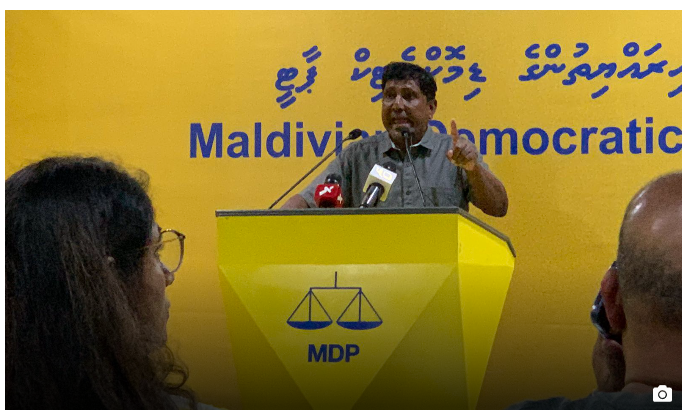
The Maldivian Democratic Party (MDP), once the dominant force in the country’s democratic transition, is now grappling with internal fractures and external pressures, as its leaders warn of “deceptive traps” laid by rivals seeking to weaken the party.
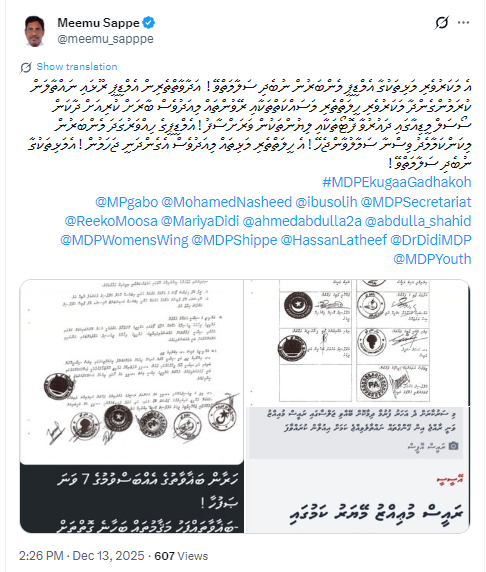
In a post on X, Amed Shafeeq—better known among party loyalists as Meemu Sappe—issued a stark warning to members of the Maldivian Democratic Party. He cautioned supporters against what he described as “cunning attempts and plots” circulating on social media, pointing to photos and articles that he claimed revealed coordinated efforts to undermine the party. “It is very clear from the photos and articles that the enemies are still going ahead with their efforts to destroy the MDP,” Shafeeq wrote, attaching documents he said illustrated the scale of the threat. He urged members to remain vigilant, warning that “the deceptive traps are still being set today.”
The remarks come at a time of renewed turbulence in Maldivian politics. The MDP, which once commanded a majority in Parliament and produced two presidents, has been weakened since losing power in 2023. Former President Ibrahim Mohamed Solih’s defeat to Mohamed Muizzu of the People’s National Congress (PNC) left the party with just 12 seats in the 93-member legislature. Since then, the MDP has struggled to maintain cohesion, even as prominent figures like Mohamed Nasheed recently announced their return to the party after a period of estrangement.
The party’s leadership has sought to revive its pro-democracy credentials, staging rallies under the banner of “Citizens in defence of the Constitution.” These efforts are aimed at countering Muizzu’s controversial anti-defection law, which critics say consolidates power in the ruling coalition and undermines parliamentary independence.
Yet the MDP’s internal divisions remain stark. Some members of The Democrats—a splinter group formed after Nasheed’s departure—have resisted reintegration, highlighting the difficulty of rebuilding a unified opposition. Meanwhile, party leaders have increasingly turned to international diplomacy, with MDP president Abdulla Shahid meeting European Union ambassadors in Colombo in September to seek support amid what he described as a deepening political crisis.
Against this backdrop, the warnings about “traps” resonate as both metaphor and reality. In a country where social media has become a battleground for political narratives, MDP leaders fear that misinformation campaigns could erode their already fragile base. The party’s critics, however, argue that such rhetoric reflects desperation rather than strategy, pointing to the MDP’s declining influence in Parliament and its inability to present a coherent alternative to Muizzu’s government.
Still, the MDP’s legacy as the architect of the Maldives’ democratic opening in 2008 gives its words weight. For many supporters, the party remains a symbol of resistance against authoritarianism. Whether it can translate that legacy into renewed political relevance will depend on its ability to navigate both the external pressures of a dominant ruling coalition and the internal fissures that continue to weaken its ranks.
In the Maldives today, the struggle is not only for jobs and economic stability, but for the survival of a party that once embodied the nation’s democratic aspirations.