News Desk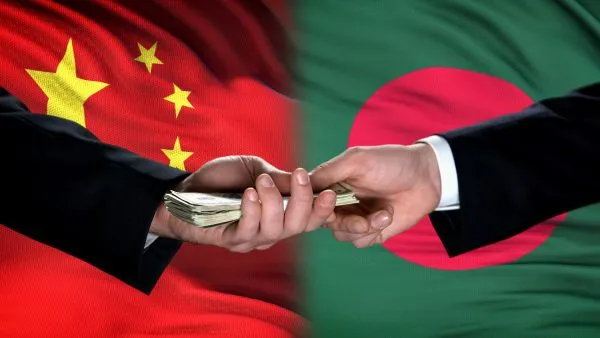
BEIJING — A delegation of 22 Bangladeshi officials, including political leaders and civil society figures, arrived in China for a 10-day visit, the latest sign of Beijing’s efforts to deepen its influence in South Asia. The trip, initiated by China, comes as Bangladesh’s relations with its longtime ally India grow strained, offering Beijing an opening to pull Dhaka closer into its orbit. Analysts see the move as part of China’s broader strategy to counterbalance India and expand its foothold in the region — a playbook it has used before, notably with Sri Lanka. But that history also casts a shadow over China’s promises, raising questions about what happens when its partners face trouble.
The Bangladeshi delegation, led by Abdul Moyeen Khan of the Bangladesh Nationalist Party (BNP), will meet with Chinese government officials and Communist Party leaders, signaling an intent to build ties across the political spectrum. “It’s a goodwill visit,” Khan told the BBC, though the timing — amid a political vacuum in Dhaka following the ouster of former Prime Minister Sheikh Hasina — suggests more than just pleasantries. China has stepped up its outreach since Hasina’s fall, hosting BNP officials late last year and engaging with Islamist parties like Jamaat-e-Islami. With bilateral trade already at $24 billion, mostly Chinese exports, Beijing is positioning itself as an economic lifeline for Bangladesh’s 170 million people.
This charm offensive mirrors China’s approach in Sri Lanka over the past two decades. There, Beijing poured billions into infrastructure — ports, highways, an airport — under its Belt and Road Initiative, winning favor with successive governments. The Hambantota Port, a $1.5 billion project, became a symbol of China’s ambitions, promising economic growth and jobs. Sri Lanka’s leaders, eager for development without the strings of Western loans, embraced the deal. By 2017, though, the country was drowning in debt, with China holding about a fifth of its $7.4 billion foreign obligations. When Sri Lanka couldn’t pay, China took a 99-year lease on the port, a move critics called a debt trap.
Then came Sri Lanka’s 2022 economic collapse. Foreign reserves evaporated, fuel and food shortages sparked protests, and the government defaulted on its debts. China, despite its earlier largesse, offered little relief. It pledged just $74 million in humanitarian aid — a fraction of the $4 billion India rushed in — and dragged its feet on debt restructuring until international pressure mounted. “China builds relationships when the sun is shining,” said Ruwanthi Perera, a Colombo-based political analyst. “But when the storm hits, it’s nowhere to be found.”
That pattern has implications for Bangladesh. China’s investments there — a $3.6 billion bridge, a $1.2 billion submarine base — have fueled growth and military ties. Dhaka joined the Belt and Road in 2016, and China accounts for 74 percent of its arms imports. Yet, as Bangladesh navigates its own challenges, including political instability and a looming election, some worry it could face a similar fate. “The debt trap fears aren’t baseless,” said Shahab Enam Khan, a professor at Jahangirnagar University. “But Bangladesh’s returns on these projects are higher than Sri Lanka’s were. It’s not a straight repeat.”
Still, China’s track record suggests a transactional approach: lavish support to secure loyalty, followed by a hands-off stance when crises hit. In Sri Lanka, the port lease became a geopolitical win for Beijing, giving it a strategic perch in the Indian Ocean. Bangladesh, at the crossroads of South and Southeast Asia, offers similar appeal — a gateway to the Bay of Bengal and a buffer against India. But if Dhaka leans too heavily on China, it risks being left exposed when the bill comes due.
For now, Beijing’s overtures are working. India’s refusal to extradite Hasina, who fled to New Delhi after her ouster, has fueled anti-India sentiment in Bangladesh, creating space for China to step in. “Delhi can’t assume the subcontinent is its backyard,” said Zhou Bo, a Chinese analyst at Tsinghua University. “That attitude opens doors for us.” Yet, Sri Lanka’s experience lingers as a cautionary tale: China’s embrace may feel warm — until it doesn’t.