News Desk
Donald Trump’s latest economic gambit—a chaotic overhaul of world trade and logistics unveiled on April 2, 2025—has unleashed havoc, with his “Liberation Day” tariffs threatening to upend global markets. As the U.S. imposes a 27% duty on Indian goods starting April 9, fears mount that India, a linchpin of stability in the neighborhood and the Global South, could face economic turbulence. Nations whose economies lean on India’s robust trade and manufacturing—from South Asia to Africa and beyond—now brace for ripple effects that could destabilize an already fragile region. This WideLensReport special article examines the fallout of Trump’s reckless trade policy on India, exploring how his miscalculations not only imperil a key U.S. partner but also risk undermining the broader global economic order.
India: A Stabilizing Force Under Siege
Donald Trump’s latest economic gambit—a sweeping set of “reciprocal tariffs” unveiled under the grandiose banner of “Liberation Day”—is a masterclass in miscalculation. Among the targets, India faces a 27% duty on its goods entering the U.S. starting April 9, a move Trump justifies by claiming India levies tariffs as high as 52% on American products. The reality? His numbers are a fiction, his methodology a farce, and the fallout threatens to destabilize not just the U.S. economy but the global trade order. India, meanwhile, stands poised to weather the storm with resilience and even seize opportunities amid the wreckage.
The Tariff Math That Doesn’t Add Up
Trump’s assertion that India imposes a 52% tariff on U.S. goods—part of a broader narrative of foreign trade abuses—isn’t just exaggerated; it’s a deliberate distortion. The truth, grounded in data from the World Bank and the U.S. Trade Representative (USTR), paints a starkly different picture.
India’s weighted mean applied tariff on all imports was 6.1% in 2022, with a simple average ranging from 12% to 17% depending on the sector.
For U.S. goods specifically, the average applied tariff hovers around 12-14%. Yes, outliers exist—luxury goods like wines can face duties up to 150%, and agricultural products like almonds might hit 40-120%—but these are exceptions, not the rule.
The bulk of U.S. exports to India, such as machinery ($11 billion in 2024) and mineral fuels ($8 billion), face tariffs of 5-20%.
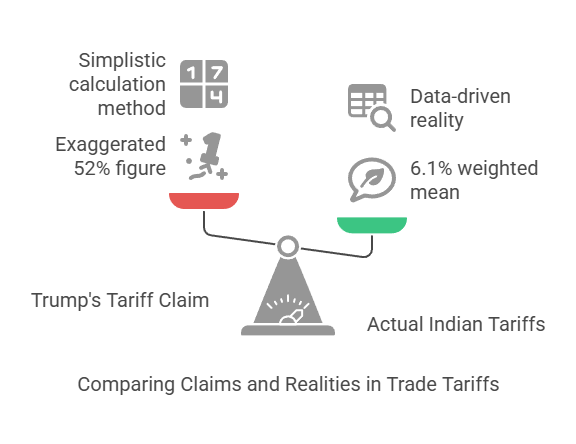
Financial journalist James Surowiecki exposed the sham behind Trump’s figures, revealing that the administration didn’t calculate actual tariff rates or non-tariff barriers as claimed. Instead, “they just took our trade deficit with [each] country and divided it by the country’s exports to us,” he posted on X, calling it “extraordinary nonsense.”
For India, the U.S. trade deficit was $46 billion in 2024, with Indian exports to the U.S. at $87.4 billion. That crude division yields roughly 52%, which Trump then halved to 27%—a number he touted as “kind.”
Economist Paul Krugman, baffled by similar distortions (like the EU’s alleged 39% tariff, when it’s actually under 3%), has lambasted the approach as baseless.
Washington Post columnist Catherine Rampell, initially skeptical of Surowiecki’s theory, conceded its accuracy after USTR confirmation, decrying the “dumb calculation” driving policy.
A Global Economy in Trump’s Crosshairs
The consequences of this tariff tantrum are already reverberating. U.S. stocks tumbled in after-hours trading on April 2, with Dow Jones futures shedding over 1,000 points—a 2.5% drop—and the S&P 500 plunging 3.6%. Asian markets followed suit, and the dollar weakened as investors braced for chaos. “Stuff is going to get a lot more expensive really fast,” warned Semafor’s Liz Hoffman, a sentiment echoed by former Treasury Secretary Lawrence Summers, who posted, “Never before has an hour of Presidential rhetoric cost so many people so much.” He pegged the global economic loss at $30 trillion—$300,000 per U.S. family of four. Former Vice President Mike Pence called it “the largest peacetime tax hike in U.S. history.”
JPMorgan warned that full implementation could “push the U.S. and global economy into recession this year,” a view shared by Brad Setser of the Council on Foreign Relations. “In the short run, the effect is probably a recession,” Setser told the Washington Post. “In the long run, it’s a vision of the U.S. that is very isolated from the world.”
American consumers, already reeling from a first-quarter market dip and a twelve-year low in confidence, now face higher prices on everything from Indian textiles to Vietnamese electronics (slapped with a 46% tariff). Trump’s carve-outs for semiconductors and steel do little to soften the blow.
India’s Economic Resilience Shines
For India, the 27% tariff is a challenge but not a catastrophe. Exports to the U.S., valued at $87.4 billion in 2024, account for just 2.2% of India’s GDP—far less than Vietnam’s 25% reliance.
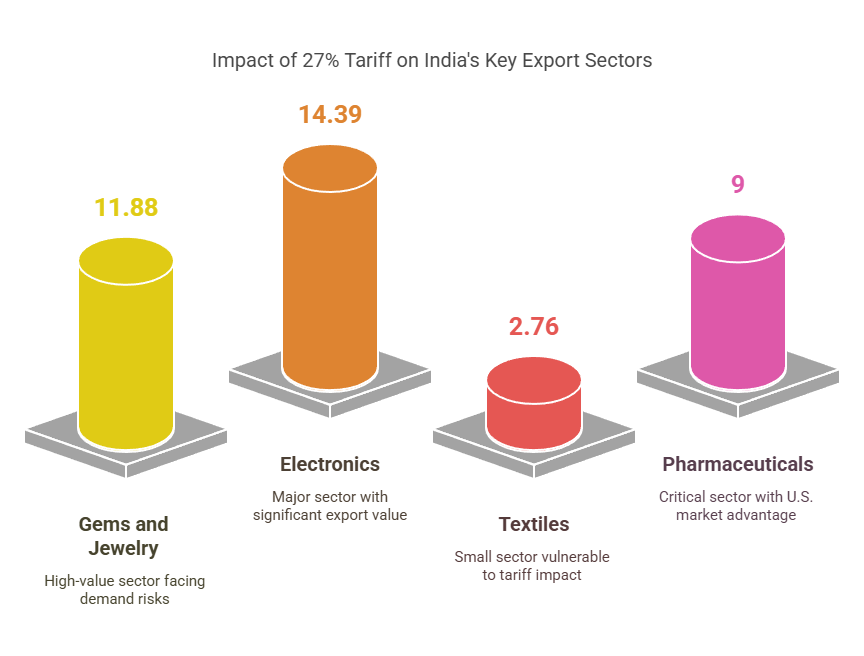
Estimates suggest annual export losses of $2 billion to $7 billion, potentially trimming 5-10 basis points off India’s projected 6.6% GDP growth for 2025-26. Key sectors like gems and jewelry ($11.88 billion), electronics ($14.39 billion), and textiles ($2.76 billion) will feel the pinch, with tariff hikes raising costs for U.S. buyers and risking demand drops.
Small exporters, already squeezed by logistics costs, may struggle, as Abhijit Das, former head of the Centre for WTO Studies, noted to the BBC: “Many are small manufacturers who will struggle to absorb a 27% tariff hike.”
Yet India’s story is one of opportunity amid adversity. Pharmaceuticals, a $9 billion export lifeline supplying nearly half of U.S. generic drugs, are exempt—for now—preserving a critical edge. Higher tariffs on rivals like China (34%) and Bangladesh (37%) could shift U.S. market share to India in textiles and steel, where it boasts robust capacity.
Ajay Sahai of the Federation of Indian Export Organisations told Reuters that India’s “export competitiveness would be less impacted than key rivals,” highlighting potential gains in apparel and footwear. India’s trade ministry is optimistic, studying “opportunities that may arise due to this new development,” per a statement.
Negotiation and Diversification: India’s Playbook
India isn’t sitting idle. New Delhi is mulling tariff cuts on $23 billion of U.S. imports—machinery, wood products, and more—to blunt the impact, with talks targeting a deal by autumn 2025. This builds on a February pledge between Trump and Prime Minister Narendra Modi to boost bilateral trade to $500 billion by 2030. Unlike Trump’s bluster, India’s approach is measured, leveraging its $129.2 billion trade relationship with the U.S. (including a $41.8 billion U.S. export flow) to negotiate rather than retaliate. A 2019 tit-for-tat of $240 million in duties on U.S. goods shows India can push back, but Modi’s government seems focused on de-escalation.
Longer term, India could pivot to the EU or China to offset U.S. losses, though global demand and logistics will test this strategy. Its domestic consumption-driven economy—less export-dependent than peers—offers a buffer, ensuring stability even as Trump’s tariffs roil others.
The U.S. Deficit Obsession Misses the Point
Trump’s fixation on the $46 billion U.S. goods trade deficit with India ignores the bigger picture. That figure, while real, is dwarfed by deficits with China ($367 billion) and the EU ($235.6 billion), yet India faces a disproportionate 27% levy. The U.S. enjoys a services trade surplus with India, thanks to IT and outsourcing, but Trump’s goods-only lens distorts the narrative. His tariffs aim to shrink deficits, but as Krugman and others argue, they’re more likely to shrink the U.S. economy itself.
India, by contrast, emerges as a pragmatic player—navigating Trump’s folly with a mix of resilience, strategic exemptions, and diplomatic finesse. While the U.S. risks isolation and recession, India’s adaptability could turn this trade war into a proving ground for its economic mettle. Trump’s tariff blunder may cost the world dearly, but India is poised to shine through the chaos.