 News Desk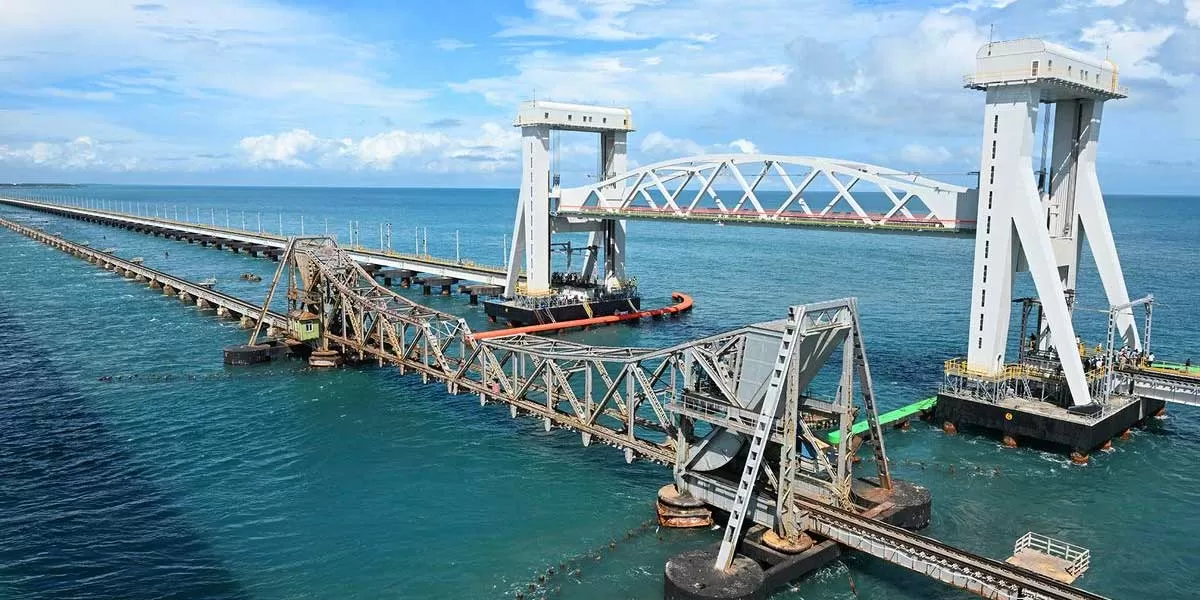
RAMESWARAM, India — On Sunday, Prime Minister Narendra Modi inaugurated the new Pamban Bridge, India’s first vertical-lift sea bridge and a striking symbol of modern engineering. Stretching 2,070 meters across the Palk Strait in Tamil Nadu, the structure links the sacred island of Rameswaram to the mainland, replacing a 110-year-old colonial-era relic with a testament to India’s growing infrastructure prowess.
Built by Rail Vikas Nigam Limited (RVNL), a public sector enterprise under the Ministry of Railways, the bridge features a 72.5-meter vertical-lift span that rises 17 meters in just over five minutes to allow ships to pass beneath—while still supporting trains traveling at speeds up to 75 kilometers per hour.
Constructed at a cost of over ₹550 crore (approximately $66 million), the bridge comprises 99 spans of 18.3 meters each, plus the towering navigational span. It’s built to endure cyclone-strength winds of up to 230 kilometers per hour and withstand the corrosive marine environment of the Bay of Bengal. Innovations include stainless steel reinforcements, high-grade protective coatings, and a fully automated electro-mechanical system—marking a leap from the manually operated Scherzer rolling lift bridge built by the British in 1914, which was decommissioned in 2022.
RVNL employed the Auto Launching Method with hydraulic jacking to position the massive lift span—a technique highlighting India’s cutting-edge approach to bridge construction in challenging coastal environments.
Meanwhile, in the far north, Afcons’ Chenab Bridge, completed in 2022, soars 359 meters above the riverbed in Jammu and Kashmir. This 1,315-meter-long steel arch bridge overcame seismic risks and rugged Himalayan terrain, setting a global benchmark in engineering. Last week, Afcons also made headlines in the Maldives, erecting a massive precast structure that further showcased the company’s cross-border capability and India’s expanding infrastructure footprint.
From the southern tip of Tamil Nadu to the Himalayan heights, and now across the Indian Ocean, Indian engineering giants like RVNL and Afcons are leaving an indelible mark—one of ambition, precision, and innovation.
For Rameswaram, a pilgrimage hub steeped in myth and home to the Ramanathaswamy Temple—which draws more than 25 lakh devotees annually—the bridge is a transformative development. The old structure had reduced train speeds to a crawl, taking 25 minutes to cross. The new bridge cuts that to under five minutes, promising a major boost to both tourism and regional trade. In a nod to Ram Navami, Mr. Modi also flagged off a new Rameswaram–Tambaram train service and dedicated infrastructure projects worth over ₹8,300 crore across Tamil Nadu, elevating the day’s significance.
From the Pamban’s hydraulic precision to the Chenab’s vertiginous heights, India’s engineers are bridging the extremes—south to north, and beyond. These achievements not only connect geographies but also signal the nation’s rise as an engineering powerhouse, fusing its past and future with steel and resolve.