News Desk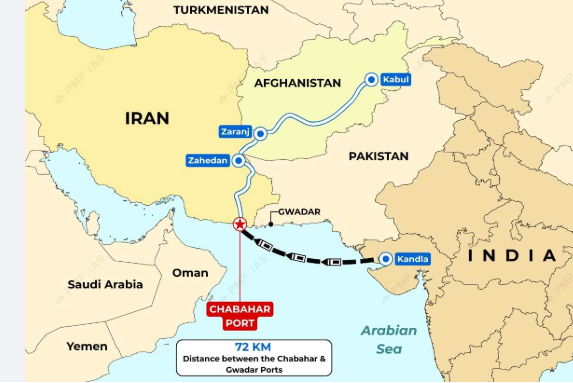
In a boost to its geopolitical and economic stature, India is cementing its role as a key player in the Eurasian trade landscape through strategic investments in the Chabahar Port and the International North-South Transport Corridor (INSTC). These developments not only enhance India’s connectivity with Central Asia and Russia but also position it as a vital partner in the burgeoning BRICS infrastructure revolution.
The Chabahar Port, located on Iran’s southeastern coast, has long been a cornerstone of India’s strategy to bypass Pakistan and access landlocked Afghanistan and Central Asian markets. Recent developments have seen India Ports Global Ltd (IPGL) sign a long-term contract with Iran’s Ports and Maritime Organization to develop the Shahid Beheshti Port Terminal.
This agreement, part of a broader vision to integrate Chabahar into global trade networks, underscores India’s commitment to transforming the port into a regional hub. The port’s strategic location on the Gulf of Oman provides a direct route to the Indian Ocean, significantly reducing transit times and costs for goods moving between India, Iran, and beyond.
Parallel to these efforts, India is making substantial strides in the INSTC, a multi-modal transport route that connects India to Russia via Iran, Azerbaijan, and other Central Asian countries. The corridor, which leverages a combination of rail, road, and sea transport, aims to cut down the travel time for goods between Mumbai and Moscow from approximately 40 days to just 16-21 days. India’s recent focus on the INSTC includes infrastructural upgrades and policy initiatives to ensure seamless connectivity.
For instance, the operationalization of the INSTC’s rail component, with the first scheduled freight train from Russia arriving in Iran on November 8, 2025, marks a milestone in this endeavour. This train, part of a broader pact to handle 40 million tonnes of freight annually by 2026, highlights the corridor’s potential to revolutionize trade dynamics.
India’s proactive approach is further evidenced by its collaboration with Russia and Iran to enhance the INSTC’s efficiency. The corridor not only facilitates trade but also strengthens diplomatic ties among the three nations. India’s investment in Chabahar and its role in the INSTC are seen as counterbalances to China’s Belt and Road Initiative, offering an alternative trade route that prioritizes Indian interests and regional stability.
These developments come at a time when global trade patterns are shifting, with the BRICS nations increasingly focusing on infrastructure to counter Western dominance. India’s efforts are not just about economic gains; they also reflect a broader strategy to assert its influence in a multipolar world. By leveraging Chabahar and the INSTC, India is not only enhancing its trade capabilities but also fostering stronger ties with Russia and Iran, two key players in the Eurasian geopolitical chessboard.
As these projects advance, they promise to reshape regional trade dynamics, offering a glimpse into a future where India plays a pivotal role in connecting East and West. This underscores India’s rising prominence as a facilitator of international trade and a beacon of stability in an increasingly complex world.