News Desk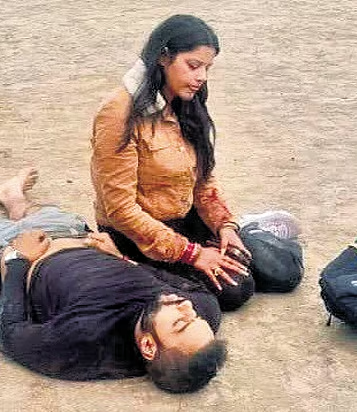
India marked one year since the April 22, 2025 Pahalgam terror attack, which killed 26 people in Jammu and Kashmir. The victims included Hindu tourists and a Nepalese national. The attack took place in the Baisaran meadow area near Pahalgam. Three armed militants infiltrated from across the border and carried out a targeted assault based on religious profiling. The incident became one of the deadliest attacks in the region in recent years.
Investigators identified the attackers as members of The Resistance Front, a group linked to Lashkar‑e‑Taiba. Evidence connected the operation to Pakistan‑based handlers. Indian agencies traced communication patterns, weapons signatures and infiltration routes to networks operating from Pakistan. Officials stated that the attackers separated men from women and children and executed victims at close range after demanding religious identification.
India responded with a multi‑layered strategy that combined military, intelligence and diplomatic actions. The most significant step was Operation Sindoor, launched on the night of May 6–7, 2025. Indian forces conducted precision strikes on nine terror camps in Pakistan and Pakistan‑administered Kashmir. The strikes targeted infrastructure linked to Lashkar‑e‑Taiba, Jaish‑e‑Mohammed and Hizbul Mujahideen. Officials stated that more than 100 militants and trainers were eliminated. Indian forces used long‑range cruise missiles and air‑launched systems to strike high‑value sites while avoiding civilian areas.
The strikes triggered a brief period of military escalation between India and Pakistan. During this phase, the Indian Air Force demonstrated technological advantages, including the use of BrahMos supersonic cruise missiles and electronic warfare systems. Indian strikes also targeted multiple airbases. Analysts described this period as a demonstration of India’s ability to conduct deep, coordinated operations.
Parallel to the cross‑border strikes, India launched Operation Mahadev to track down the three Pahalgam attackers. The operation lasted more than 90 days and covered dense forests and mountainous terrain. Security forces used drones, surveillance aircraft and real‑time intelligence to narrow the search area. On July 28, 2025, Indian Special Forces neutralised all three militants after a prolonged pursuit.
India also initiated a diplomatic campaign to highlight Pakistan’s role in cross‑border terrorism. Indian delegations shared evidence with partner countries and international organisations. Several governments condemned the attack and expressed support for India’s counter‑terrorism efforts. India suspended elements of the Indus Waters Treaty, expelled Pakistani diplomats and strengthened border controls.
The Pahalgam attack led to a new counter‑terror doctrine that integrates military, intelligence and diplomatic tools. Indian officials stated that the country would respond to major attacks with decisive action across multiple domains. They also rejected the idea that nuclear escalation threats could limit India’s response.
International observers noted India’s attempt to balance force with restraint. They highlighted the focus on targeting terror infrastructure while avoiding civilian harm. The combination of military precision and diplomatic outreach strengthened India’s position in global counter‑terror discussions.
As the anniversary approached, public remembrance focused on the victims and the families affected. Images of survivors and relatives, including the widow of Lieutenant Vinay Narwal, remained central to national reflection. The Indian Army stated that the response to the attack demonstrated the country’s resolve to protect civilians and dismantle terror networks.
India continues to emphasise that the Pahalgam attack represents a turning point in its security posture. Officials describe the past year as a period in which India combined operational capability with strategic messaging to deter future attacks. The government maintains that cross‑border terrorism will meet a firm and coordinated response.