News Desk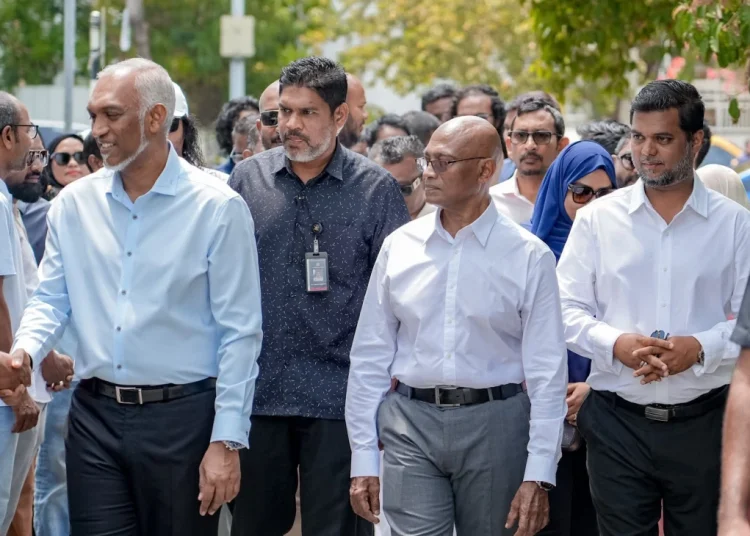
Moosa Ali Jaleel’s life has been shaped by service. For more than three decades he wore the uniform, rising through the ranks and standing on the front line during one of the country’s darkest hours. Today, at 63, he is walking through the narrow lanes of Malé with a different mission. No rifle. No command post. Just a promise that the city deserves a mayor who serves, not a politician who performs.
Jaleel, contesting the Malé mayoral seat on the PNC ticket, rejects the idea that the mayor’s office is a political platform. He calls it a service post, one that should focus on municipal needs rather than party battles.
“I will be fair to all the people living in the city,” he said during a recent visit to homes in Maafannu and Henveiru. “You don’t have to be a politician to provide municipal services. You need to listen, work with the government and deliver.”
Jaleel is one of the few surviving officers who fought back during the 3 November 1988 attack. At the time, he was commander of the MNDF Headquarters Task Force. He retired in 2012 after 32 years of service and was awarded the highest service award last year for his role in defending the country.
He speaks of that day without embellishment. It was duty then, he says, and this is duty now. “I defended the people. Today I want to serve them.”
Malé has seen several mayors, most of them from the MDP. Yet Jaleel argues that the city’s core problems have remained unchanged because of weak management.
He believes the most effective period was during President Dr Mohamed Muizzu’s two years as mayor. “If any mayor had treated the council as a service institution, people would not be living like this today,” he said.
Jaleel insists he will not be a mayor for one party. “I belong to a party, but that will not affect the service I give. Fairness is the only way.”
Malé’s congestion is a problem every mayor has promised to fix. Jaleel says the solution is not widening roads. “Every house is full. People will not agree to give up parts of their homes. So widening roads is not an option.”
His proposal is straightforward: build parking buildings across the city. With no dedicated parking structures, vehicles spill onto the streets, narrowing already tight roads.
He points to recent improvements under the current administration, including the MTCC completed road from the Izzuddin Jetty to the North Harbour and the redesign of the fish market area.
“These changes happened because of President Dr Muizzu’s planning,” he said. A project is now underway to widen the road from the official jetty to the Henveiru ferry terminal.
Jaleel’s visits to homes across Malé have left a deep impression. He describes families of three or four living in rooms barely ten feet by ten feet, with low ceilings and no ventilation.
“You raise your hand and touch the ceiling. Many people live in very poor conditions. Not everyone, but far too many,” he said. “Some have to put partitions inside already tiny rooms. It is heartbreaking.”
He says this is the main reason he decided to run.
Jaleel says he will work within President Muizzu’s Strategic Action Plan, which the president had drafted when he himself intended to run for mayor five years ago.
“There will be minor changes, but they will be made in consultation with the government,” he said. “The city council cannot function without working with the government.”
He warns that if a mayor with a different ideology takes office, progress will stall. “If someone who does not want to work with the government becomes mayor, things will be delayed. We have already seen this.”
Jaleel’s campaign is built on the idea that Malé needs a manager, not a performer. His critics say a soldier cannot run a city. He responds with the same calm he carried through his military years.
“I have spent my life serving this country. This is simply another form of service.”
Whether voters agree will be known soon. But as he walks through the city’s crowded lanes, stopping at doorsteps and listening to stories of cramped rooms and rising costs, Jaleel seems certain of one thing: Malé deserves better, and he believes he can deliver it.
This interview was originally published on Vaguthu Online.