News Desk
China is expanding its global economic and strategic influence while European states increase their dependence on Chinese technology, infrastructure, and finance. The trend is most visible in energy transition industries and global trade routes, and it is raising concern in Europe about future autonomy and security.
China now dominates key sectors that underpin the global green transition. It controls about 80 per cent of global solar panel production, 75 per cent of battery manufacturing, and 70 per cent of electric vehicle output. This dominance gives China strong leverage over future energy and mobility systems.
European Union institutions promote a Green Transition and present Europe as a leader in climate policy. However, Europe relies heavily on Chinese components and technology to implement these policies. European countries have reduced dependence on Russian gas, but they have replaced it with dependence on Chinese solar, battery, and electric vehicle supply chains.
Analysts warn that this pattern creates a strategic vulnerability. Europe builds its future energy systems on imported Chinese technology and, in many cases, on Chinese credit. This dependence can limit Europe’s ability to act independently in foreign policy, industrial policy, and security policy.
China is also expanding its control over global trade infrastructure. Chinese companies participate in port projects in more than 90 countries. These projects include ports in Europe. Through these investments, China gains influence over important maritime routes and logistics hubs that support global trade.
Observers describe these ports as potential strategic outposts. They argue that control over port operations can give China leverage in future economic or political disputes. Control over logistics and shipping can also shape which countries gain or lose from changes in global trade flows.
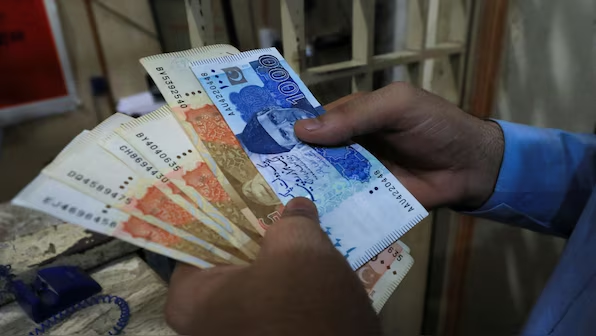
Another area of concern is the international financial system. Chinese policymakers aim to increase the role of the renminbi as a global reserve currency. If the renminbi becomes a widely used alternative to the dollar and the euro, it could reduce the financial advantages that Western countries currently enjoy.
For decades, the dominance of the dollar and the euro has allowed Western governments to borrow at relatively low cost and to finance extensive social welfare systems. If more countries shift reserves and transactions to the renminbi, Western borrowing costs could rise. This shift could limit the ability of European governments to fund social programmes and maintain current levels of public spending.
At the same time, the United States remains heavily engaged in conflicts and crises in the Middle East, including tensions involving Iran. Critics argue that this focus drains Western attention and resources, while China concentrates on long-term technological and economic gains.
China invests in artificial intelligence, robotics, and advanced manufacturing. These sectors are likely to shape global power over the next decades. In contrast, European governments spend significant effort on regulatory frameworks that some industry voices see as restrictive. This contrast raises fears that Europe may fall behind in innovation and industrial capacity.
The combined effect of industrial decline, regulatory pressure, and external dependence worries many European commentators. They warn that Europe risks becoming a “vassal continent” in economic terms. In this scenario, Chinese companies would own or control critical infrastructure, supply chains, and technologies that Europe needs for energy, transport, and digital systems.
Such a situation could give China indirect influence over European political decisions. If European economies rely on Chinese technology and finance, policymakers may face pressure to avoid actions that could threaten access to those resources. This pressure could affect positions on security, human rights, trade disputes, and alliances.
Critics argue that Europe must rebuild industrial capacity, diversify supply chains, and reduce strategic dependence on any single external power. They call for investment in domestic manufacturing of solar panels, batteries, and electric vehicles, as well as stricter screening of foreign investments in critical infrastructure such as ports.
They also urge European leaders to align climate, industrial, and security policies. In their view, Europe must treat energy transition technologies not only as environmental tools but also as strategic assets. Without such a shift, they warn that Europe may lose the ability to shape its own future and may instead adapt to decisions made in Beijing.