News Desk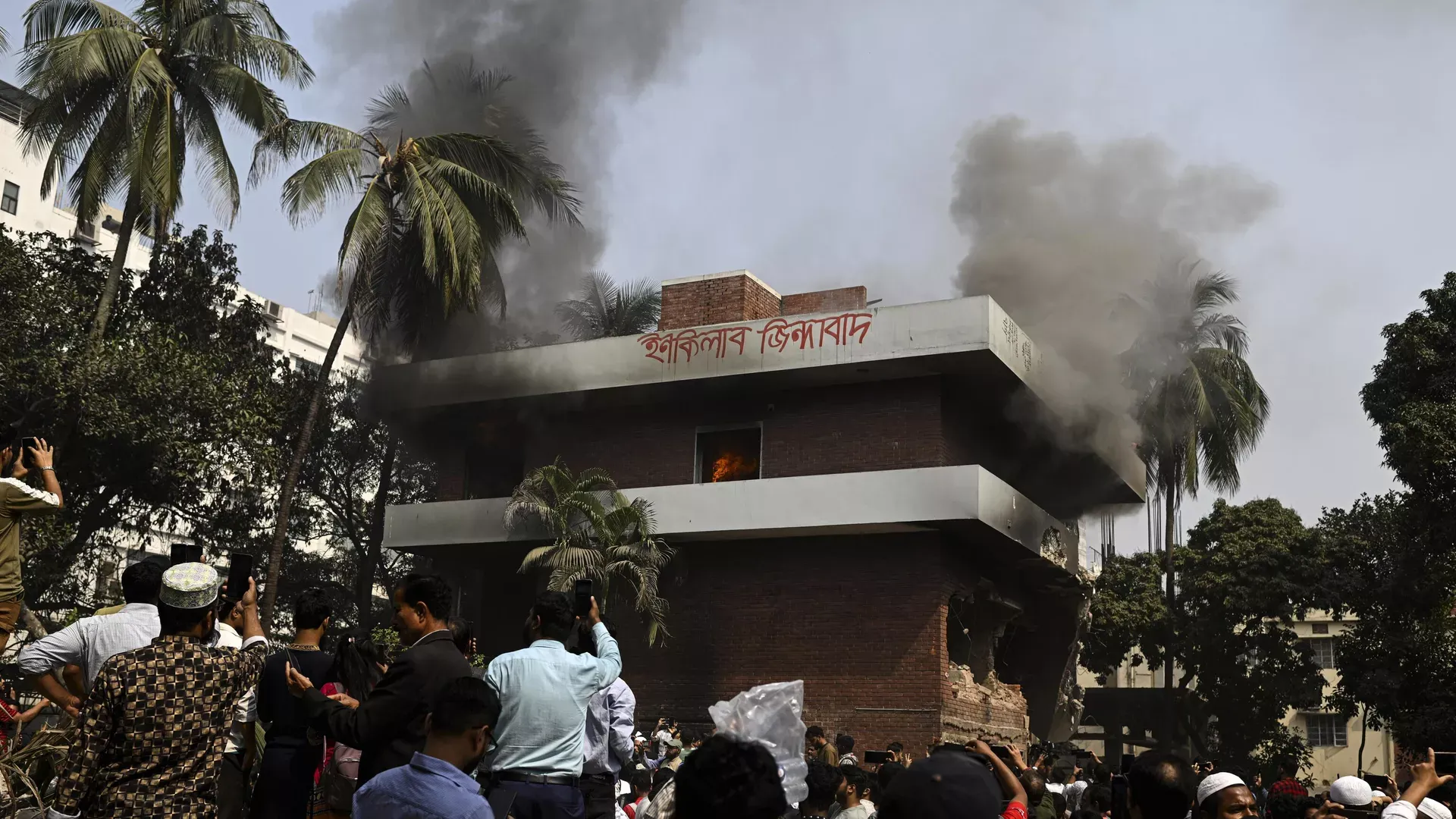
DHAKA — The violent attacks on historical sites linked to Sheikh Mujibur Rahman, Bangladesh’s founding father, are not isolated acts of vandalism. Rather, they represent a broader struggle over national identity, fueled by geopolitical interests and a deliberate effort to rewrite history. The question is not just who Mujib was, but what Bangladesh will become.
The demolition of Mujib’s residence on Road 32 in Dhanmondi earlier this month was a calculated assault, carried out by extreme elements. Law enforcement stood by as the historic home—once a symbol of Bangladesh’s independence—was destroyed. In the days that followed, Pakistani social media accounts celebrated the attack, hailing it as the “end of a traitor’s legacy.” But in reality, this was more than just an attack on a single leader. It was an attack on Bangladesh’s history itself.
Mujib, widely regarded as the architect of Bangladesh’s independence, has long been a target for revisionists. His legacy is contested on multiple fronts—by radical Islamist groups seeking to frame him as a secular enemy of Islam, by factions within Bangladesh who favor a closer ideological alignment with Pakistan, and by external actors with strategic interests in reshaping the country’s identity. The attacks on his memory are not new, but they have gained momentum with the rise of social media-driven disinformation and the increasing influence of extremist networks.
Bangladesh’s history has always been a battlefield. The deep ideological divide that existed before 1971—between those who identified as Bengalis first and those who saw themselves primarily as Muslims—remains unresolved. Mujib’s vision of a secular, Bengali-first identity stood in direct contrast to the pro-Pakistan forces that opposed the country’s liberation. Many of the same groups that collaborated with the Pakistani military during the 1971 war are now part of Bangladesh’s political and social landscape, particularly through Jamaat-e-Islami and affiliated Islamic organizations.
In the decades following Mujib’s assassination in 1975, successive military regimes worked to erase his contributions. The war criminals of 1971 were rehabilitated, history books were altered, and the narrative of Bangladesh’s independence became murky. It was only after Sheikh Hasina’s return to power that Mujib’s place in history was fully restored. Yet, as recent events show, that restoration remains fragile.
Pakistan has never fully reconciled with its defeat in 1971, and many in its military establishment still view Bangladesh’s independence as a historical aberration. Radical elements in Bangladesh, often funded by Pakistan, actively promote narratives that depict Mujib as a “traitor” rather than a national hero. These efforts are amplified by social media campaigns, where disinformation spreads rapidly among younger generations with little exposure to historical facts.
The ease with which Mujib’s legacy is being contested raises an uncomfortable question: Is Bangladesh’s historical memory so short-lived?
The recent attacks suggest that, without strong countermeasures, history can be rewritten within a single generation. A significant portion of Bangladesh’s youth—particularly those educated in madrasas with limited exposure to secular history—are growing up without a full understanding of the liberation war.
The silence of international actors is equally troubling. While many global organizations advocate for the preservation of cultural heritage, few have spoken out against the destruction of Mujib’s historic sites. This inaction emboldens radical forces and weakens efforts to safeguard Bangladesh’s historical truth.
Bangladesh stands at a crossroads. The battle over Mujib’s memory is, at its core, a battle over the country’s identity. Will it continue on the path of secular nationalism, or will it succumb to revisionist forces that seek to reshape its past and future? The government’s response—or lack thereof—will be crucial in determining the outcome.
For now, the destruction of Mujib’s home serves as a stark warning: history is not just something to be remembered. It is something that must be actively defended.