News Desk
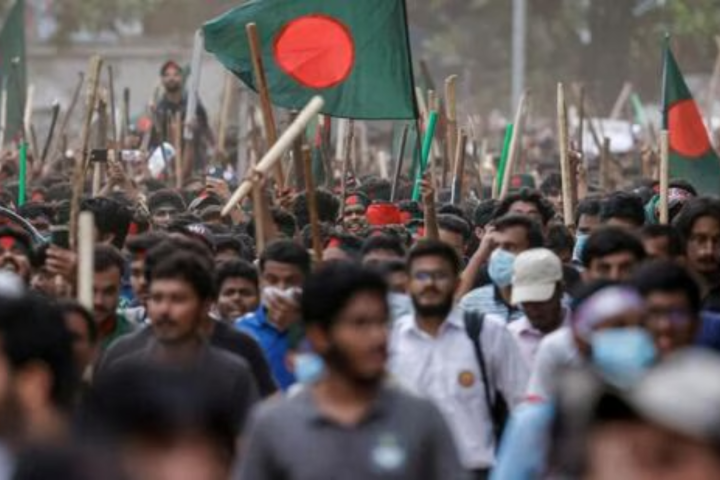
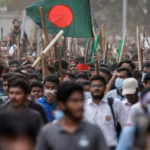
DHAKA, Bangladesh — The crowds began gathering before dawn, long before the funeral prayers for Khaleda Zia were announced. They came in silence at first — elderly men who remembered the tumultuous 1990s, young women who had only known her as a name in textbooks, and thousands who simply felt that something irreversible had shifted in the country’s political bloodstream.
By midday, the streets around the capital’s mosque were a dense, unmoving sea of bodies. The former prime minister’s coffin, draped in green and red, moved slowly through the crowd, its passage less a procession than a reckoning.
Her death, after years of illness and political isolation, has become more than a moment of mourning. It has become a mirror — reflecting a Bangladesh caught between its past and a future that feels increasingly improvised.
Tarique Rahman’s return from exile — hurried, emotional, and politically explosive — has added a volatile layer to the national mood. His arrival at Dhaka drew thousands, despite the heavy police presence and the government’s warnings against “unauthorized gatherings.”
For many supporters, his homecoming is not just filial duty but a symbolic reopening of a political chapter the current administration had tried to seal shut.
But Rahman returns to a Bangladesh transformed — not by elections or public mandate, but by a technocratic caretaker government led by Muhammad Yunus, whose rise to power has been hailed abroad as a “stabilizing intervention” and criticized at home as a democratic bypass.
The Yunus administration, installed amid political crisis and economic strain, governs with the vocabulary of reform but the instincts of a provisional authority. Its supporters describe it as a necessary pause — a chance to reset institutions and curb corruption. Critics call it something else entirely: a government without consent.
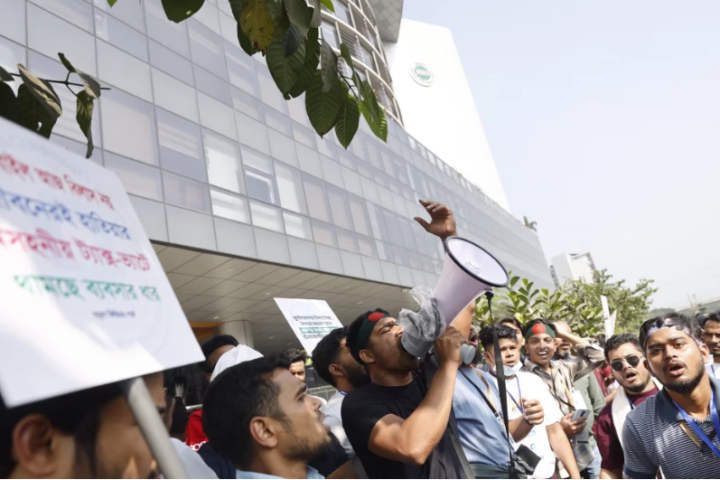
In tea stalls and university dormitories, the scepticism is blunt.
“Reform is not a substitute for legitimacy,” said a political science lecturer in Dhaka. “You cannot govern indefinitely on borrowed time.”
The administration’s sweeping anti‑corruption drives, its restructuring of the bureaucracy, and its promises of “ethical governance” have won praise from international partners. But inside Bangladesh, the mood is more ambivalent. Many see the reforms as selective, the arrests as politically convenient, and the rhetoric as a polished veneer over an unelected regime.
The looming election — whenever it is finally announced — hangs over the country like monsoon humidity. The government insists it will be “free, fair, and credible.” But the timeline remains vague, and the political field feels anything but level.
With Khaleda Zia gone, her party fractured, and her son’s legal status uncertain, the opposition landscape is both energized and destabilized. The ruling technocrats, meanwhile, appear reluctant to relinquish control before they have “completed reforms,” a phrase that has begun to sound elastic.
Diplomats whisper about a “managed transition.” Activists warn of a “democratic vacuum.” Ordinary citizens, exhausted by inflation and political paralysis, simply want clarity.
As Khaleda Zia was lowered into the earth, the crowd fell into a hush that felt heavier than grief. It was the silence of a country contemplating its next chapter — one in which old political dynasties collide with new unelected authorities, and where the ballot box remains a promise rather than a date.
Her death has not closed a chapter. It has reopened questions the nation has avoided for years:
Who gets to govern?
Who gets to choose?
And how long can a country wait for an election that defines its future?
For now, Bangladesh stands at a crossroads — mourning a leader, watching a son return, and living under a government that insists it is temporary even as its shadow grows longer.