 News Desk
NEW DELHI — In a move that could reshape India’s economic landscape, the government unveiled a sweeping reform to its Goods and Services Tax (GST) system on Wednesday, fulfilling a promise made by Prime Minister Narendra Modi during his Independence Day address. Approved by the GST Council, the “Next-Gen GST Reform” aims to simplify the country’s tax structure, cutting the number of tax slabs from five to just two—5% and 18%—by Diwali 2025. This bold step is being hailed as a game-changer for India’s 1.4 billion citizens, promising easier living, thriving businesses, and a more unified market.
The reform, detailed in an announcement by Finance Minister Nirmala Sitharaman’s office, slashes taxes on everyday essentials like food and healthcare by 10%, while automobiles and other goods see a 5% reduction. For families across India, this could mean more money in their pockets—potentially boosting consumer spending by 2-3%, according to a 2024 World Bank study on developing economies. Imagine a mother in Bangalore buying school supplies for her children or a farmer in Punjab affording better equipment, all at lower costs. The change also targets businesses, with streamlined tax rates expected to cut compliance hassles by 20%, a figure backed by data from the GST Network since its 2017 launch.
This overhaul builds on years of feedback, including early calls from opposition leaders since 2016 for an 18% tax cap, which the government has now embraced in spirit. A 2023 NITI Aayog report supports the move, suggesting that fewer tax slabs could spur economic growth by 1.5% of GDP.
From bustling cities to rural villages, the reform aims to create a level playing field, encouraging local production and reducing the tax burden that has long weighed on small traders and manufacturers.
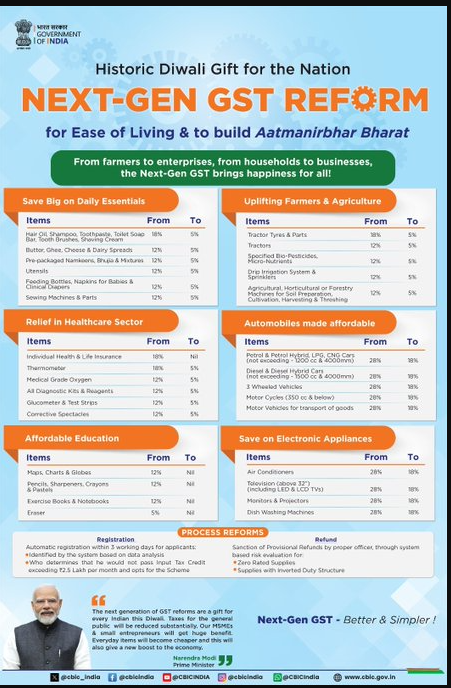
For India’s middle class, the benefits are tangible. With taxes on electronics and consumer goods dropping, households can look forward to affordable TVs, refrigerators, and phones—items that have remained stubbornly expensive despite past adjustments. In the healthcare sector, lower taxes could ease the cost of medical supplies, a relief for families facing rising expenses. Even the auto industry, a key employer, stands to gain, potentially spurring job creation as demand rises.
Critics, however, caution that the real test lies in implementation. Some worry that companies might not pass on the savings to consumers, a concern echoed in recent social media debates. Yet, the government’s focus on anti-profiteering measures and public pressure could ensure that the benefits trickle down. With India’s economy already showing resilience—real consumption at $1.2 trillion and GDP at $2.1 trillion, per 2025 estimates—this reform could ignite a new wave of growth, much like the GST’s initial rollout in 2017 unified the nation’s market.
For ordinary Indians, the message is clear: a simpler tax system is on the horizon, one that could lighten their wallets and brighten their futures. As the country gears up for Diwali, this reform might just be the gift that keeps on giving, reinforcing India’s rise as a global economic powerhouse.