News Desk
NEW DELHI — In a world grappling with uneven recovery from global crises, India is carving out a narrative of resilience and progress. The United Nations Development Programme’s (UNDP) 2025 Human Development Report (HDR), released on May 6, 2025, paints an encouraging picture of India’s ascent on the Human Development Index (HDI), a composite measure of life expectancy, education, and income per capita.
Rising three spots to rank 130 out of 193 countries, India’s HDI value climbed from 0.676 in 2022 to 0.685 in 2023, inching closer to the threshold for “high human development” (HDI ≥ 0.700). This steady upward trajectory, detailed in the report titled “A Matter of Choice: People and Possibilities in the Age of AI,” reflects India’s sustained efforts to improve the quality of life for its 1.4 billion people, even as global human development faces its slowest progress since 1990.
The HDI, introduced by the UNDP in 1990, shifts the focus of development from purely economic metrics to human-centered indicators. For India, this framework highlights remarkable gains over the past three decades. Since 1990, the country’s HDI value has surged by over 53%, outpacing both global and South Asian averages. This growth is anchored in significant improvements across all three HDI dimensions: health, education, and standard of living.
In health, India’s life expectancy at birth has reached a historic high of 72 years in 2023, up from 58.6 years in 1990. This 9.1-year increase is a testament to the country’s robust public health initiatives. Programs like the National Rural Health Mission, Ayushman Bharat, Janani Suraksha Yojana, and Poshan Abhiyaan have bolstered healthcare access and outcomes, particularly in rural areas.
The UNDP report credits these efforts for India’s strong post-pandemic recovery, which saw life expectancy rebound from a dip to 67.2 years in 2021. “India’s life expectancy reaching its highest level since the inception of the index is a testament to the country’s robust recovery and its commitment to long-term human well-being,” said Angela Lusigi, UNDP India’s Resident Representative.
Education, another pillar of the HDI, tells a similarly uplifting story. Children entering India’s school system today are expected to stay in school for 13 years on average, a significant leap from 8.2 years in 1990. Mean years of schooling have also risen, from 3.1 years in 1990 to 6.9 years in 2023.
Initiatives like the Right to Education Act of 2009, Samagra Shiksha Abhiyan, and the National Education Policy 2020 have expanded access to education, particularly for marginalized communities. However, the report notes that quality and learning outcomes remain areas for improvement, a challenge India is tackling with renewed focus on teacher training and digital learning tools.
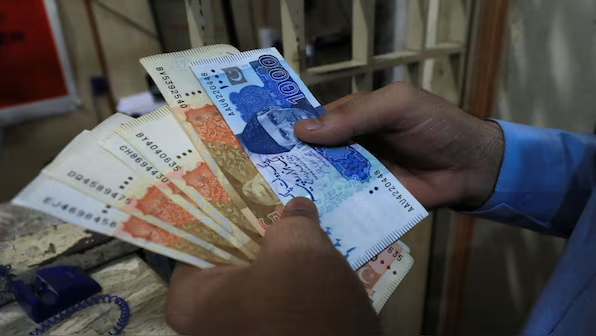
On the economic front, India’s Gross National Income (GNI) per capita has soared from $2,167 in 1990 to $9,047 in 2023 (based on 2021 Purchasing Power Parity). This fourfold increase reflects India’s emergence as a global economic powerhouse, driven by policies promoting digital inclusion, financial access through programs like Jan Dhan Yojana, and job creation via the Mahatma Gandhi National Rural Employment Guarantee Act (MGNREGA).
The UNDP highlights that 135 million Indians escaped multidimensional poverty between 2015 and 2021, a feat that underscores the country’s commitment to inclusive growth.
India’s progress is particularly striking when viewed against the global backdrop. The 2025 HDR warns that human development worldwide is stalling, with the gap between high- and low-HDI countries widening for the fourth consecutive year. While rich nations like Iceland, Norway, and Switzerland dominate the top ranks, half of the world’s poorest countries remain below their pre-COVID levels. India, however, stands out in the Asia-Pacific region, which the UNDP praises for its resilience. With a 48.4% HDI increase since 1990, India’s growth outshines many of its neighbors, including Nepal (145th) and Pakistan (168th).
The report also celebrates India’s strides in gender equality, a critical complement to HDI metrics. India’s Gender Inequality Index (GII) value of 0.437 in 2022 outperforms both the global average (0.462) and the South Asian average (0.478), ranking the country 108 out of 166 nations. Improvements in reproductive health and a declining adolescent birth rate have driven this progress, though challenges like low female labor force participation (a 47.8% gap compared to men) persist.
Recent policy moves, such as a constitutional amendment reserving one-third of legislative seats for women, signal India’s intent to bridge these gaps,
India’s emergence as a global leader in artificial intelligence (AI) adds a futuristic dimension to its human development story. The 2025 HDR notes that India boasts the world’s highest self-reported AI skills penetration, with 20% of its AI researchers now staying in the country, up from nearly zero in 2019. Initiatives like AI-based advisory services for farmers in local languages and skill development programs in states like Tamil Nadu and Telangana, in partnership with the UNDP, are harnessing technology to enhance human capabilities. The report emphasizes that AI, if guided by inclusive policies, could amplify India’s progress in health, education, and agriculture.
Yet, India’s journey is not without hurdles. Inequality remains a significant drag, reducing the country’s HDI by 30.7%, one of the highest losses in the region. Income and gender disparities, particularly in labor force participation and political representation, continue to challenge inclusive growth. The UNDP warns that without deliberate policy interventions, these inequalities could deepen, especially as AI transforms economies. “To truly realize its human potential, India must confront inequality head-on, not just as a moral imperative but as a strategic priority,” the report states.
As India stands at the cusp of “high human development,” its story is one of ambition and resilience. The UNDP’s 2025 report underscores that the country’s progress is not inevitable but a result of deliberate choices—investments in health, education, and economic inclusion that have lifted millions out of poverty and expanded opportunities. With a renewed focus on women-led development and AI-driven innovation, India is poised to continue its ascent, provided it tackles the persistent shadow of inequality. For a nation of its scale and complexity, this steady climb on the HDI is a powerful reminder that progress, however incremental, can transform lives.