News Desk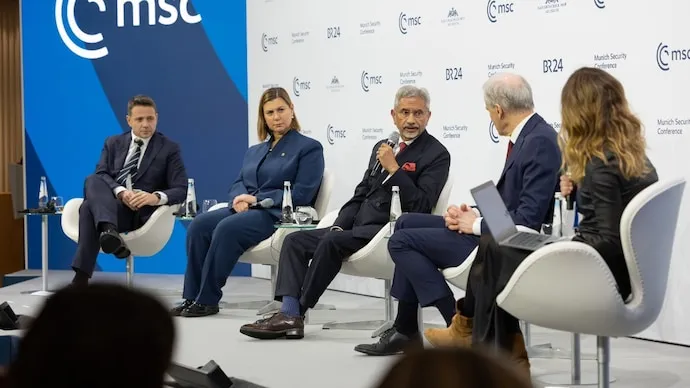
The world is shifting, and not subtly. The transition from unipolar dominance by the United States to a multipolar order is reshaping the global landscape. The Munich Security Conference 2025 offered a clear-eyed analysis of this transformation, pointing to both opportunities and challenges as emerging powers like India rise to prominence. In this fluid geopolitical moment, India’s vision for multipolarity stands out for its pragmatism and inclusivity.
As External Affairs Minister Dr. S. Jaishankar recently articulated, India’s growing influence is not just about asserting itself but about ensuring global balance. “A multipolar world is feasible only by a multipolar Asia,” he declared at the EU Indo-Pacific Ministerial Forum in Stockholm. This statement encapsulates India’s belief that true multipolarity begins at the regional level. Asia, with its diverse economies, cultures, and political systems, must anchor this shift by ensuring that no single power dominates its narrative.
India’s approach to multipolarity is deeply rooted in its civilizational ethos. Dr. Jaishankar has often described India’s role as that of a “Vishwamitra”—a friend to the world. This vision is not merely aspirational but is being operationalized through a robust foreign policy that emphasizes multi-alignment over non-alignment. By engaging with a wide array of partners—from the United States to Russia, from the European Union to Japan—India is positioning itself as a stabilizing force in an increasingly polarized world.
At the Nikkei Asia 2024 Future of Asia Forum, Jaishankar stated, “The world is undergoing a flux—driven by geopolitical, geo-economic, and geo-technological developments. In the last four decades, economic and political rebalancing accelerated by globalization has been driving us towards multipolarity.”
India’s leadership in the Quad, alongside the United States, Japan, and Australia, exemplifies its commitment to a rules-based international order. At the same time, its strategic partnerships with Russia and its active role in BRICS reflect its ability to navigate and influence diverse geopolitical spheres. This duality is not a contradiction but a deliberate strategy to foster dialogue and cooperation across ideological divides.
The Munich Security Report 2025 highlights a critical paradox: while more rising powers can now influence global issues, this very multiplicity has made consensus on international crises more elusive. The world is divided not just by the distribution of power but also by ideological polarization. Even within the Western alliance, fissures are evident. The United States and Europe, once united under the banner of liberal internationalism, are increasingly diverging in their strategic priorities.
The report also underscores the risks of global disorder. As multipolarity intensifies, the lack of a unifying framework threatens to undermine multilateral cooperation. The reelection of President Donald Trump has added to this uncertainty. The Trumpism’s disdain for liberal institutionalism and its pivot toward unilateralism have left traditional U.S. allies grappling with questions of strategic autonomy.
Amid this flux, India’s vision for a balanced and equitable global order offers a compelling counter-narrative. Dr. Jaishankar’s assertion that “globalization is the overwhelming reality of our times” underscores India’s commitment to interconnectedness. India’s advocacy for reformed multilateralism is not about dismantling existing institutions but about making them more inclusive and representative.
India’s principled stand on issues like climate change, its leadership in the International Solar Alliance, and its active participation in forums like the G20 demonstrate its ability to contribute constructively to global governance. By championing sustainable development, equitable growth, and articulating a forward-looking foreign policy, India is not just responding to global challenges but actively shaping international solutions through crafted diplomacy.
The journey toward a multipolar world will not be linear or easy. The diffusion of power is inherently destabilizing, as it disrupts established hierarchies. Yet, it also opens up new possibilities for collaboration and innovation. India’s role in this evolving order will be pivotal. Its emphasis on principles, its ability to engage diverse partners, and its commitment to regional and global stability position it as a key architect of this new world order.
As the world navigates this transitional phase, India’s steady hand offers hope. Its vision of a multipolar Asia as the foundation for a multipolar world is both ambitious and achievable. By fostering dialogue, championing inclusivity, and adhering to equitable principles, India is not just a participant in the global order but a leader in shaping its future. In an era marked by uncertainty, India’s approach to multipolarity serves as a beacon of balance and pragmatism.