News Desk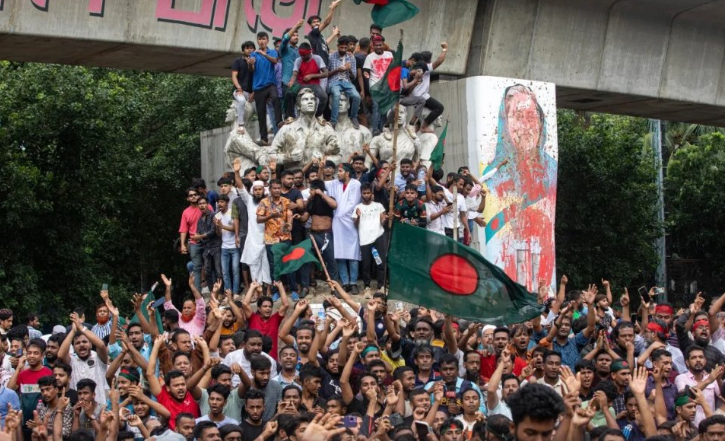
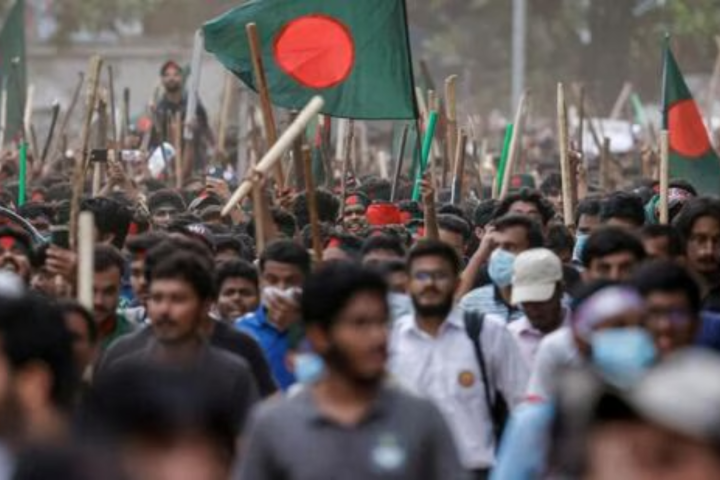
For weeks now, Bangladesh has been convulsed by a wave of violence that feels both familiar and alarmingly new. The killing of a seven‑year‑old girl in a politically targeted arson attack, the torching of homes, the lynching of minorities, and the eruption of anti‑India protests have pushed the country into a moment of reckoning. Bangladesh has seen political turbulence before — often timed with elections — but the current unrest carries a darker undertone, one that raises a difficult question: is the country drifting into a self‑destructive spiral, or is this simply another chapter in its long tradition of bruising political combat?
The answer lies somewhere in the uneasy space between the two.
Bangladesh’s political system has always been vulnerable to power vacuums, but the present one is unusually dangerous. The interim government, led by Muhammad Yunus, was established to oversee the transition toward the next election cycle and maintain order following the end of Sheikh Hasina’s term. Instead, it has struggled to assert authority, leaving the streets to be governed by rumour, rage, and opportunistic actors. In a nation where institutions are fragile and political loyalties run deep, a weak state is not merely a governance problem — it is an invitation for chaos. Bangladesh has been here before, most notably in 2006–2008, when a military-backed caretaker government stepped in amid electoral turmoil. But the current vacuum feels more brittle, less controlled, and far more vulnerable to exploitation by radical groups.
Those groups have wasted no time filling the empty space. The rise of outfits like Inquilab Moncho, whose slain activist Sharif Osman Hadi has become a rallying symbol, reflects a broader shift in Bangladesh’s political landscape. Radical organizations have long existed on the margins, but they traditionally lacked the space to dominate national discourse. Today, with the state distracted and the political class fragmented, these groups are stepping confidently into the centre. Their rhetoric — anti-India, anti-secular, and often openly Islamist — is gaining traction among young, disaffected Bangladeshis who see little hope in the traditional parties. Allowing such forces to shape the national mood is not merely risky; it is a strategic gamble that borders on self‑harm.
Election-year volatility is nothing new in Bangladesh. The country’s political history is punctuated by violent pre-election cycles, from the hartals of the 1990s to the street battles between Awami League and BNP supporters in the 2000s. But this time, the violence feels less like a contest between two political machines and more like a structural breakdown.
The unrest is deeper, more communal, more extremist and unpredictable. What once could be dismissed as “politicking” now resembles a slow erosion of the state’s ability to manage dissent. The burning of homes, the killing of children, and the targeting of minorities are not the usual tools of electoral pressure; they are signs of a society fraying at the edges.
Communal violence, in particular, has become a grim barometer of state weakness. Bangladesh’s minorities — especially Hindus — have long been caught in the crossfire of political battles. But the recent attacks, including the lynching of a Hindu man over alleged blasphemy, suggest a more dangerous trend. When mobs can act with impunity, it signals that the state’s deterrent power has collapsed. Historically, Bangladesh has oscillated between secular nationalism and religious conservatism, but even during its most turbulent periods, the state maintained a baseline of control. Today, that baseline appears to be slipping.
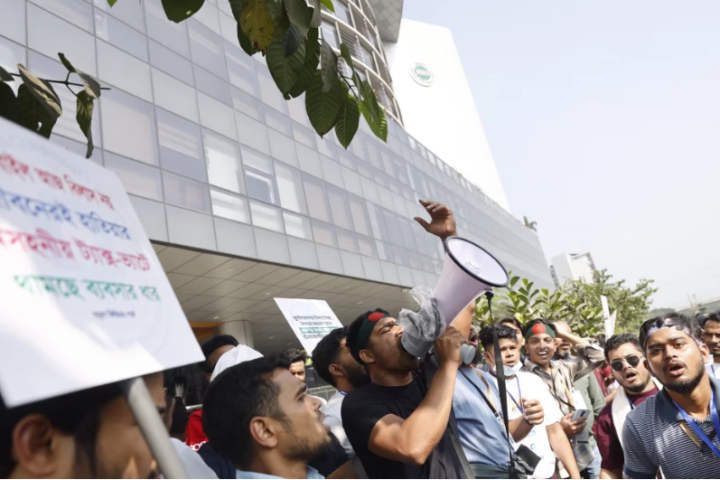
This instability has spilled into Bangladesh’s most important bilateral relationship: its ties with India. Anti-India protests outside diplomatic premises, the suspension of Indian visa operations in Chittagong, and the growing prominence of anti-India rhetoric among radical groups have pushed Dhaka toward a confrontational posture it cannot sustain.
Geography alone makes hostility toward India a losing proposition. Bangladesh is surrounded by India on three sides; its trade routes, energy supplies, and security partnerships are deeply intertwined with its neighbour. Historically, periods of anti-India sentiment in Bangladesh — from the early Ziaur Rahman years to the BNP-Jamaat coalition of the early 2000s — have coincided with economic stagnation and rising extremism. Becoming hostile to India is not strategy; it is self‑harm disguised as nationalism.
The economic and security risks are mounting simultaneously. Investors are jittery. Supply chains are disrupted. International observers are raising alarms about the safety of minorities and the erosion of democratic norms. At the same time, security forces appear overstretched, struggling to contain radical groups that sense an opportunity to expand their influence. Bangladesh has always walked a tightrope between economic ambition and political volatility, but the rope is now fraying.
The future hinges on whether the state can reassert control. If governance strengthens, institutions recover, and extremist groups are pushed back to the margins, Bangladesh may yet stabilize. But if the current drift continues — if the violence deepens, if anti-India sentiment hardens, if minorities remain unprotected — the country risks choosing a path that is not merely politically reckless but genuinely suicidal.
Bangladesh has survived many crises. It has rebuilt after cyclones, coups, assassinations, and economic shocks. But the present moment feels different because the threat is internal, diffuse, and ideological. It is not a single party or leader that endangers the country’s future, but a convergence of weakness, anger, and opportunism. Whether this is just another round of political brinkmanship or the beginning of a deeper unravelling will depend on decisions made in the coming months — decisions that will determine whether Bangladesh steps back from the edge or continues its dangerous march toward self‑destruction.